
Ontario Controversy Adds More Fuel to the EV Incentive Debate
Steph Willems
by Steph Willems

Two sides, two seemingly valid arguments. And in the middle, five $1.1 million cars.

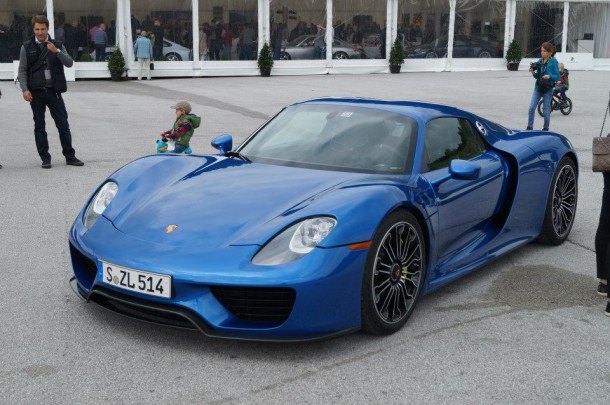
Through the province’s Electric Vehicle Incentive Program, Ontario taxpayers helped lower the price of five Porsche 918 Spyders last year, according to Canada’s national broadcaster, leaving many wondering why their cash helped fund supercars for the ultra wealthy.

The program shaved just over $5,500 off the price of each $1.1 million hybrid Porsche — a limited edition model possessing 887 horsepower, with a top speed of 210 miles per hour.

One of those vehicles has since burned to the ground in a Toronto-area gas pump fire, which, for some, serves as a perfect metaphor for taxpayer-funded EV incentives.

The debate over whether to stimulate EV sales with public cash or let market forces rule the day isn’t relegated to any province, state or country. In Germany, Chancellor Angela Merkel is under fire for allocating $1.4 billion to boost her country’s stagnant EV sales.

The technology that goes into EVs warrants a higher sticker price (for now, anyway), but things get really prickly when subsidies flow to those who can well afford a high-end EV or hybrid, be it a Tesla Model X or the Fisker Karma of years past.

In Ontario, where the third-largest government expenditure is the interest payment on the province’s $300 billion debt, the debate rages anew.

Imagine the view of a resident who drives a ’02 Corolla and doesn’t make enough to purchase a new EV of any type, subsidy or not. Is it fair that they contribute to the purchase of someone else’s Tesla — and perhaps pay more at the pump to finance the program?

The flip side of the argument is that the resident stands to reap less noticeable benefits, like improved air quality, or perhaps greater investment in transit (which are funded heavily by gas taxes in Ontario), thus allowing them to ditch their old car.

When it started the program in 2010, EVs and hybrids were still newcomers to the automotive landscape. Their numbers were few, so the payout through the program wasn’t enough to ruffle feathers.

As automakers ramped up production of new models, the program remain unchanged, which led to nearly $880,000 of public money being spent on six-figure luxury EVs. That’s a lot of green spent on a small number of ultra-lux green wheels — surely, not much environmental bang for the taxpayer’s buck(s).

Belatedly recognizing this problem, the Ontario government changed the incentive rules in February. EVs costing more than $150,000 are no longer eligible, incentives for those costing more than $75,000 are capped at $3,000, and the available subsidy grew at the bottom end (to a maximum of $14,000), dependent on battery size and passenger capacity.

The changes seem more equitable, but many will still say governments have no place taking cash from one person’s hand to put a car in another person’s driveway.

With a flood of lower-cost EVs on the way, where do governments go from here? Should they double down on incentives, reform their rules, or eliminate the perk altogether?

Steph Willems
Steph Willems

More by Steph Willems

Comments
Join the conversation
2 of 37 comments
  • Amwhalbi My 1972 Mercury Capri was my first stick shift car. God, I miss that thing. It was a blast to drive.
  • Vid169489471 The technology exists today to produce a variable color temperature (kelvin) LED lamp. It can vary from 2700k that soft orange look to 6500k the bright daylight with the bluish tint.Since everything in a late model car is computer controlled, it would be an easy task to write a few lines of code that enables your vehicle to not only dim down from hi to low beam but to shift color temp down to the 2700k range for oncoming traffic, then back up to 5000k once oncoming traffic has passed. For the operator it would be automatic and seamless. For older cars they could be retrofitted with LEDs that are 2700k on low beam and 5000k on hi beam. As far as standards, there could be a lumens max, and a minimum. Several States already have minimum lumen standards going back to the old incandescent bulbs. Why not update these to national standards.
  • Jam169859557 More regulation is needed for ALL vehicle lighting systems. [list=1][*]The lighting that is most blinding are the rapidly flashing red, blue and amber lights on emergency vehicles. The lights themselves are blinding, flashing so rapidly that it's impossible for even the sharpest eyes to adjust. What's worse, is the nature of the emergency requires a careful view of the area surrounding the emergency vehicle. There is something going on that needs to be seen. More flashing lights is not the solution.[/*][*]Brighter headlights need to be regulated. The tall riding vehicles do not need headlights positioned so high that they blind drivers in lower riding vehicles. And those heasdlights need to be aimed properly. When I first started driving my 2020 Subaru Outback, many drivers would flash their lights, hoping I would dim my lights. This stopped after I performed am easy adjustment that tilted the beam lower. Late model Subaru headlamps are designed with a sharp cutoff that project less glare above the hood line. When the headlights are properly aimed, other drivers are not blinded by the beam.[/*][*]Customized light assemblies make it more difficult to see the marker lights (tail lamps, turn signals and side marker lamps) that have been tinted. There are many municiple codes that prohibit this tinting, but these laws are seldom enforced.[/*][/list=1]Solutions: Tight controls on emergency vehicle lighting. In trying to make these vehicles more visible, a dangerous side effect is reducing the ability of drivers to see the surrounding perils.Headlight design regulations that reduce the height of the headlight assemblies. Just because a pickup truck has a hood that sits 4 feet abouve the pavement, it does not mean the headlights need to be so high. Owneres should maintain proper adjustments to their vehicle headlights.Establish and enforce regulation requiring a illumination standard be followed.
  • Stl170698708 as someone who hates big government, and their interference;but you can add me to the list of people that are blinded by the lights.unfortunately "the poop is out of the horse and no way is it going back in"They have had 5 years to make lights bigger, badder and brighter because in the vehicle work it is go big or go home!Trucks are the worst because so many people use them to express their dominance and that is big, big, big $$ both at the Original Purchase and in the Aftermarket world.If, we are so lucky to get some good government regulation on this it will also take some very good Court enforcement to get the aftermarket people with fines and lawsuits.Much like the EPA did with the Diesel Tuner Industry that felt emission regulations didn't apply to them.This is from someone that owns said pickup truck with the same bright headlights,but i only use the truck when I have too and always turn off the Fog lights when driving in traffic.
  • Art65765977 I saw a porsche 911 with the most amazing headlights from behind approaching the Sunshine skyway in Florida. The pattern was 108 degrees across sweeping the road like a broom. My brother and I were amazed. I don't know what it looked like from the front but i am sure it was better than American cars
Next