
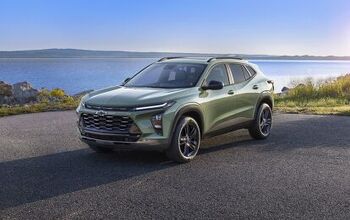
Rental Review: 2024 Chevrolet Trax LT

In the year 2024 - a strange world foreign to anyone old enough to remember Zima - the Chevrolet Trax is a full-size car.
I was informed of this jarring fact by my local Hertz agent.
"Gosh! Is self-identification at work here, or is there some type of science to back all of this up?" I wondered.

Seems the good folks at Hertz looked at the second-generation Trax's interior volume and legroom, compared it to the various Malibus they had sitting on the lot, and, taking into consideration the Trax's front-drive-only layout, bestowed GM's lowest-cost crossover with a size rating befitting an Impala (RIP).
For sure, my late father's unloved 2013 Trax could only dream of such status. And with good reason, as that stumpy phonebooth-perched-on-a-skateboard was everything the new Trax isn't.
Low-income Americans and returning GM buyers express their collective thanks for that.
I'll admit to being oddly curious about the big-ified Trax since it returned - rather unexpectedly - for the '24 model year. In my travels through the U.S., it's clear the longer, lower, wider, vastly better-looking second-gen model isn't having trouble finding buyers, especially in the flyover areas outside major urban centers. And so, with a week off work and an old college buddy's seaside home beckoning, there could be only one vehicle worthy of a cross-country shakedown cruze.
Er, cruise.

And what better guy to put this thing through its paces, I thought? Yours truly has found himself behind the wheel of a low-end GM car for the majority of his adult life, and in the backseat for a not-insignificant part of his childhood. The current uninterrupted GM ownership streak began in 2008. Call me conservative, call me cheap, call me a dinosaur clinging desperately to a long-gone Western culture in which Detroit was king and foreign cars were built for ants, but low-rung offerings from Chevrolet have, more often than not, proved themselves profoundly livable vehicles.
Low purchase costs (*especially* used), cheap maintenance, mainly reliable drivetrains, decent suspensions, so-so brakes, piles of front legroom, and reasonable power and gas mileage were their virtues. Audiences used to line up for a taste.
Settling into the new Trax for the 930-mile jaunt east, cursing the mid-rung LT's drab light grey metallic paint all the while, I took stock of my new surroundings. At first blush? Classy, especially for a vehicle with a U.S. MSRP of $22,300 (a base LS starts at a mouth-watering $20,400).
Two-tone dash and door finishes of varying surface textures, faux leather seating with cloth inserts, a broad 11-inch touchscreen with digital gauge cluster, and jet nozzle air vents (with blue accents) flanking it all, the Trax makes a good first impression. Yet, so do lots of people who ultimately prove impossible to live with. How does the relationship feel a week later? In this case, a few cracks formed immediately.

I've said it before and I'll say it again - the elimination of the handbrake hasn't done the elbows and knees of America any favors. The tall and fairly wide center console in the Trax will surely intrude into the hiproom of those not built like a pool noodle, and slightly impede access to the shifter for those who sit far back and low, as I do. My elbow suffered repeated blows while attempting to buckle up. And while the off-the-shelf six-speed automatic's shifter surrounds itself in always-dusty yet superficially elegant piano back, the console itself seems constructed of the cheapest possible pebbled plastic. Look to the upper doors for more of that. Sure, it's no one's idea of an expensive car, but how about a console lid that hinges on the side for easier access, and a bit of a softer one, too?
Of course, that lid is plusher than a kitten's behind when compared to the door armrests, which come close to 'coconut-shattering' on the hardness scale. Costs must be kept down in order to slot something below the Trailblazer in the Chevy lineup, sure, but these are easy issues to fix - especially when you consider the amount of content this Trax had on tap.
While base models feature a stripped-down suite of niceties, the volume LT comes standard with adaptive cruise, lane hold with lane departure warning, proximity warning, blind spot monitoring, HD backup camera with rear cross-traffic alert, Android Auto and Apple CarPlay connectivity, single-zone climate control with A/C, among lesser accoutrements. Hardly a stripper. There's even a volume knob for the audio system, though with its lofty placement you'll have to dodge both the wheel and the wiper stalk to access it.

The Trax's main saving grace? Room! Despite pushing 6'4", this driver could extend his legs and not touch the pedals with the driver's seat in its rearmost position. Even with that chair positioned for my comfort, my knees didn't come close to the seatback after scrambling into the rear bench. Backseat passengers will enjoy a flat floor and excellent legroom for the car's class; just forget about a center armrest, map pockets, or anything beyond a couple of device plug-ins. Behind that row, I learned there's plenty of room for multiple rifles and shotguns, as well as luggage.
I vacation prepared, obviously.
As the trip wore on and speeds gradually entered the scan-for-cops range, I couldn't help being surprised at the diminutive 1.2-litre turbo three-cylinder's ability to mask its lack of displacement. It's no GT off the line, though you can easily squawk the tires. At speed, however, the tranny displays an eagerness to drop a gear with barely any additional throttle input, greatly improving the car's responsiveness. Rated for 28 mpg city, 32 highway, and 30 combined, my highway-heavy trip returned 32 mpg - comparable to its subcompact crossover competitors, but still below the consumption enjoyed by the former Cruze owners this vehicle so obviously targets. One wonders what the old 1.4-liter turbo four from the Cruze could have managed in this application.

Ah, the Cruze.
Like the hazy memories of a long-lost love, thoughts of the 2018 Cruze I had sitting back at home constantly inserted itself into the driving experience.
"Those door switches and handles look awfully familiar," I thought. "What else showed up from the estate sale?"
Luckily, not the steering! My main Cruze gripe is the steering's miniscule on-center dead zone, which results in constant minor corrections at highway speed. Not a trace in the Trax, thankfully.
Overall, the ride just felt familiar. Someone in Korea clearly pressed the 'Standard GM' button when it came time to tune the suspension. There's considerable more ground clearance on this rig (7.3 inches), but cornering was flat (not Macan flat, obviously), bumps were handled with an amount of aplomb befitting a slightly more expensive vehicle, and no audible rattles or vibrations intruded into the ever-present road noise (caused partially by the ICE tires this thing wore, despite 90-degree temps. Thanks, Hertz!). Suspension travel might be the only difference between the two vehicle's squishy bits. This isn't a vehicle one buys to power aggressively through tight curves, clearly, so such observations aren't worth much.

So, does the Trax fulfill the GM promise of decent content offered at an affordable price? Undoubtedly, and it does so while looking better and more substantial than its competitors. The Trax also offers more rear seat legroom and cargo volume than the FWD-only Nissan Kicks and Hyundai Venue, despite costing just $400 more than the Venue in base form, and a grand less than the Kicks. Both of those rides fail to measure up on the power scale, too.
With 137 horsepower and 162 lb-ft on tap, the Trax kicks sand in the face of both the Venue (121 hp, 113 lb-ft) and Kicks (122 hp, 114 lb-ft), while wowing their girlfriends with added inches. The Trax's external dimensions emasculates both cars, and even outsizes its Trailblazer stablemate. There's a further 9.5 inches stem to stern compared to the Kicks, and it boasts a whopping 19.5 inches on the Venue. Food for thought. This is also a car with a hood flat and long enough to see from inside - great for me, as I like to feel like the captain of a ship.
Could I live with the Trax? Sure - a set of decent winter tires makes this an all-season rig in most locales (though I question that massive driver-side wiper's ability to clear wet, heavy snow). Plus, foam padding is a cheap buy at Lowes. Will the Trax continue to burn up the subcompact sales charts, giving the yuppiemobile Subaru Crosstrek a run for its money? Undoubtedly, unless a long-term reliability issue crops up to give the Trax a run-don't-walk reputation.


I don't know what the hell GM is doing with the rest of its lineup, but the Trax shows that the company hasn't forgotten where it's been. Maybe it can help it figure out where to go.
[Images © 2024 Steph Willems/TTAC.com]
Become a TTAC insider. Get the latest news, features, TTAC takes, and everything else that gets to the truth about cars first by subscribing to our newsletter.

More by Steph Willems










Comments
Join the conversation