
Early Access Review: "The Last Independent Automaker," Covering Everything AMC

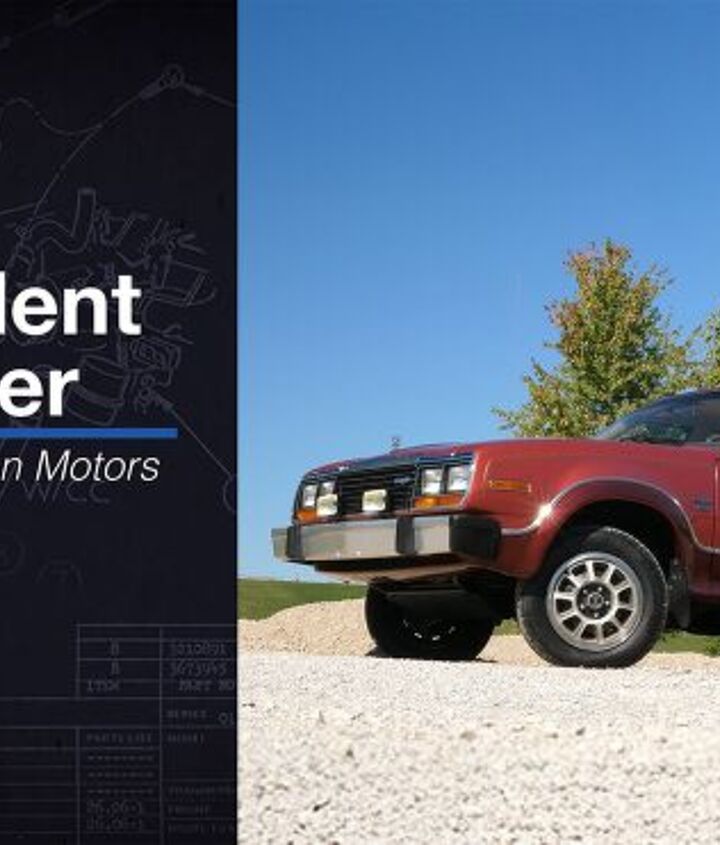
It has been over three years in the making, but the documentary The Last Independent Automaker chronicling the life and times of the American Motors Corporation debuts today on PBS. The team behind the documentary secured over 100 hours of footage from the AMC vaults, scoured hundreds of historical photographs, and interviewed more than 35 people from the AMC sphere.
(Note: TTAC was provided with advance screeners of all six episodes of the documentary, and we reviewed the first three.)

That last point is particularly poignant when one considers AMC was dissolved 36 years ago, on June 20, 1988. There’s only so much time the folks who knew the company’s original CEO George Mason personally or built an AMC Gremlin at the factory will be around to share their stories. This is important stuff.
The documentary is segmented into six parts, each about 30 minutes long. The series opens in the early Fifties during the Nash-Kelvinator period. The automaker and appliance manufacturer merged in 1937, and Kelvinator’s CEO George Mason became the driving force behind the combined company. Mason received a sterling reference to company founder Charles Nash via Walter P. Chrysler, as Chrysler felt he could handle a car company well.

Nash-Kelvinator struggled as a small independent automaker against The Big Three but had a genius new idea for 1950 with the launch of the Nash Rambler, a compact car that didn’t skimp on equipment or styling. It was the first compact car offered in America that didn’t have an air of poverty. The Rambler was so impressive that it swayed future CEO George Romney (above, black and white) to join Nash, and skip becoming the CEO of Packard. It was a decision Romney was certainly glad of in short order.
Nash-Kelvinator picked up another car company, Hudson, in 1954. Hudson was known for its sporty cars with nice handling but doomed itself with the Step-Down design of the Hornet in 1950. The design was such that changes could not be made to the body or shape easily, meaning the Hornet was outdated quickly as its sales plummeted. The new trio of brands was the real start of the story, as in 1954 the company was renamed American Motors.

The documentary spends almost as much time talking about the people as it does the cars: Factory conditions, the union, the office workers. Through interviews with former AMC employees and descendants of the executives, historians, and other experts, it provides a lot of the historical context around AMC and its home in Kenosha, Wisconsin.
The second episode picks up at the end of the Fifties, where the The Big Three had their reactions to the successful Rambler American line ready (think Valiant, Corvair, Falcon). Going more directly against the larger players meant a more mainstream customer base, and more focus on appearances. It was at this point Richard Teague joined AMC and would remain its chief designer right through to 1983, after he penned the XJ Jeep Cherokee.

By the early Sixties, the Rambler line was such a success that in 1961 it reached third in volume behind Ford and Chevrolet. Shortly thereafter following a decade in charge at American Motors and two decades in automobiles, George Romney left the company to pursue politics. The company’s control shifted to Roy Abernathy, who wanted to push the Rambler brand upmarket and move focus away from economy cars.
Part of the shift in focus was seen in the new Rambler line of 1965, as the line included the Classic, the full-size Ambassador, and the disastrous pony car competitor, the Marlin. The mid-Sixties push upmarket was really the start of AMC’s issues, as the more expensive cars failed to excite its traditional older economy customer base, or the upmarket younger one it wanted to pursue.

Halfway through the documentary in the third episode, AMC was on the precipice of an important acquisition and a sale. The company’s eye was on the Kaiser-Jeep brand as it struggled along after its owner passed away in the late Sixties. The company was inherited by the owner’s family and they were eager to sell.
The decision came from the top in October 1969 to purchase Jeep and get its affairs in order. To get some cash for the Jeep deal, AMC management sold off Kelvinator assets in 1968 to sewing machine and fridge company White Consolidated Industries. Kelvinator’s lineage exists today: White later became White-Westinghouse appliances, and was acquired by Electrolux in 1986. Electrolux spun off the sewing machines into the Husqvarna brand, and its other appliances consolidated under Electrolux.

Unfortunately the $70,000,000 ($857.3M adj.) purchase of Jeep during a union workers’ strike at Kenosha did not go down well with employees. With hindsight, Jeep was likely the thing that kept AMC going as long as it did, and meant it had value to the likes of Renault and later Chrysler. Jeep was a shambles at the time, and AMC needed to organize it and make it more efficient.
The third episode wraps up at a high point for the brand, as the OPEC crisis of 1973 meant buyers flocked to its more economical offerings like the interestingly shaped Gremlin and the smaller Hornet. With the addition of Jeep the brand could also appeal to a wider customer base, as the sports utility vehicle began to build the mainstream appeal it carries to this day.

As each 30-minute block episode covers about five to eight years in the history of the company, The Last Independent Automaker is fairly information dense. It switches perspectives from global to national, and local to insider in short order, and is definitely not a “watch while you’re texting” program. I occasionally found myself wishing there was less detail about the union strife and more information about the particulars of the lineup offered for each model year.

But that’s the Rare Rides Icons part of my brain kicking in (can’t be turned off), and not what this documentary set out to do. The team’s stated goal back in 2022 was to make an encompassing documentary that covered AMC from a holistic view - all the people, places, and things. And that is certainly what they’ve accomplished with this series. If you’re interested in AMC, give it a watch. Information on how to watch is here.
[Images: The Last Independent Automaker]
Become a TTAC insider. Get the latest news, features, TTAC takes, and everything else that gets to the truth about cars first by subscribing to our newsletter.
Interested in lots of cars and their various historical contexts. Started writing articles for TTAC in late 2016, when my first posts were QOTDs. From there I started a few new series like Rare Rides, Buy/Drive/Burn, Abandoned History, and most recently Rare Rides Icons. Operating from a home base in Cincinnati, Ohio, a relative auto journalist dead zone. Many of my articles are prompted by something I'll see on social media that sparks my interest and causes me to research. Finding articles and information from the early days of the internet and beyond that covers the little details lost to time: trim packages, color and wheel choices, interior fabrics. Beyond those, I'm fascinated by automotive industry experiments, both failures and successes. Lately I've taken an interest in AI, and generating "what if" type images for car models long dead. Reincarnating a modern Toyota Paseo, Lincoln Mark IX, or Isuzu Trooper through a text prompt is fun. Fun to post them on Twitter too, and watch people overreact. To that end, the social media I use most is Twitter, @CoreyLewis86. I also contribute pieces for Forbes Wheels and Forbes Home.
More by Corey Lewis







Comments
Join the conversation
A classmate of mine's sister had a Rambler - forget the model. She was rendered disabled after a collision where the rear wheels literally folded. He was riding with her that day and was injured to a lesser extent. I seem to remember this being 'a thing' at that time similar to the Corvair's woes. I, too, appreciated the AMX. Unfortunate things went the way they did at that time.😒
I was interviewed for this, and have a scene, discussing the brougham era. I got to attend the premiere in Maryland last month, but we didn’t get to see the entire series. I’m really looking forward to seeing the whole thing.