
U.S. Postal Service Decides to Snub Electric Vehicles

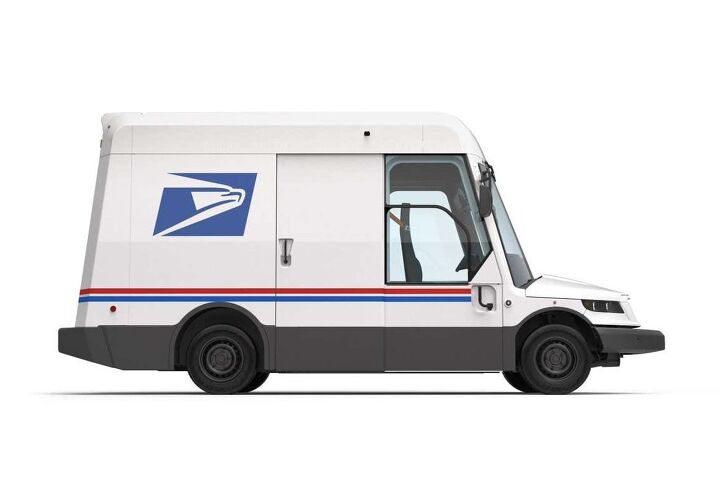
The United States Postal Service (USPS) has been under pressure from the White House to replace its aging fleet with all-electric vehicles. But it’s looking like mail carriers will continue doing their jobs in oddly shaped trucks that burn gasoline.
While the Biden administration’s green agenda calls for government fleets to begin transitioning to EVs, the USPS had already decided to purchase 165,000 examples of the Oshkosh Defense NGDV that’s dependent upon liquid fuel. Despite the contractor saying trucks could be converted into battery electric vehicles and/or hybrids, the vast majority will be wholly reliant on internal combustion. The USPS has decided that it’s just not cost-effective or practical to do anything else and no amount of pressure from the White House will be changing its mind.
Money on the other hand…
Postmaster General Louis DeJoy said the agency would consider adding more EVs to its fleet sometime in the future. However, this would be dependent upon the USPS receiving more money from the government – which is pretty much what it’s been saying since before it revealed the Oshkosh trucks in 2021.
“As we have reiterated throughout this process, our commitment to an electric fleet remains ambitious given the pressing vehicle and safety needs of our aging fleet as well as our fragile financial condition. As our financial position improves with the ongoing implementation of our 10-year plan, Delivering for America, we will continue to pursue the acquisition of additional BEV as additional funding – from either internal or congressional sources – becomes available,” DeJoy stated on Wednesday. “But the process needs to keep moving forward. The men and women of the U.S. Postal Service have waited long enough for safer, cleaner vehicles to fulfill on our universal service obligation to deliver to 161 million addresses in all climates and topographies six days per-week.”
One could definitely argue that there were better alternatives to the upcoming NGDV. Effectively a modern version of the Grumman LLV (Long Life Vehicle), the Oshkosh truck offers a familiar experience with better specifications. Those LLVs more than lived up to their namesake, so it’s not surprising to see the post office wanting to stick to what has worked before.
But its efficiency has been criticized by the Environmental Protection Agency (EPA), which bemoaned its 8.6 mpg as barely better than the old Grumman’s 8.2 mpg. While fleetwide economy will stack to make a real difference, the EPA expressed concerns that the USPS Environmental Impact Statements (EIS) pertaining to the truck were lackluster and should be redone. Though the agency’s current administrator, Michael S. Regan, is an acolyte for all-electric vehicles and seems to be in broad alignment with the Biden administration’s broader agenda to electrify U.S. fleets.
“We thank the federal agencies, including the EPA, for their input,” Mark Guilfoil, USPS’s vice president of supply management, stated this week. “After thorough review and study we determined that EPA’s request for a supplemental [environmental impact statement] and public hearing would not add value to the Postal Service’s already year-long review. It is also important to note that a supplemental EIS and public hearing are not legally required.”
The post office has claimed that loading up its fleet with EVs would be too costly in the short term. While it acknowledged that battery-equipped vehicles were supposed to yield lower operating costs over time, it wasn’t ready to test that theory if it meant spending more upfront. Unless Congress passes a law that would effectively force the USPS to buy up electrics or redirects a bunch of money, all-electric mail trucks will probably remain an uncommon sight in the United States for years to come.
Expect a bunch of lawsuits from environmental groups citing the EPA’s claim that the new (non-BEV) trucks could cause $900 million in climate damages. Though we shouldn’t forget that environmental social governance (ESG) scores, the commodification of carbon credits, and social pressure are often used as leverage to force organizations to act in a manner that’s in accordance with those in power.
Officially, the Postal Service is supposed to be an independent agency that makes decisions (mostly) for itself. Unofficially, the Biden administration wants it to buy electric vehicles from an approved list of mostly unproven manufacturers – including a former frontrunner (Workhorse) that is under investigation by the Securities and Exchange Commission and Department of Justice over accusations of fraud.
[Image: USPS]
Consumer advocate tracking industry trends and regulations. Before joining TTAC, Matt spent a decade working for marketing and research firms based in NYC. Clients included several of the world’s largest automakers, global tire brands, and aftermarket part suppliers. Dissatisfied, he pivoted to writing about cars. Since then, he has become an ardent supporter of the right-to-repair movement, been interviewed about the automotive sector by national broadcasts, participated in a few amateur rallying events, and driven more rental cars than anyone ever should. Handy with a wrench, Matt grew up surrounded by Detroit auto workers and learned to drive by twelve. A contrarian, Matt claims to prefer understeer and motorcycles.
More by Matt Posky











Comments
Join the conversation
As I understand, the procurement process was started in 2015. At that time interested vendors were provided a set of specifications that were required to be met. Each vendor was required to produce a certain number of test vehicles for review and testing prior to the contract being awarded. The whole process is very time consuming. To change to an all-electric vehicle would put the process way behind schedule. The oldest LLV went into service in 1987. It's time to put those dogs to rest. I anticipate the USPS will adjust the contract to include a percentage of E-LLV replacements. Those could then be put to use in metro and urban areas, where the infrastructure may be easier to install at larger mail facilities. This would then allow USPS to move the newer ICE units out to the more rural locations where the VPO's (Vehicle Post Office) are smaller and may not yet justify the cost (some offices are very small, physically) of upgrading to EV use. USPS needs to get those old dogs of the street. Third and fourth generation reverse engineered parts sourced from the pacific rim nations makes it very difficult to keep them running safely and reliably.
How many units of the Mercedes-Benz Metris has USPS bought? I've seen quite a few of those around (an RHD version), and they even have a black-and-white USPS eagle in the center of the grille, replacing the three-pointed star.