
Quantum Leaps: Suzuki Kizashi Hayabusa Edition

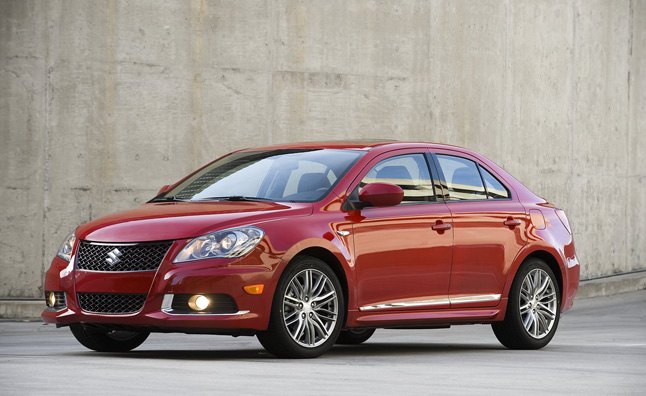
The Suzuki Kizashi was not a great car. That said, it certainly wasn’t a bad car – and I don’t think I’ll court controversy by saying that the car, launched nearly in tandem with news that Suzuki was withdrawing from the U.S. market, never really got a fair shake. It was a car that, for a reasonable-ish $27,000, could be had with a manual transmission and all-wheel-drive. That, along with a willing chassis and some “ drivers’ car” marketing, makes for a great story. “I coulda been a contender,” and all that.
There was another marketing pitch for the little Suzuki Kizashi that lives rent-free in my brain, though. It’s the one where Suzuki compares the Kizashi to its racy GSX-R sport bikes and all-conquering, big-bore hyperbike, the Hayabusa, and makes the case that the Kizashi might just be a four-wheeled Suzuki motorcycle that you can strap some child seats into.
Would a simple engine swap be enough to make the Kizashi a sports car for the ages? Let’s find out.
KIZASHI MEANS “SOMETHING GREAT IS COMING”
To be clear, the Kizashi may have been many things – but it was not “great”, and it was certainly not great in the high-strung, engaging, buzz-bomb of a motorcycle trapped in the body of a passenger sedan sort of way those ads might lead you to expect. In fact, it was sold as a sort of entry-luxe sport sedan to middle managers, a sort of outside-the-box alternative to an Acura TL. It was a safe play, but it could have been much wilder.
Indeed, all the ingredients were there. The Hayabusa’s 1.3-liter inline-four makes a substantial 187 horsepower at 9,750 rpm and 110 lb-ft of torque at 7000 rpm. That’s not substantially more power and a lot less torque than the Kizashi’s 2.4-liter four made, I’ll grant you that – but that just means the Kizashi’s existing driveline is up to the task of putting the ‘Busa’s power down. What’s more, the 2.4 liter delivers its peak hp at a relatively lazy 6,000 rpm on its way to an indicated 6,500 rpm redline. The Hayabusa? The ones I’ve seen have tachometers that go up to 13,000.
So, the two engines offer similar power levels – but present vastly different experiences. On the one hand, a bigger, torquier four-cylinder and forced “luxury” sport comparisons to high-end Civics and entry-level Acuras. On the other … I mean, I don’t know about you guys, but I can’t think of anything that would have even come close to being called a direct competitor. Even the Type R Integras run out of juice about a thousand rpm under the ‘Busa’s hp peak, and the ‘Busa still has a lot of tach to cover.
Short of a DTM Alfa Romeo 155 from the 90s or a Group B rally car, where else could you experience 11,000+ rpm in a car? Let alone one you could strap some child seats into? Even if, on paper, the mythical Hayabusa Edition Kizashi wouldn’t have been much faster than its 2.4-liter brothers – would that have mattered? Would it be any less of a legendary sports car?
So, the Kizashi obviously could have been much wilder – and maybe it should have been.
SETTING THE STAGE FOR A 13,000 RPM KIZASHI
The enthusiast case for a Hayabusa-powered Suzuki Kizashi makes itself. The real question, then, was whether or not Suzuki could make a business case for something as insane as a 13,000 rpm tach in a mainstream sedan. The clear answer is: No. Of course, not – but I don’t like the question, because the Kizashi was never going to be a mainstream sedan.
After losing nearly 80 percent of their overall sales between 2007 (their best year, with 101,884 units sold) and 2010 (23,994), Suzuki absolutely knew they were in trouble by the time they launched the Kizashi. The trouble was that they didn’t understand why.
See, Suzuki had become successful in the U.S. by offering quirky, off-beat cars and SUVs that traded off the perceived quality of Japanese construction. The two people I knew who bought XL7s talked about how fun the SUVs were. I remember my college roommate’s dad, in particular, telling me that his new ’98 XL7 “does everything I need it to.”
By 2007, though, all that quirkiness was gone. The redesigned XL7 had grown significantly, and had taken conscious, deliberate GM-fueled steps towards the mainstream and, it was thought, a broader audience overall. By the time it cracked the 100,000-sale mark in 2008, the once fun-and-different Suzuki line-up was almost fully populated by rebadged Fiat, Nissan, and GM products. There was nothing lighthearted or fun about a Suzuki Equator that would make it a better option than the Nissan Frontier it was based on. The new XL7, instead of being a lengthened Sidekick with “grandkid seats” in the back had become a restyled Chevy Equinox – so why not buy the Chevy? Or the Nissan? Was the Suzuki Reno really any better than the Daewoo Lacetti, or the SX/4 better than the Fiat Sedici?
Suzuki, in other words, was already gone. It had become a dumping ground for GM’s industry dealings and succeeded on the basis of low prices and easy, sub-prime loan approvals … at least, that’s what the numbers indicate. Those are the loans that disappeared in 2009 when the financial crisis hit. By the time that had shaken out, Suzuki’s quirky quality had been replaced with cynical badge-engineering, and the Kizashi, competent as it was, was always going to be too little, too late.
It’s right here, the instant that Suzuki realizes it’s done for in the U.S., where our auto-industry Sam Beckett comes into play and makes things right … for Suzuki motorcycles.
IT WAS NEVER ABOUT THE CAR
When you lose 80 percent of your overall sales in the space of 24 months and your main source of financing is standing in front of Congress and begging for money, you know shit’s bad – but things were looking slightly better over at Suzuki Cycles.
Yes, sales were down at the two-wheeled division, but not catastrophically so. Add in the fact that a number of dealers were still sitting on 2006 and 2007 inventory when the crash hit and that ’08 and ’09 were actually decent years for motorcycle and scooter sales. Indeed, the then-CEO of Genuine Scooters suspected he might be recession-proof. “When people have money, they buy scooters as toys,” he said (I’m paraphrasing). “And when they don’t have money, they buy scooters because they need cheap transportation.”
Suzuki Cycles was never leaving the US, and the Kizashi would never be enough to turn the tide for Suzuki Auto. A whisper here, a comment there, a convincing PowerPoint to the right guy, and Suzuki Auto might have been convinced to take the last 50 or so Kizashi sedans and stuff a Hayabusa engine under the hood. If I were doing it, I’d ditch the “luxury sport” front seats, too, and replace them with properly gaudy Recaro sport seats, as the Suzuki Swift GTi had in the ‘90s. Add in a wide-open exhaust and sell them all as SCCA or NASA touring specials “for Off-Road Use Only” to avoid certification costs and you’d have sold them all in an instant. More than that, those cars would have been a legendary swan song – a hearty “f- you!” to General Motors and a solid gold “Certificate of Authenticity” that could be pointed to, ever after, as a reminder that Suzuki could have been great.
It would also be an awesome commercial for Suzuki Cycles in the US, sure – but think of what it would have done for Suzuki’s global car sales? Yes, the wildest, sort of affordable sports sedan ever built was a U.S.-only deal, and that was pretty limited, but just imagine how good their new hot hatch is! Look, this one even comes with the same seats as the Hayabusa Edition Kizashi and maybe an $11 plastic spoiler that we can charge you a few million yen for. You – yes, you! — can have a little piece of that magic for just a few dollars on top of that reasonable monthly payment and, maybe, even feel a bit like a super cool Kizashi race car driver.
I think a Suzuki Kizashi Hayabusa Edition would have been the automotive marketing coup of the last decade, but that’s just me. You’re the Best and Brightest, and some of you even hit the track now and then, would a car like that pique your interest? Let us know in the comments.
[Image: Suzuki]
I've been in and around the auto industry since 1997, and have written for a number of well-known outlets like Cleantechnica, the Truth About Cars, Popular Mechanics, and more. You can also find me talking EVs with Matt Teske and Chris DeMorro on the Electrify Expo Podcast, writing about Swedish cars on my Volvo fan site, or chasing my kids around Oak Park.
More by Jo Borras






Comments
Join the conversation
The Truth About Motorcycles: "Per vehicle miles traveled, motorcyclists are about 29 times more likely than people in passenger cars to die in a traffic crash." https://www.nhtsa.gov/road-safety/motorcycles Bonus: "Of special note is the death rate among what the IIHS calls “supersport motorcycles” or what we might term racer replicas, which was pegged at 22.5 deaths per 10,000 registered motorcycles. The next nearest rate was 10.7 among “Sport/unclad sport” all the way down to 5.7 for cruisers and 6.5 for touring motorcycles." https://thekneeslider.com/supersport-motorcycle-death-rates/
There is a Mini (real one, not the BMW remake) on YouTube with a 'busa engine installed.