


Rare Rides: The 1984 Ferrari 288 GTO - Eighties Exotica and a Childhood Toy Story

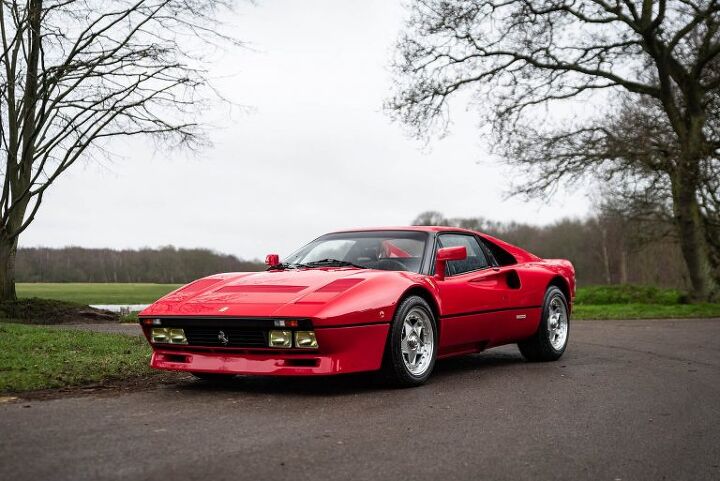
Today’s Rare Ride is a seriously sporty evolution of Ferrari’s well-known 308 GTB. Built as a homologation special, the 288 GTO was one of the most exclusive vehicles Ferrari produced in the Eighties.
It’s a car which became relevant to me this past weekend, when a rusty example was unearthed in my parents’ backyard.

The 308, which preceded the 288 GTO, was introduced in 1975 as a successor to the unloved Dino 246 GT. The 246 was the end of sub-Ferrari brand Dino, which was an exercise designed to shift lower-cost sports cars without diluting Ferrari’s brand heritage. By the time the 308 debuted, Dino was one year away from extinction.

A few years into the 308’s run, a hot new racing series emerged: Group B rallying. Ferrari sent the 308 GTB into Group B and won several events across continental Europe. Enzo Ferrari wanted more racing action, however, and started dreaming up a race-focused successor to the 308. In order to take part with a Group B car, at least 200 homologated road cars had to be produced and sold to actual customers. The 288 was taking shape.

Ferrari used the 308 as the basis for the 288, with an eye on speed to development and cost savings. But changes to the 308 were so extensive that not much of the original car remained by the time the 288 entered production. That made it much more expensive, though wealthy clientele did not mind paying for extra Ferrari performance and a limited edition car.

Visual changes for the 288 GTO included larger front and rear spoilers, new mirrors, large flared fenders, and quad driving lights. There were also some cues that hearkened back to the 250 GTO of two decades prior: the copious number of body vents and the rear wing design. Though the 288 was wider than the 308 upon which it was based, it was still around 500 pounds lighter due to weight saving measures (totaling 2,555 lbs). Its hood was made of Kevlar, the roof a composition of Kevlar and carbon fiber, and the rest of the body was mostly fiberglass. Heavy steel was used only in the doors.

A new engine was made specially for the 288, one which took the base 2.9-liter V8 from the 308 and added two turbochargers. To comply with class regulation, the bore was reduced by one millimeter. Ferrari also added fuel injection, which, combined with the other changes, meant 395 horsepower — a figure made even more impressive considering the 308’s stock engine made 242 horses. 60 miles per hour arrived in five seconds, and top speed was 179 mph.
Road versions of the 288 GTO started production in 1984, with a total of 272 rolling off the line before production stopped in 1987; 271 were painted red, and one was painted black. Today’s Rare Ride has covered just 9,300 miles, and is priced on request. From other listing prices on these, it’s worth about $3,000,000.

Worth slightly fewer dollars is the 288 GTO pictured here. This past weekend I went to visit my parents, who lost the largest tree in their back yard earlier in the week. As I was checking out what remained of the tree debris, I noticed — placed off to the side — a red die cast car. One of mine from childhood. We played around that tree all summer as kids, and I imagine it had sat in the crook of it since circa 1992. I must’ve put the Ferrari up there and forgot about it, and there it remained for the next 28 years or so. Twitter tells me it was made by Majorette.

My barn-tree find car will stay with its dirt and debris as-is, and a case for it is on the way.
[Images: seller, Corey Lewis/TTAC]
Interested in lots of cars and their various historical contexts. Started writing articles for TTAC in late 2016, when my first posts were QOTDs. From there I started a few new series like Rare Rides, Buy/Drive/Burn, Abandoned History, and most recently Rare Rides Icons. Operating from a home base in Cincinnati, Ohio, a relative auto journalist dead zone. Many of my articles are prompted by something I'll see on social media that sparks my interest and causes me to research. Finding articles and information from the early days of the internet and beyond that covers the little details lost to time: trim packages, color and wheel choices, interior fabrics. Beyond those, I'm fascinated by automotive industry experiments, both failures and successes. Find me on Twitter, @CoreyLewis86.
More by Corey Lewis









Comments
Join the conversation
Corey, when someone asks to see some of your best writing; include this story.
You had me there!