
Hydrogen-Fueled Driving is the Dream That Won't Die, and Ford Wants to Make It Cheaper
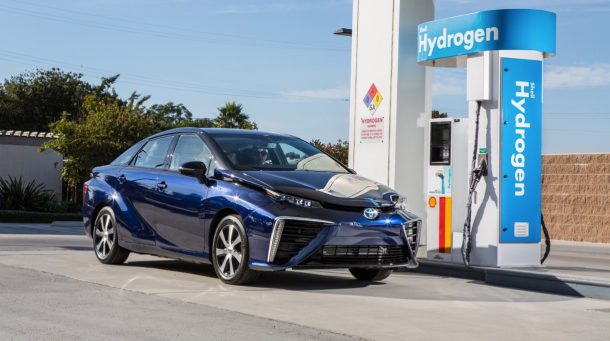
Hydrogen fuel cell vehicles have been in development for as long as hybrids, but while one of those technologies can be found in any Walgreens parking lot, the other still occupies a tiny micro-niche in the marketplace.
Besides the lack of refueling infrastructure, hydrogen-powered driving is hindered by the high cost of fuel cells. After receiving $6 million from the feds, Ford Motor Company and the Los Alamos National Laboratory hope to change that, the Detroit Free Press reports.
The grant, awarded by the U.S. Department of Energy, aims to spur development of cheaper fuel cells, which convert hydrogen and oxygen into electricity. Without a cost-effective production system, fuel cell vehicles will continue to be an ultra-low volume afterthought, hamstrung by their lack of competitive pricing.
This isn’t the first time Ford dipped its toe into the hydrogen vehicle realm. Prior to the recession, the automaker tested a small fleet of fuel cell-powered Focus vehicles. That demonstration program also saw support from the DOE.
Ford isn’t ruling out using the technology if it becomes cost-effective to use. In a statement, the automaker said, “The grant will help further our research efforts to develop next-generation technologies for our vehicles.”
As it stands, the flow of hydrogen vehicles into the U.S. market is like a tap that leaks a drop of water a few times a day. Less than 300 Toyota Mirai sedans found buyers as of July (according to Business Insider), though the automaker plans to cautiously ramp up production next year. The Hyundai Tucson fuel cell vehicle recently saw its first buyers in the U.S. and Canada, and Honda plan to market the Clarity later this year.
As of today, only 29 public hydrogen refueling stations exist in the U.S.
More by Steph Willems
Latest Car Reviews
Read moreLatest Product Reviews
Read moreRecent Comments
- Amwhalbi My 1972 Mercury Capri was my first stick shift car. God, I miss that thing. It was a blast to drive.
- Vid169489471 The technology exists today to produce a variable color temperature (kelvin) LED lamp. It can vary from 2700k that soft orange look to 6500k the bright daylight with the bluish tint.Since everything in a late model car is computer controlled, it would be an easy task to write a few lines of code that enables your vehicle to not only dim down from hi to low beam but to shift color temp down to the 2700k range for oncoming traffic, then back up to 5000k once oncoming traffic has passed. For the operator it would be automatic and seamless. For older cars they could be retrofitted with LEDs that are 2700k on low beam and 5000k on hi beam. As far as standards, there could be a lumens max, and a minimum. Several States already have minimum lumen standards going back to the old incandescent bulbs. Why not update these to national standards.
- Jam169859557 More regulation is needed for ALL vehicle lighting systems. [list=1][*]The lighting that is most blinding are the rapidly flashing red, blue and amber lights on emergency vehicles. The lights themselves are blinding, flashing so rapidly that it's impossible for even the sharpest eyes to adjust. What's worse, is the nature of the emergency requires a careful view of the area surrounding the emergency vehicle. There is something going on that needs to be seen. More flashing lights is not the solution.[/*][*]Brighter headlights need to be regulated. The tall riding vehicles do not need headlights positioned so high that they blind drivers in lower riding vehicles. And those heasdlights need to be aimed properly. When I first started driving my 2020 Subaru Outback, many drivers would flash their lights, hoping I would dim my lights. This stopped after I performed am easy adjustment that tilted the beam lower. Late model Subaru headlamps are designed with a sharp cutoff that project less glare above the hood line. When the headlights are properly aimed, other drivers are not blinded by the beam.[/*][*]Customized light assemblies make it more difficult to see the marker lights (tail lamps, turn signals and side marker lamps) that have been tinted. There are many municiple codes that prohibit this tinting, but these laws are seldom enforced.[/*][/list=1]Solutions: Tight controls on emergency vehicle lighting. In trying to make these vehicles more visible, a dangerous side effect is reducing the ability of drivers to see the surrounding perils.Headlight design regulations that reduce the height of the headlight assemblies. Just because a pickup truck has a hood that sits 4 feet abouve the pavement, it does not mean the headlights need to be so high. Owneres should maintain proper adjustments to their vehicle headlights.Establish and enforce regulation requiring a illumination standard be followed.
- Stl170698708 as someone who hates big government, and their interference;but you can add me to the list of people that are blinded by the lights.unfortunately "the poop is out of the horse and no way is it going back in"They have had 5 years to make lights bigger, badder and brighter because in the vehicle work it is go big or go home!Trucks are the worst because so many people use them to express their dominance and that is big, big, big $$ both at the Original Purchase and in the Aftermarket world.If, we are so lucky to get some good government regulation on this it will also take some very good Court enforcement to get the aftermarket people with fines and lawsuits.Much like the EPA did with the Diesel Tuner Industry that felt emission regulations didn't apply to them.This is from someone that owns said pickup truck with the same bright headlights,but i only use the truck when I have too and always turn off the Fog lights when driving in traffic.
- Art65765977 I saw a porsche 911 with the most amazing headlights from behind approaching the Sunshine skyway in Florida. The pattern was 108 degrees across sweeping the road like a broom. My brother and I were amazed. I don't know what it looked like from the front but i am sure it was better than American cars
Comments
Join the conversation
At some point the insurance industry is likely to weigh in on FCV's. For example the idea of underground parking lots full of these things is scary.
A major analysis that typically isn't done is what I'll call "wellhead to tailpipe" How much energy does it take to get a fuel ( be it gasoline, electricity, hydrogen etc) from the place of production to the final use as transportation. In many cases it can be single digit efficiency! H2 efficiency depends on the type of fuel cell, each has it's advantages and disadvantages. For the PEM type (i.e. Ballard's fuel cell powered bus) the hydrogen in made by cracking natural gas, to give CO and H2. CO is a poison to a PEM cell, and has to be discarded, so right away you're throwing away half the fuel. SOFC cells can use CO as a fuel but they operate at red hot temperatures (typically 750-800C ) and it takes at least 4-5 hours to get them to temperature from cold, since the various materials inside them at brittle and have to be warmed slowly. Once hot they must be fed fuel contentiously to protect the cells from air which will destroy them. It's like leaving your car idling all the time you're not using it. I used to work at an R&D company building and developing fuel cells, and transportation is a very poor application for them. Continuous load, like base load for the electrical grid is what they are good at. Cars are better off as straight electric with batteries, or hybrids. Or like trolley buses years ago with overhead power supplied.