
Trackday Diaries: He Wrangled 'Till The Butcher Cut Him Down.

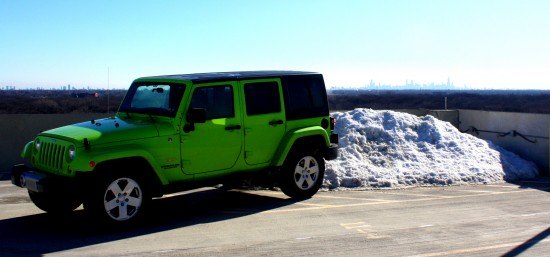
“So, I ordered myself a Jeep.”
“Awesome! What did you end up getting?”
“Loaded Sahara Unlimited, Gecko Green, tan leather, six-speed manual, just like you suggested.”
“Well, that is what I suggested alright… but…”
“But what?”
“I didn’t think you were actually going to do it.”
When TTAC alumnus Michael Karesh reviewed an automatic-transmission Sahara Unlimited last year, he enthused over the Jeep’s ability to be “steered with the throttle” and suggested that the manual-transmission variant might be even quicker than his tested automatic. Alas, he stated that the tires led to “mushy slides”, thus slightly reducing my enthusiasm for such a tail-happy beast. The last time I drove something that was both able to be steered with the throttle and did mushy sliding, it was a Camaro-Mustang-Challenge race car on used tires in the middle of a relatively long sprint race, and I found it to be a handful indeed.
Still, when my pal Curvy McLegalbriefs decided to go shopping for a Jeep last year I put in a vote for a manual-transmission Wrangler. She already owned a Grand Cherokee and a Crossfire so the Wrangler was simply going to be a toy for when she felt like bombing around the unimproved roads surrounding her century-old brick home, said domicile being located in the area known to readers of The Hunger Games as “District 12”. Still, it was a leap of faith; she didn’t know how to operate a stick-shift and our initial driving lessons in my Boxster, which took place after she’d ordered the Jeep, were marked by quite a bit of stalling and the occasional Ben-Kingsley-in-Sexy-Beast outburst from my place in the passenger seat.
Ten thousand miles later, she’s quite used to her green machine and she cheerfully zips it up and down very steep hills with no trouble whatsoever. I expected this would happen. She doesn’t give up easily. It’s part of her character. She grew up on a farm in the Midwest, studying the distant contrails overhead and planning her escape with meticulous precision. Cut to the present day, and she’s been everywhere from London to Guantanamo Bay. She has a bright future, a taste for vintage clothing, and no female friends whatsoever.
When a friend of mine asked me to come out to Chicago for a weekend and play bass for a guitar-club jam at some crappy dive bar halfway between the lake and O’Hare Airport, I looked at the distance (760 miles roundtrip), the equipment I’d need to bring for the trip (one SWR 4×10 cabinet, one amp rack, one Fender Jaco Pastorius Artist fretless four-string, one Carvin SB5000 five-string with a flamed koa top), and the weather (ten degrees above zero, snow predicted). I then asked C. McL if I could borrow the Jeep. She agreed, on the condition that she come along to keep me out of trouble. I had no objections.
Stick-shift Wranglers of the current generation are pretty rare. In fact, I’d never driven one before, since the press fleet at the intro was mostly automatics and I’m no longer on the Chrysler loaner list. My first impressions as we loaded the Jeep with two hundred-plus pounds of gear and pulled away towards Chicago were mostly negative. The clutch has a long pedal travel but ninety percent of it is superfluous. The long “bite zone” that I really appreciated in my old five-speed Discovery isn’t present here. Off-road, that would matter. Nor is the shifter up the standards of my ’97 Rover. Not even close. It’s long, agricultural, and extremely vague. My admiration for my traveling companion grew as I rowed the gears on the way out of my neighborhood. Was I in fourth or sixth? Only the lugging Pentastar knew for sure.
Speaking of which… Chrysler’s V-6 is my favorite among the current crop of big-power domestic sixes, well ahead of the DI Chevy in second place and the 3.7 Duratec in a distant, thrashy third. In the Chrysler 200, the Pentastar is fantastic. In the Caravan, it’s good. In the Wrangler, it feels overmatched. It needs to rev to make anything happen and it appears to have none of the casual thrust the old four-liter Jeep engine possessed in spades. Surely there’s a bit of perspective shear at work here, as I’m certain the 4.0 was weaker than the Pentastar everywhere a dyno could measure, but there you go. To make this Wrangler move with traffic, you have to shift aggressively and keep the hammer down. The observed fuel economy of 16.5mpg I saw during the trip is a reflection of that.
It’s also a reflection of the Jeep’s barn-door silhouette. The conditions of the oral travel agreement to which C. McL and I both agreed prior to the trip stated that my iPod would be plugged into the uConnect head unit for the duration, and that I would select the music. Unfortunately for me, my old 160GB iPod Classic doesn’t work with the uConnect head, so instead we listened to a hellish confection of Muse, Mumford & Sons, and the Zac Brown Band on various Sirius channels. In those conditions, I was glad that wind noise at 80mph and above makes the stereo almost useless. We stopped at Sweetwater Sound in Fort Wayne to pick up a 1/8″ cable, but cranking up to hear the quiet parts of “Blue Train” made the loud parts unbearable. Back to Mumford & Sons.
I’d never been in a Wrangler that rode particularly well, and I still haven’t, but this Sahara is far from the CJ-5s of my youth. The super-long (by Jeep standards) wheelbase spaces the bumps out and the tooth-rattling reaction to speedbumps I remember from various BMX-related trips in soft-top YJs is gone. As we entered Chicago proper, the Wrangler came into its element a bit. The pockmarked, off-camber streets of America’s Second City (All the hassle of New York, with none of the good parts!) didn’t bother it much. The Pentastar proved capable of pulling hard enough in first and second to make the gaps where required. The high driving position offered me a chance to stare Cayenne drivers down as I signaled my desire to acquire their current lane positions, by force if necessary. The long throws of the shifter never became second nature to me but my gearchanges became slightly less deliberate after a while.
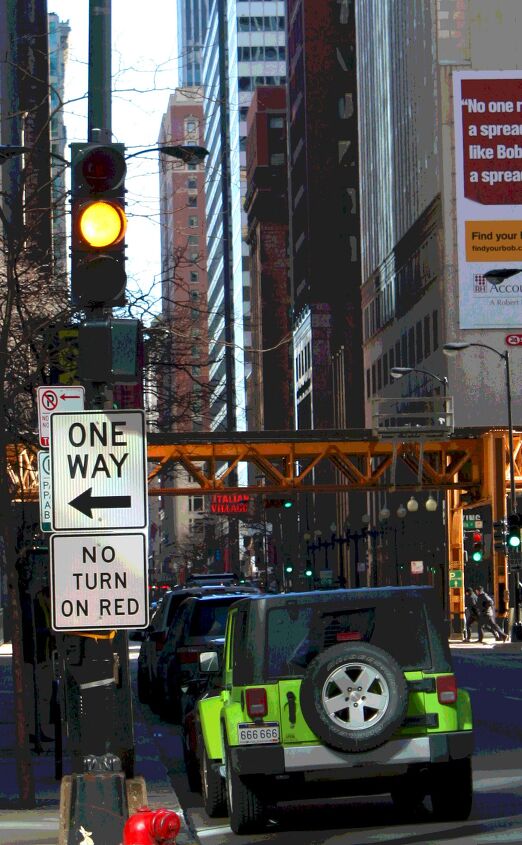
To unload my gear at the bar, I had to make a sharp U-turn and pop up a curb, and the Wrangler handled that task at least as well as my Town Car would have. Perhaps more usefully, people in the immediate vicinity smiled at my actions, because — hey — I’m in a bright green Jeep, how bad of a guy can I be? In fact, I repeatedly noticed that kind of goodwill shown to the Sahara over the course of the weekend, including a fellow who stopped in the middle of the road of Chicago Music Exchange to offer me a paid-up parking meter pass. He wasn’t even in a Jeep; he was driving an F-150. But he was a fan.
Tuning up my Jaco bass, I confirmed what I had suspected: the combination of ten-degree external temperatures, an uninsulated fiberglass top, and an overmatched HVAC system had combined to detune the instrument’s low string from E to C#. That’s great if you’re Stanley Clarke and you’re about to hold down the low end on a Return to Forever song but for me it was a worrisome sign that extended Jeep trips would be bad news for wooden instruments. After half an hour in the bar things were back to normal, but in the interest of reviewing the Wrangler for a wide audience I should note that I’d hesitate before carrying precious items through the winter in this vehicle, whether we’re talking a PRS Private Stock with mammoth-ivory and paua heart bird inlays or something less expensive, like a human heart packed in ice. Luckily I left the PRS at home and I’ve never had a human heart of any kind.
To my immense satisfaction, the gig broke up at midnight or so, allowing me to leave the Wrangler on the top floor of the Intercontinental Hotel’s parking garage and get a full night’s worth of sleep before heading home the next day. Despite numerous attempts to do so, I never managed to steer the Jeep with the throttle, possibly because I was being a bit of a wimp. There’s nothing like the threat of an SWR bass cabinet hitting you in the back to calm down the ol’ hooning impulse. By the same token, I never managed to turn the tires to mush of any kind. They seemed fine. I made a couple of aggressive moves in the very short spaces between tollbooths on Chicago’s so-called freeway system and was never particularly disappointed in the Wrangler’s response. It wasn’t as good as my old Rovers in that respect either but neither did it ever give any sign that it was about to roll over or do anything traditionally Jeepy. The brakes were strong and dependable. The dynamic package is perfectly up to the standards of the modern road environment.
At the end of the trip, I briefly considered whether I’d buy one of these for myself. I had to conclude that the answer was “not really”. I don’t need the Jeep’s off-road capability and if I found myself doing a lot of out-of-town gigs in bad weather I’d probably just put snow tires on an AWD minivan. Still, it’s a charming and utterly unique vehicle in a marketplace that is increasingly converging towards some sort of One Tall Wagon To Rule Them All. More than anything, the Wrangler points out what crap Land Rover’s turning out nowadays. Bloated junk that won’t hold up or travel through rough conditions like the Wrangler can, at half again the money. Depressing. I’d rather have this Wrangler than any current LR product… but I’d rather have my ’97 Discovery, suitably updated with modern electronics, over the Wrangler.
For my little attorney friend, the Wrangler is just great. She’s very good at driving it now and she likes being able to make plans regardless of weather or road surface. I’m glad she got it, and I’m glad it’s still available for her and people like her to buy. It’s still the real thing.
More by Jack Baruth




Comments
Join the conversation
Hey - what happened to Jack's original tags? Is this why he's going to Farago's new site?
You exaggerate, Jack. Chicago has MOST, if not all, of the hassles of New York. But also VIRTUALLY ALL of the virtues, if not in quite such profusion.