
Mitsubishi’s S-AWC: The Brand’s AWD Secret Weapon
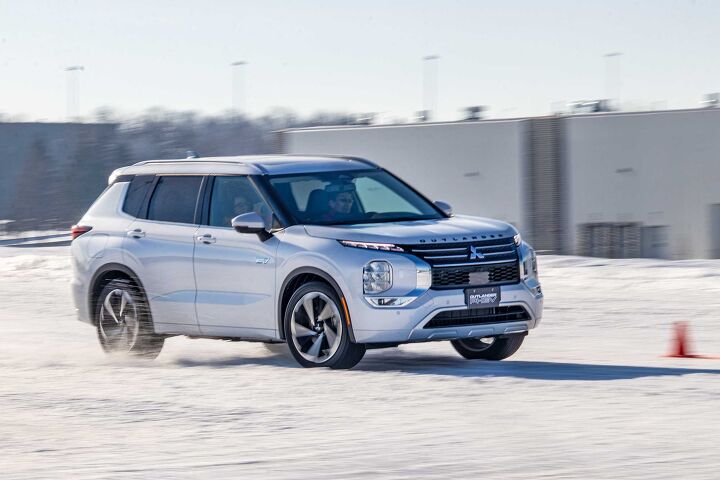
When you think of performance Mitsubishis, the Outlander PHEV is almost certainly not what comes to mind. Each time I drive one I’m surprised at how good it is, specifically its handling. A seven-passenger PHEV crossover shouldn’t handle this well. I’d previously driven it on closed tarmac and dirt courses. Each time I’d leave both the autocross and track and think—why is this so fun? It shouldn’t be this fun.
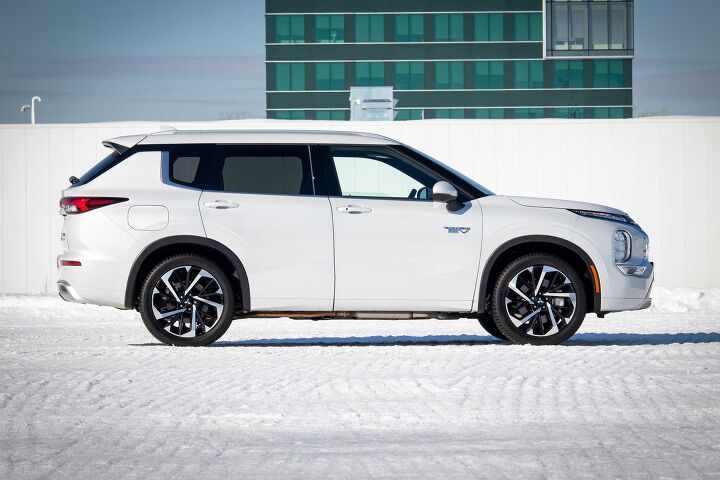
The Outlander PHEV punches above its weight in the handling department, especially for a 4,600 lb. seven-passenger crossover. Part of the sorcery comes from Mitsubishi’s S-AWC (Super All Wheel Control) all-wheel drive technology, which debuted on the Lancer Evolution X back in 2007. The S-AWC system showcases a three-pillar approach for handling different road surfaces. It has different drive modes including normal, tarmac, gravel, snow, and mud. You can get it on the Eclipse Cross, Outlander, and Outlander PHEV in North America. Having driven all three, it’s most impressive in the PHEV thanks to its twin electric motors and unique tuning.
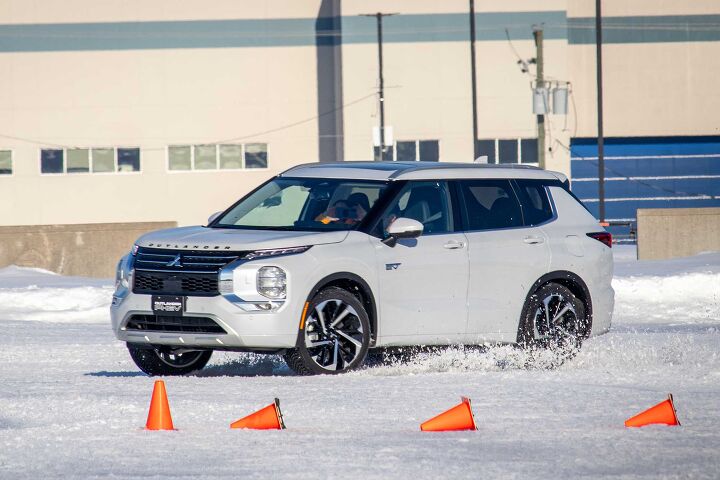
Full disclosure: I attended a Mitsubishi Motors drive event at the ICAR Complex near Montreal, Quebec, on the company’s invitation. Mitsubishi put me behind the wheel of Outlander PHEVs on a closed snow/ice course to experience S-AWC in the winter. There were several U.S. and Canadian Mitsubishi Motors representatives, and two Mitsubishi Motors Corporation employees from Japan: Kentaro Honda, C-Segment Chief Vehicle Engineer; and Kaoru Sawase, PhD, Engineering Fellow. Sawase is also known as the godfather of S-AWC.
Both Honda and Sawase touted the brand’s 4WD and AWD heritage with Pajero/Montero, Galant, and Lancer Evolution. They talked about how Mitsubishi’s experience in Dakar Rally and WRC honed the brand’s 4WD/AWD prowess and led up to S-AWC. No, Mitsubishi isn’t bringing back its gas-powered performance vehicles, but they recognize the legacy models as key components in its history.
Through charts, diagrams, and mathematical equations, it was clear Mitsubishi was heavy on engineering and software tuning for S-AWC. Sawase, who has won multiple awards for his engineering and has written or contributed to several publications on vehicle control, was indeed the godfather of S-AWC and it showed.
The S-AWC magic is in the electronic tuning. Add to it Outlander PHEV’s twin motors—the rear being more powerful than the front—and you’ve got an intriguing AWD recipe.
Mitsubishi’s S-AWC has three components: Longitudinal torque distribution, lateral torque vectoring, and four-wheel brake control. Respectively this is 4WD, AYC (active yaw control), and ABS/ASC. This system allows for continuous control working in conjunction all the time.
While the PowerPoint presentations were engineering-heavy, the proof is how it works (or doesn’t) in real-world implementation. Is S-AWC more marketing material than true traction? The snow and ice driving would be the judge of that.
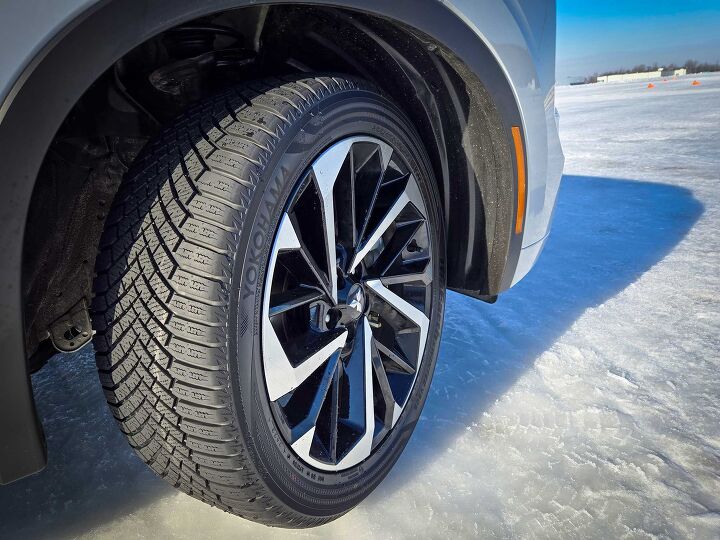
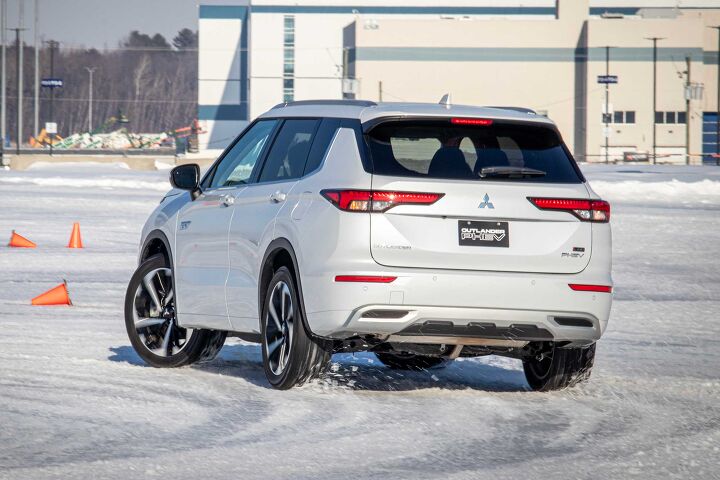
Mitsubishi brought several white Canadian-spec 2024 Outlander PHEVs for us to drive. Other than a speedometer in km/h and the temperature readout in Celsius, they’re the same as a U.S. models. While the 20-inch wheels are shod with Nexen all-season rubber from the factory, our test vehicles wore Yokohama BlueEarth Winter V906 winter tires. (Quebec requires winter tires with a 3PMS rating for part of the year.)
Our first S-AWC test was to drive a wide-diameter circle at about 20 km/h (12.4 mph) in snow mode. Even at this slow speed, you could feel the system making corrections as the vehicle either mildly under- or oversteered. Riding shotgun was a driving instructor. He’d randomly tell you to punch the throttle. The Outlander PHEV briefly lurched forward and within seconds the vehicle would mildly rotate and the S-AWC would correct. Next, we switched to normal mode. Traction and handling were adversely affected with pronounced understeer. If you flicked it right, you could induce oversteer, however. The team flashed the traction system installing a special drive mode adding more front-drive bias for us to experience, which did usual FWD things like plow forward when trying to turn. Then, it was a few more laps in snow mode to round out the circular test. Pun intended.
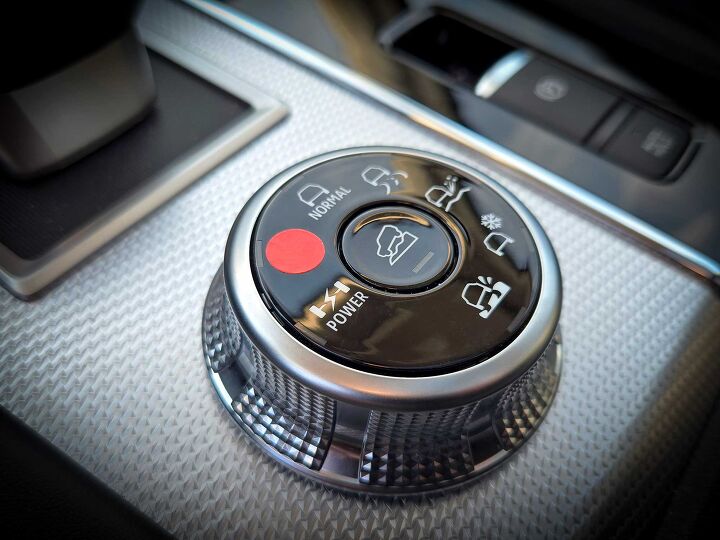
Later, the track was rearranged into a snow-covered autocross with slaloms, wide 180-sweepers, and straightaways. Again, we twisted the S-AWC drive mode dial through the various modes during separate runs. There were marked differences between each of them, offering more pronounced differences versus the circle drives. I also gave gravel mode a shot. It let the wheels spin more and did things with the yaw that conjured up visions of Tommi Mäkinen sliding his Evo through a WRC stage. Unsurprisingly, snow mode offered the most control. Normal mode was somewhere in between.
To prove a point, one Outlander PHEV was equipped with OE all-season rubber. As expected, traction was greasy at best compared to the Yokohama V906 winter tires. News flash: Snow tires are better in snow; more at 11:00.
Toward the end of the day Sawase gave ride-alongs. This was his tech and he knew how to use it best. He placed the vehicle in gravel mode and disabled traction control. Sawase-San piloted the PHEV like a rally driver, sliding sideways through slaloms and drifting around 180-degree corners. There may or may not have been donuts. OK, there were donuts. I’m not sure if the more powerful rear electric motor aids in the ability to have a RWD bias at times or if it’s the yaw control. Maybe both. But this is part of why this thing feels fun to drive at times, and downright hoonable at others. Pretty much everyone—including Sawase—got out of the Outlander PHEV with a big grin during his rides. Again, more fun than anyone expects (maybe even Sawase).
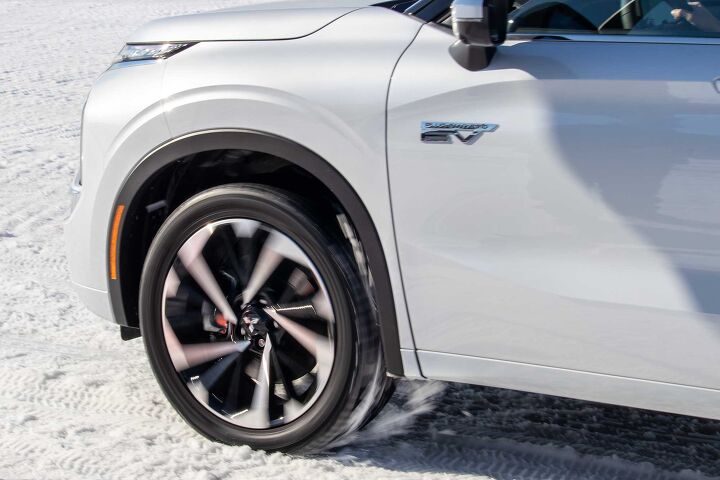
The Mitsubishi team mentioned the active yaw control multiple times as a key component to the ability to make the Outlander PHEV fun to drive when pushed. (They also mentioned its comfort, stability, and safety.) The active yaw control helps control how much rotation the car has, and Mitsubishi pioneered this in 1996. Mitsubishi states that AYC helps balance the side forces between the front and rear to maximize cornering performance, which will enhance understeer or oversteer behavior and handling response. This is where mathematics and equations come into play. AYC takes into account steering angle, vehicle speed, and actual yaw rate, throws it into an equation, and outputs yaw movement. The result is the ability to hone the yaw rate you need or want. And while AYC is only one component of the S-AWC system, it’s one that sets it apart from competitors’ systems.
Mitsubishi’s S-AWC is complex and effective mostly thanks to electronic tuning. Whether you’re trying to navigate a snowy road, traverse a muddy track, or have some fun on a gravel trail, the ability for drivers to tailor the system to their needs (and wants) isn’t marketing hype. In fact, Mitsubishi might under-hype it. This system works surprisingly well and helps the Outlander PHEV be more fun than you’d expect. And while the Outlander shares a platform with the Nissan Rogue, S-AWC is a Mitsubishi-exclusive giving the car its own driving demeanor.
The PR team touted the 2023 Outlander and Outlander PHEV as homeruns for the brand. (If you were curious, in 2023, there were 6,681 PHEV models sold and 42,501 gassers.) The PHEV variant continues to be a surprise in the segment, an underrated overachiever. Mitsubishi needs a second hit with whatever its next model will be for North America. Hopefully it’ll be as good as the Outlander PHEV, and hopefully it also employs its S-AWC system.
[Images © 2024 Andy Lilienthal/TTAC.com]
Become a TTAC insider. Get the latest news, features, TTAC takes, and everything else that gets to the truth about cars first by subscribing to our newsletter.

More by Andy Lilienthal




Comments
Join the conversation
Will a low, low, discount price be this vehicles salvation?
Hi,
Peter's comments appear angry and biased. Does he know Mitsubishi is fully manufactured in Japan and has mainly 3 vehicles in its line up? This allows them to produce them and have no artificial "waiting list" especially after COVID price gouging. Also, a fully loaded Outlander PHEV is $61K after Govt Subsidies and sales taxes. So save up the money and go get one as there are sooooo many on the lots.
Jake