

Rare Rides Icons: The Lincoln Mark Series Cars, Feeling Continental (Part XXIV)

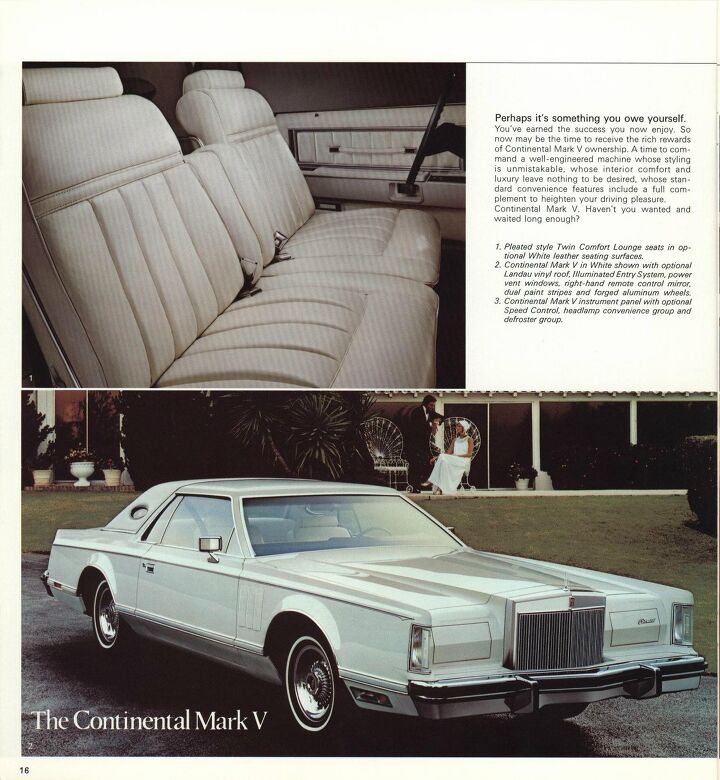
We continue with more Continental Mark V coverage today, and hone our focus on the model’s various trims. After their successful (big profit center) introduction in 1976 on the Mark IV, the quite expensive Designer Series trims were a shoo-in for a return on Mark V. Lincoln took full advantage of the popularity of “special” trim and gingerbread during the late Seventies, and went a little wild with the options. New colors, limited editions, and Designer Series layouts that changed by the year! It’s time for some in-depth trim action, and Luxury Group is up first.
Note: Though we planned to cover the Designer Series in this installment, the breadth of the Luxury Group offerings warranted their own entry.
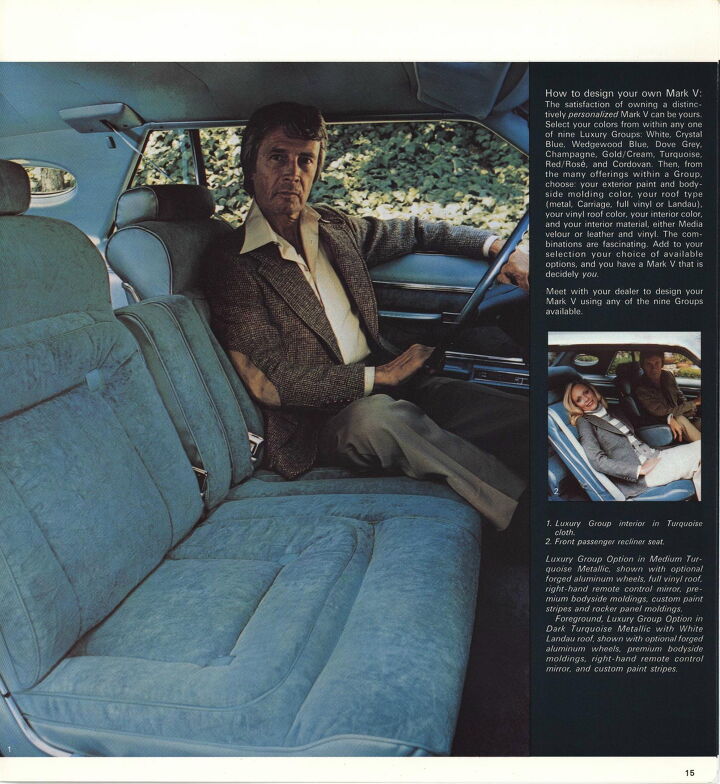
The Mark V’s more basic interior option was the Luxury Group. Packaged by its various interior color sets, the Luxury Group enabled a buyer to hand-select their Mark’s color scheme. Luxury Group options were available for the Mark V’s full run from 1977 to 1979, though some groups proved less popular and were changed out for others.
The process was simple, but provided much choice: Luxury Groups determined the interior look via upholstery and trim and were selected first. Within a Luxury Group was the choice between full velour or a combination of leather and vinyl. Note that velour was not available on all Luxury Groups; more on that in a moment. After upholstery was the exterior color, which was not restricted by the Luxury Group interior choice.
There were a variety of paint schemes (upper, lower, roof, midsection) available, and the customer selected up to four different exterior paint colors all on the same car. Said paint melange was topped by the customer’s choice of roof treatment. As mentioned last time, a painted roof was available but seldom selected, while more popular were landau and full-length vinyl roof coverings. The color of the vinyl was also selected by the customer.
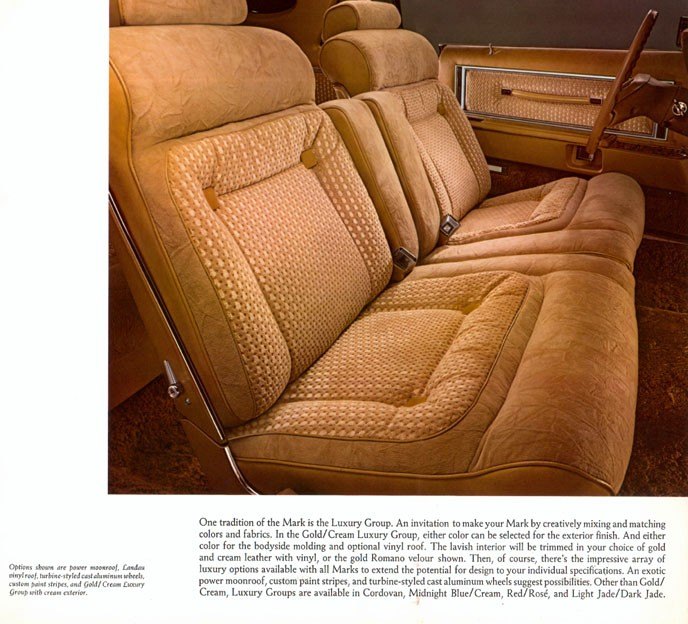
And there was yet more customization beyond the Luxury Group: Side body moldings were available in an impressive 16 different colors, as were the optional pinstripes that ran along the secondary character line. In addition to the most often selected turbine alloy wheels, there were other wheel choices and wheel covers.
Worth noting here, a Luxury Group and color set did not bind the customer to any particular basic or fully-loaded status. Every optional extra available in a given year for the Mark V was available with every Luxury Group. The freedom of choice meant thousands and thousands of potential combinations, something that’s simply not possible in a modern mass-produced vehicle at any price. And that’s truly personal luxury.
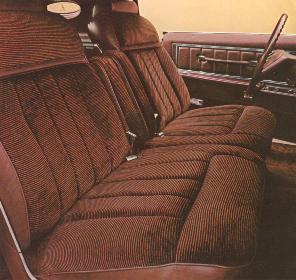
There were six different Luxury Group options for the Mark V’s debut year in 1977: Cordovan and White, Gold and Cream, Midnight Blue and Cream, Red and Rose, Light Jade and Dark Jade, Midnight Blue and Dove, and the simply named Grey. Of those, only two - Cordovan and White, and Gold and Cream - offered velour upholstery. Specifically for the Luxury Groups, the velour was called “Romano.”
For the Ace of Base Mark buyer, there was a standard velour interior, available in six different colors. This type of Mark V customer received a vertically pleated seat design that lacked any button tufting and denoted the car’s basic status. Separately from the Luxury Group, there was a Majestic Velour Luxury Group. This provided a different pillow top seat design to the Romano velour, which was more overstuffed and had additional pleating. Majestic Velour was available in Blue, Red, Jade, or Dove Gray, and was a standalone option.
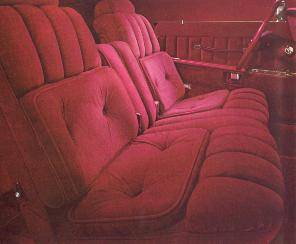
Luxury Group offerings were revised in 1978, as more monochromatic themes replaced the less popular color groups of 1977. On offer were Wedgewood Blue, Red and Rose, Light Jade and Dark Jade, Cream and Gold, Dove Gray, Chamois, Champagne, and Cordovan and White. Luxury Group Velour in 1978 was called “Media,” and was offered across almost all Luxury Groups.
The Mark’s standard velour had a new name for 1978: Ultravelour. With the same vertically pleated look as before, the velour returned in the exact same colors as 1977. They were Black, Wedgewood Blue, Red, Cordovan (Bill Blass only), Jade, Chamois, and Gold.
As Lincoln introduced new special edition trims to the Mark V options list, it removed the unpopular Majestic Velour package. Majestic Velour was offered for a single year and would be a rare interior to encounter today. Worth noting, the Majestic Velour material was part of the Givenchy Edition. But that was only for 1977, and it was offered in different colors to the standalone Majestic Velour option.
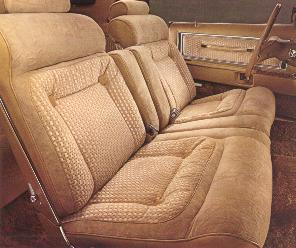
The Luxury Group expanded considerably in the Mark V’s final outing for 1979. Leather with vinyl or Media velour returned as seating materials, but there were fewer velour options than in 1978. The impressive list included Wedgewood Blue, Red, Red and Rose, Cordovan, Turquoise, Crystal Blue, Gold, Cream and Gold, White and Turquoise, Dove Gray, Champagne, White and Turquoise, White and Dark Red, White and Midnight Blue (Collector’s Series), White and Black, White and Champagne, White and Wedgewood Blue, White and Cordovan, White and Crystal Blue, White and Jubilee Gold, and Midnight Blue (again, Collector’s Series).
Of those 21 Luxury Group interiors, only seven were available with velour: Wedgewood Blue, Red, Cordovan, Turquoise, Crystal Blue, Gold, Dove Gray, and Champagne. For the basic Ultravelour customer who liked a plainly pleated seat, colors were revised in 1979. Limited more than in previous years, basic upholstery was available in Black, Wedgewood Blue, Dark Red, Cordovan, Cream, and Champagne.
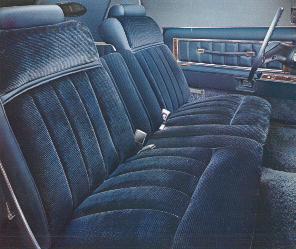
For each year of the Mark V, there was an optional leather/vinyl interior as a standalone option. It was of the same basic pleated seat design but in a wider variety of single- and two-tone colors. It was fairly evident that Lincoln wanted the customer to spend for the upgrade to the leather interior, as 14 colors were available versus six in velour.
Before today, your author didn’t truly appreciate the wealth of combinations and choices available to the Mark V customer. Such freedom surely made ordering a Mark V feel like a special event. Our next Rare Rides Icons installment on the Mark V will be dedicated to the Designer Series cars, and the limited special edition models available in 1978 and 1979. Until then, keep your dinner jacket at the ready.
[Images: Ford]
Become a TTAC insider. Get the latest news, features, TTAC takes, and everything else that gets to the truth about cars first by subscribing to our newsletter.
Interested in lots of cars and their various historical contexts. Started writing articles for TTAC in late 2016, when my first posts were QOTDs. From there I started a few new series like Rare Rides, Buy/Drive/Burn, Abandoned History, and most recently Rare Rides Icons. Operating from a home base in Cincinnati, Ohio, a relative auto journalist dead zone. Many of my articles are prompted by something I'll see on social media that sparks my interest and causes me to research. Finding articles and information from the early days of the internet and beyond that covers the little details lost to time: trim packages, color and wheel choices, interior fabrics. Beyond those, I'm fascinated by automotive industry experiments, both failures and successes. Lately I've taken an interest in AI, and generating "what if" type images for car models long dead. Reincarnating a modern Toyota Paseo, Lincoln Mark IX, or Isuzu Trooper through a text prompt is fun. Fun to post them on Twitter too, and watch people overreact. To that end, the social media I use most is Twitter, @CoreyLewis86. I also contribute pieces for Forbes Wheels and Forbes Home.
More by Corey Lewis









Comments
Join the conversation
"There were a variety of paint schemes (upper, lower, roof, midsection) available, and the customer selected up to four different exterior paint colors all on the same car."
Huh? I'm not sure where that came from...
A roof could never be ordered in a contrasting paint from the body of any Mark V - Contrasting roofs were vinyl only. Perhaps you're thinking of the two-tone combos and variations on the Mark IV, the Grand Marquis coupe, the Williamsburg Continental sedans, Thunderbird, Cougar, or the 1980 Lincoln lineup? Even then one could never choose 4 separate paint colors - only among the limited, prescribed two-tone choices. (I returned to update: If you reread the 1978 Luxury Group pages, you will see that it says you may have chosen *from* up to 4 paint colors for any interior color - But you could not choose more than one on any car.)
For the V, two tone paint was only available from the factory on the Bill Blass in 1979. The side and lower panels, the Continental hump inset & bumper fillers were Navy and the upper body was white. Similar paint treatments were carried through and color choices expanded in 1980 to the Mark VI and Continental.
Meanwhile, Majestic Velour was carried forward in the main Continental sedan and couple lineup after 1977 - however Mark V swapped in "Luxury Cloth with Unique Broadlace Inserts" for the very popular Wedgwood Blue or Jubilee Gold 1978 Diamond Jubilee Editions, and "Kasmann II Cloth" for the Midnight Blue 1979 Collectors Series. That still allowed clients to choose from 4 interior material choices overall.
The Continental is how Ford managed to use twice the metal to make half as much car.