
Shocker! Trucker Union Opposes Exemptions for Autonomous Vehicles
The Transport Workers Union of America has issued its formal opposition to requests, filed by Alphabet's self-driving unit Waymo and autonomous technology company Aurora, seeking an exemption from some of the rules pertaining to the warning devices equipped to semi-trucks.
According to Reuters, the Federal Motor Carrier Safety Administration (FMCSA) received a joint application from Waymo and Aurora asking for a five-year exemption from rules that require drivers to place reflective triangles or a flare around a stopped truck to alert other drivers and help prevent a crash. The reason is that driverless trucks would not have someone in the cab that can hop out and handle the task.
From Reuters:
Aurora and Waymo instead want to use warning beacons mounted on the truck cab to avoid the need for human drivers.
The Transport Workers Union of America said the petition is "inappropriate, represents an overreach and a misuse of the waiver and exemption process, and would significantly diminish the safety of our roads. It should be rejected in the strongest possible terms."
It urged the safety board to ensure "rigorous oversight and standards" before widespread deployment of such new technologies.
Regardless of which method is actually safer, truckers aren’t likely to support any changes to the rules that will eventually leave them jobless. Though it’s similarly hard to imagine driverless trucks ever catching on without there being some major legislative changes and a lot more unemployed drivers.
As things currently stand, Congress has moved extremely slowly on tweaking federal regulations pertaining to vehicles over 10,000 pounds — with legislators often confessing they don’t really understand the relevant technologies. Meanwhile, while the government has been hesitant to change formal safety rules, it’s been broadly okay with allowing companies to self-certify autonomous test vehicles under 10,000 pounds. But the industry wants more leeway, despite not having done much to earn the public’s trust.
Waymo noted in the request it has a fleet of 48 Class 8 trucks, equipped with autonomous driving systems that operate with human operators on board who can drive the vehicles when necessary. So this shouldn’t really represent much of a problem for them until they elect to dump the safety drivers.
Aurora likewise wrote that it operates a fleet of 28 Class 8 trucks with autonomous capabilities. Those vehicles also have human operators on board. So, again, it looks like the only thing the exemption would change is how many of those people would be employed.
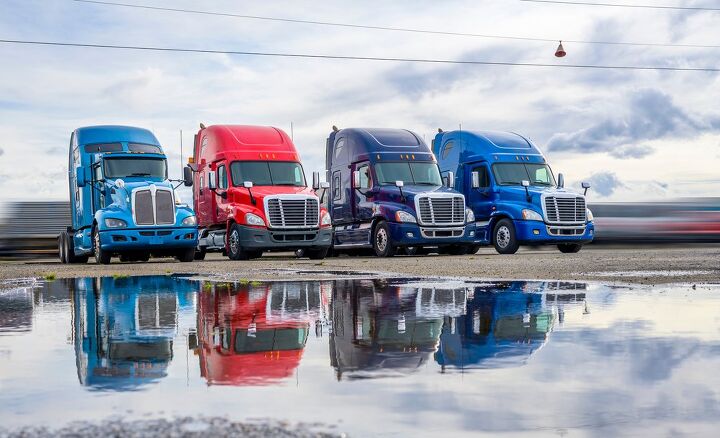
[Image: Vitpho/Shutterstock]
Become a TTAC insider. Get the latest news, features, TTAC takes, and everything else that gets to the truth about cars first by subscribing to our newsletter.
Consumer advocate tracking industry trends and regulations. Before joining TTAC, Matt spent a decade working for marketing and research firms based in NYC. Clients included several of the world’s largest automakers, global tire brands, and aftermarket part suppliers. Dissatisfied, he pivoted to writing about cars. Since then, he has become an ardent supporter of the right-to-repair movement, been interviewed about the automotive sector by national broadcasts, participated in a few amateur rallying events, and driven more rental cars than anyone ever should. Handy with a wrench, Matt grew up surrounded by Detroit auto workers and learned to drive by twelve. A contrarian, Matt claims to prefer understeer and motorcycles.
More by Matt Posky
Latest Car Reviews
Read moreLatest Product Reviews
Read moreRecent Comments
- Amwhalbi My 1972 Mercury Capri was my first stick shift car. God, I miss that thing. It was a blast to drive.
- Vid169489471 The technology exists today to produce a variable color temperature (kelvin) LED lamp. It can vary from 2700k that soft orange look to 6500k the bright daylight with the bluish tint.Since everything in a late model car is computer controlled, it would be an easy task to write a few lines of code that enables your vehicle to not only dim down from hi to low beam but to shift color temp down to the 2700k range for oncoming traffic, then back up to 5000k once oncoming traffic has passed. For the operator it would be automatic and seamless. For older cars they could be retrofitted with LEDs that are 2700k on low beam and 5000k on hi beam. As far as standards, there could be a lumens max, and a minimum. Several States already have minimum lumen standards going back to the old incandescent bulbs. Why not update these to national standards.
- Jam169859557 More regulation is needed for ALL vehicle lighting systems. [list=1][*]The lighting that is most blinding are the rapidly flashing red, blue and amber lights on emergency vehicles. The lights themselves are blinding, flashing so rapidly that it's impossible for even the sharpest eyes to adjust. What's worse, is the nature of the emergency requires a careful view of the area surrounding the emergency vehicle. There is something going on that needs to be seen. More flashing lights is not the solution.[/*][*]Brighter headlights need to be regulated. The tall riding vehicles do not need headlights positioned so high that they blind drivers in lower riding vehicles. And those heasdlights need to be aimed properly. When I first started driving my 2020 Subaru Outback, many drivers would flash their lights, hoping I would dim my lights. This stopped after I performed am easy adjustment that tilted the beam lower. Late model Subaru headlamps are designed with a sharp cutoff that project less glare above the hood line. When the headlights are properly aimed, other drivers are not blinded by the beam.[/*][*]Customized light assemblies make it more difficult to see the marker lights (tail lamps, turn signals and side marker lamps) that have been tinted. There are many municiple codes that prohibit this tinting, but these laws are seldom enforced.[/*][/list=1]Solutions: Tight controls on emergency vehicle lighting. In trying to make these vehicles more visible, a dangerous side effect is reducing the ability of drivers to see the surrounding perils.Headlight design regulations that reduce the height of the headlight assemblies. Just because a pickup truck has a hood that sits 4 feet abouve the pavement, it does not mean the headlights need to be so high. Owneres should maintain proper adjustments to their vehicle headlights.Establish and enforce regulation requiring a illumination standard be followed.
- Stl170698708 as someone who hates big government, and their interference;but you can add me to the list of people that are blinded by the lights.unfortunately "the poop is out of the horse and no way is it going back in"They have had 5 years to make lights bigger, badder and brighter because in the vehicle work it is go big or go home!Trucks are the worst because so many people use them to express their dominance and that is big, big, big $$ both at the Original Purchase and in the Aftermarket world.If, we are so lucky to get some good government regulation on this it will also take some very good Court enforcement to get the aftermarket people with fines and lawsuits.Much like the EPA did with the Diesel Tuner Industry that felt emission regulations didn't apply to them.This is from someone that owns said pickup truck with the same bright headlights,but i only use the truck when I have too and always turn off the Fog lights when driving in traffic.
- Art65765977 I saw a porsche 911 with the most amazing headlights from behind approaching the Sunshine skyway in Florida. The pattern was 108 degrees across sweeping the road like a broom. My brother and I were amazed. I don't know what it looked like from the front but i am sure it was better than American cars
Comments
Join the conversation
in the Almighty Name of our Green Goddess!, you will buy into this, or else!
oh yes, for the Greater Good, read FountainHead by Ayn Rand, the Architects' Speech to understand what is happening to the world, to America.
f