
Chinese Government Probes Automakers Over Fake Used Cars

Reports have alleged that China’s Ministry of Commerce has been looking into automakers over concerns that they may have misrepresented new vehicle sales. Apparently, there have been a sizable number of “zero-mile vehicles” appearing on used lots, suggesting companies may have been handing brand-new vehicles to dealers at a large discount to help pad monthly sales figures.
On the surface, this seems like business as usual. Similar to Western markets, China has seen reduced demand for new vehicles and is simply offering discounts to help drive volume. However, according to Bloomberg, the cars were being counted as previously sold to allow the relevant companies to meet preexisting new-vehicle sales targets. This likewise helped appease investors who were starting to shun the industry.
From Bloomberg:
‘Zero-mileage’ cars came to public attention last week, when Great Wall Motor Co. Chairman Wei Jianjun warned of an unhealthy outlook for China’s car industry following a years-long price war.
The practice sees automakers that have failed to meet their sales targets distribute new vehicles to supply chain financing companies or used car dealers, according to the dealers’ association’s Li. These essentially new cars then appear on the resale market with no mileage and manufacturers record them as sales despite not reaching the end-consumer, he wrote on Weibo.
While that would be viewed as fraud in places like the US, it’s not clearly regulated in China, he said. He urged the Ministry of Commerce and China Securities Regulatory Commission to stamp out the practice.
It’s unclear which companies are involved, but Great Wall’s Wei estimated that as many as 4,000 second-hand sellers post ‘zero-mileage’ cars on online platforms.
It’s worth noting that the Chinese government heavily subsidizes its automotive sector, especially where electric vehicles are concerned. The original plan was for this to drive competition and leave the nation with a handful of successful EV brands that survived the battle royale based on which companies had the highest number of sales. Then, those companies would go on to take on the rest of the world.
While a lot of the government assistance dried up in 2022, there remains a significant amount of pressure for brands to maintain a good showing on the home market. It appears as though China is trying to shore up any loopholes that would allow automakers to take advantage of the lingering incentives.
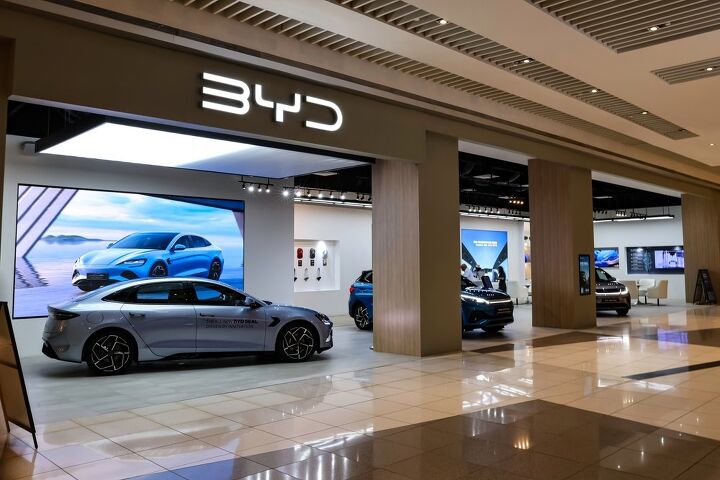
Reuters likewise noted that sales have been down in China of late, resulting in massive price reductions on most models and some lost investment capital. BYD witnessed its shares decline by about 10 percent at the very start of this week after reducing pricing on domestic models by over a third. Other brands have taken a similar approach, with China’s vehicle index estimated to be down anywhere from 2 to 4 percent.
While there is a chance that Western media is hoping to draw attention to China’s automotive woes in a bid to downplay the negative outlook taking place in North America and Europe, this wouldn’t be the first time that Chinese-backed automakers have engaged in some truly stunning levels of fraud to maintain subsidization. This actually encouraged the Chinese government to tighten its reins on the automotive industry in 2017 by placing additional restrictions on illegal registrations and falsified clients.
The current investigation could lead to more of that. China may want to boost vehicle volumes but it’s looking like some automakers may just be using subsidies to pay for those discounts applied to phony secondhand cars. Ironically, this is more or less what’s been happening on Western markets — with the core difference being that nobody appears to be faking new vehicle volumes.
China plans on having numerous meetings about the issue in the coming weeks. In addition to vehicle manufacturers, China’s Ministry of Commerce also plans on meeting with the China Association of Automobile Manufacturers (CAAM), China Automobile Dealers Association (CADA), individual retailers, auction houses, and other relevant groups.

[Images: Dr David Sing/Shutterstock; Robert Way/Shutterstock]
Become a TTAC insider. Get the latest news, features, TTAC takes, and everything else that gets to the truth about cars first by subscribing to our newsletter.
Consumer advocate tracking industry trends and regulations. Before joining TTAC, Matt spent a decade working for marketing and research firms based in NYC. Clients included several of the world’s largest automakers, global tire brands, and aftermarket part suppliers. Dissatisfied, he pivoted to writing about cars. Since then, he has become an ardent supporter of the right-to-repair movement, been interviewed about the automotive sector by national broadcasts, participated in a few amateur rallying events, and driven more rental cars than anyone ever should. Handy with a wrench, Matt grew up surrounded by Detroit auto workers and learned to drive by twelve. A contrarian, Matt claims to prefer understeer and motorcycles.
More by Matt Posky












Comments
Join the conversation
SOP for a government bailed out big 3 manufacturer both in USA and Australia.
Here are the issues with China's auto manufacturing and overcapacity to produce vehicles.
China has, according to the New York Times, the capacity to produce over 40 million internal combustion engine (ICE) cars a year.
Goldman Sachs thinks China will also have the capacity to produce around 20 million electric vehicles by the end of 2024. It should have the capacity to produce something close 25 million EVs by late 2025, as production is currently increasing by close to 4 million cars a year and Chinese firms continue to invest heavily.
China’s internal market is around 25 million cars, and not really growing—so rising domestic EV sales progressively frees up internal combustion engine capacity for export. Domestic demand for traditional cars is likely to be well under 10 million cars next year given the enormous shift toward EVs now underway inside China.
China currently has the capacity to produce over two times its own domestic demand and is adding to that capacity quickly thanks to the rapid expansion of its electric vehicle sector. It thus has almost unlimited potential capacity to export.
https://www.cfr.org/blog/will-china-take-over-global-auto-industry#:~:text=Overcapacity%20in%20China's%20automotive%20sector,state%2Downed)%20Chinese%20partners.