
Abandoned History: General Motors Sued by Beretta Over the Beretta

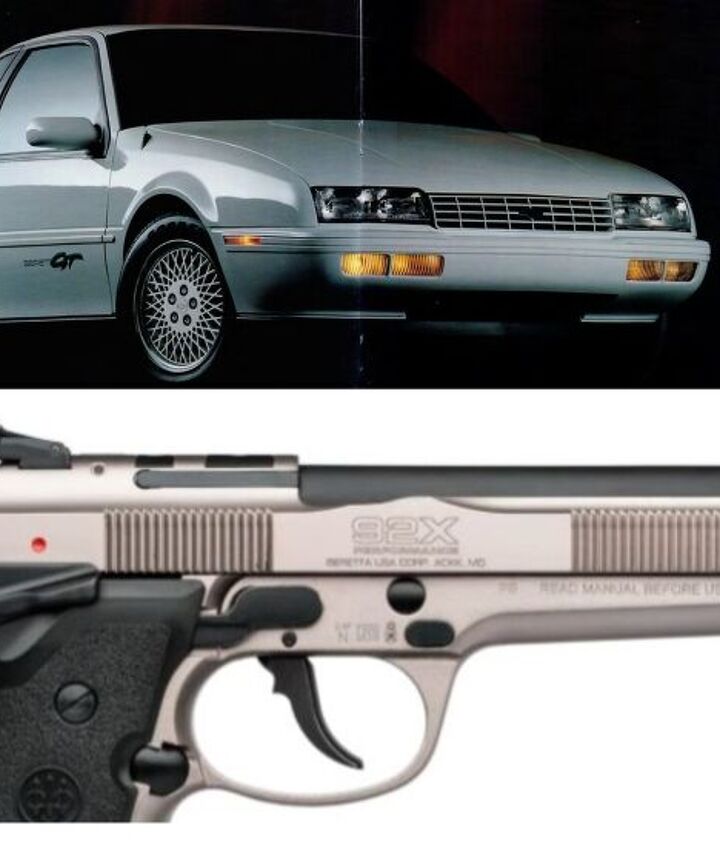
When General Motors introduced the Chevrolet Beretta in 1987, the lukewarm-to-warm economically-minded coupe wore the name of a gun manufacturer. An intentional decision, the Beretta name made the new model sound more exciting. Prior to the launch, the other Beretta (the gun company) warned The General not to use its name. GM’s executives simply ignored the warning. A lawsuit ensued as Beretta of Italy came after General Motors with guns blazing, one might say.
As the sporty compact car segment heated up in the Eighties, GM needed a replacement for its staid and/or dated two-door options at the lower end of the market. Consumers desired coupes that were sportier and cheaper than a personal luxury car like the Monte Carlo, more exciting than offerings based on sedans, and nicer than the entry-level Cavalier coupe. Enter the L-body platform.

The L-body Beretta was a replacement for the already deceased two-door Citation II (1984) and the conservative and slow-selling Celebrity two-door sedan. Consumers continually showed they didn’t want two-doors based on sedan bodies in the early Eighties, rejecting their plain Jane styling and formal rooflines. Beretta was part of a three car approach that saw the L-body as a dedicated Chevrolet platform. Unusual for the time, the L-body was not worn by any other GM brand apart from its brief stint as the Canadian market Pontiac Tempest.

Beretta was the sportiest with its dedicated coupe format. Its sibling the Corsica was the more practical option, and was offered as a four-door sedan or five-door liftback. It was the Corsica which became the Pontiac Tempest, and was offered from 1987 to 1991 in Canada, Israel, and select Middle Eastern countries.

Beretta was launched with 2.2-liter and 2.8-liter engines, and was most often optioned with a three-speed automatic. Over time the Beretta got sportier, and its GT trim spawned the even more aggressive GTU. Engines grew in displacement and a 2.3-liter 16-valve engine appeared. The 2.8 V6 was upgraded to two different versions of the 3.1-liter, the LH0 and L82.

It was around this time GM received some official paperwork from Fabrica D’Armi Pietro Beretta SpA, more commonly known as Beretta. The ancient gun manufacturing company was founded in 1526 and produced arquebus long rifles for forces in the Ottoman Empire. Its guns were notably used by the Venetians in 1571.
The company went on to add shooting clothes and accessories, cutlery, and luggage to its wares, and expanded into other firearms. A privately held company, Beretta is impressively still owned by its founding family: the descendants of founder Bartolomeo Beretta (1490-1565). It was these descendants who registered trademarks for the Beretta name in the United States in 1954, when the company was already well-known for its semi-automatic pistols.
As soon as GM unveiled the Beretta in 1987, it received multiple warning notices from Beretta of Italy. The company’s lawyers informed GM that Beretta owned the trademarks of the name in the United States, and they were off-limits for GM use. This documentation surely reached then- CEO Roger Smith (1925-2007), who decided the threat wasn’t all that serious. The Beretta name was kept for production.

The subsequent lawsuit was filed in New York federal court in July of 1988. Beretta sought $250 million ($674.6m adj.) in damages for the illegal name usage. GM’s lawyers decided it was best to settle things as quickly as possible since they didn’t have the proverbial leg upon which to stand.
Rather than receive funds directly, Beretta accepted a $500,000 ($1.29m adj.) charitable donation from General Motors to the Beretta Foundation for Cancer Research in May of 1989. Additionally GM was forced to add acknowledgements in its marketing materials and the Beretta owner’s manual that the name was used with permission of Beretta firearms. To ensure there were no hard feelings, the companies also exchanged little presents.

At the conclusion of the lawsuit, GM CEO Roger Smith traveled to Italy to meet with Beretta’s CEO, Pier Giuseppe Beretta (1906-1993). The two had a signing ceremony for the settlement, and Smith presented Beretta with a Beretta GTU that wore a special blue-to-silver ombre paint scheme. Beretta’s CEO gave Smith a rifle and a shotgun.
The gifted Beretta GTU was fortunately not lost to time! Beretta kept it in Italy for some years, but transferred it back to the United States in 2016 when it opened a new factory in Gallatin, Tennessee. The Beretta is displayed there today in showroom condition, and has a Beretta USA logo applied to its doors. We can’t use this photo, but please have a look here.

With its legal troubles behind it, Beretta continued its sales success as GM piled on the trims and options. Updates resulted in the ultimate GTZ version, which replaced the GTU from 1990 to 1993. Equipped as standard with the Oldsmobile 2.3-liter high-output Quad 4 engine, GTZ also featured an FE7 sports suspension and a five-speed manual from Getrag. Lesser models were updated to a four-speed 4T60 automatic by that time.

In its various configurations, the Beretta was a very successful car for GM. After introduction in 1987, the coupe’s first full year in 1988 saw over 275,000 sales. For comparison, the hugely successful Ford Taurus sold 294,576 sedans in 1988 (and 93,001 wagons).

Beretta’s figures dropped off to 180,242 in 1989, and then slowed through the remainder of its decade-long run. At the end of its final year in 1996, sales totaled 906,230 Berettas. It was replaced by the Lumina Coupe (badged as the Monte Carlo), on the larger W-body platform. And the Beretta-GM lawsuit is largely forgotten today, just a bit of Abandoned History.
[Images: General Motors, Beretta]
Become a TTAC insider. the latest news, features, TTAC takes, and everything else that gets to the truth about cars first by subscribing to our newsletter.
Interested in lots of cars and their various historical contexts. Started writing articles for TTAC in late 2016, when my first posts were QOTDs. From there I started a few new series like Rare Rides, Buy/Drive/Burn, Abandoned History, and most recently Rare Rides Icons. Operating from a home base in Cincinnati, Ohio, a relative auto journalist dead zone. Many of my articles are prompted by something I'll see on social media that sparks my interest and causes me to research. Finding articles and information from the early days of the internet and beyond that covers the little details lost to time: trim packages, color and wheel choices, interior fabrics. Beyond those, I'm fascinated by automotive industry experiments, both failures and successes. Find me on Twitter, @CoreyLewis86.
More by Corey Lewis






Comments
Join the conversation
They were named after what you’d want to empty into the car after having to keep one running.
I remember that Car and Driver did a comparison test of Beretta v. Beretta (wording approximate): "The Beretta (gun) doesn't have a glove box, but it fits into the one the Beretta (car) does have. You can carry four friends in the Beretta (car), but you can take out thirteen enemies with the Beretta (gun)..."