
Junkyard Find: 1988 Pontiac Fiero GT
Which of The General's Should Have Been Game-Changers But Weren't vehicles most makes the ghost of Alfred P. Sloan want to rise up and haunt his bumbling successors? The Corvair? The Citation? The Vega? The Allanté? The Aztek? How about today's Junkyard Find, the final-year Pontiac Fiero?

Since both the Vega and the Citation were innovative machines that would have dominated their respective sales decades had their good engineering not been torpedoed by poor execution and/or intracorporate squabbling, they inflicted far more lasting harm to GM than a low-volume sports car ever could have dealt out. But still, the maddening story of the Fiero must enrage Sloan's ghost.

I can't improve on Aaron Severson's masterful Kill Your Darlings: The Birth and Death of the Pontiac Fiero, so go read that right now if you haven't already done so.

Long story short, the Fiero's initial design got bean-countered into an overweight econo-commuter with a parts-bin suspension and the gnashy pushrod Iron Duke as its base engine. That's what was sold for the 1984 through 1987 model years.

But for 1988, the Fiero finally got the suspension it was supposed to have had from the beginning (with some improvements added since that time). Hooray, no more Citation/Chevette underpinnings! Few cared by that time, though, and sales of the much-improved Fiero were miserable. The car got the axe, with the final '88 Fiero built in August of that year.

I photographed this car last summer in a high-turnover Northern California junkyard, so it has been crushed by now. However, I still find discarded '88 Fieros every year or two, so parts are still out there.

This is a top-of-the-line GT model, so it has the 2.8-liter pushrod V6 rated at 135 horsepower and 165 pound-feet.

A three-speed TH125 automatic transmission was available for $490 (about $1,359 in 2025 dollars), but this car has the base Muncie/Getrag five-speed manual.

The MSRP for this car was $13,999, or about $38,814 after inflation. The base 1988 Toyota MR2 cost $12,808 while the 145-horse supercharged version listed at $16,418 ($35,512 and $45,521 in today's money). Meanwhile, a new 1988 Honda CRX Si had a sticker price of just $10,195 ($28,267).

The optional air conditioning added $775 ($2,148) to this car's cost.

Unusually for GM cars of the era, Fieros got odometers that could show hundreds of thousands of miles. That's why we can see that this one traversed 163,087.7 miles during its driving career.

Its final owner applied a bit of aftermarket suspension hardware before the end.

The RPM wheel with a lock was the only one remaining on the car when I arrived.

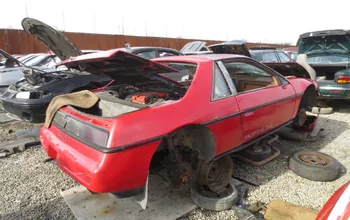
The body is pretty rough.

Worth restoring? Probably not, but some of its parts lived on in other '88 Fieros.

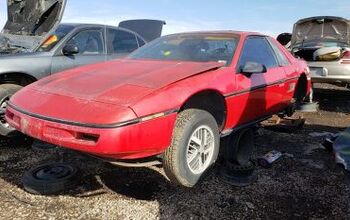
1988 Pontiac Fiero GT in California wrecking yard.

1988 Pontiac Fiero GT in California wrecking yard.

1988 Pontiac Fiero GT in California wrecking yard.

1988 Pontiac Fiero GT in California wrecking yard.

1988 Pontiac Fiero GT in California wrecking yard.

1988 Pontiac Fiero GT in California wrecking yard.

1988 Pontiac Fiero GT in California wrecking yard.

1988 Pontiac Fiero GT in California wrecking yard.

1988 Pontiac Fiero GT in California wrecking yard.

1988 Pontiac Fiero GT in California wrecking yard.

1988 Pontiac Fiero GT in California wrecking yard.

1988 Pontiac Fiero GT in California wrecking yard.

1988 Pontiac Fiero GT in California wrecking yard.

1988 Pontiac Fiero GT in California wrecking yard.
[Images: The Author]
Become a TTAC insider. Get the latest news, features, TTAC takes, and everything else that gets to the truth about cars first by subscribing to our newsletter.

Murilee Martin is the pen name of Phil Greden, a writer who has lived in Minnesota, California, Georgia and (now) Colorado. He has toiled at copywriting, technical writing, junkmail writing, fiction writing and now automotive writing. He has owned many terrible vehicles and some good ones. He spends a great deal of time in self-service junkyards. These days, he writes for publications including Autoweek, Hagerty and The Truth About Cars.
More by Murilee Martin








Comments
Join the conversation
Another example of 'a camel being a horse designed by a committee'.
When the Fiero was first unleashed on the public GM executives were still coasting on the brand loyalty that existed for GM in North America.
They believed that even though their 2 seater could not compete with the likes of the 2 seaters being manufactured/sold by Japanese companies, that the masses would still buy their product because it was from GM. So why not use cheaper parts and lacklustre interiors?
Is this like the Probe where this was supposed to be the "future sporty/muscle car" but fan loyalty and falling fuel prices crushed it? The Probe was somewhat successful comparatively (though I feel the name sounds way worse than it did in the 1990s)
Also strange considering GM badge engineering everything to death that there wasn't a Chevy or Olds version.