
Junkyard Find: 1959 Renault Dauphine
French cars have been junkyard rarities in North America for decades now, which is an ongoing disappointment for those of us who enjoy poring over machinery that ranges from fascinating to baffling in our local Ewe Pullets. I discovered a Mexican-market '06 Peugeot 407 in a Denver boneyard, earlier this year, and thought years would pass before the next time I'd hear the ghosts of André Citroën, Louis Renault, and Armand Peugeot singing La Marseillaise over a car graveyard.
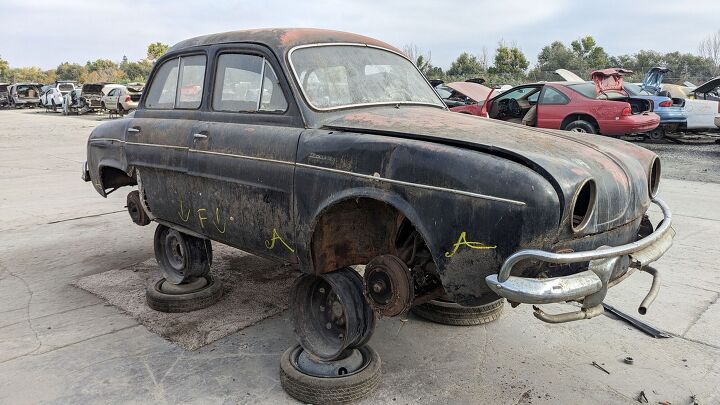
Then I learned that three Renault Dauphines had hit the regular inventory at the Pick-n-Pull in San Jose, California. I hopped a 737 out there soon after.

French cars were semi-mainstream vehicles in the United States for a good chunk of the 20th century, but their manufacturers began dropping out of our market during the last few decades.

Chrysler sold Simca 1100s (badged as 1118s and 1204s) in the USA through 1971. Citroën held out here until 1974. The final Renaults sold here were 1988 Medallions (though Renault HQ claims that we'll be able to purchase electric Alpine A110s here in 2027). Peugeot stuck it out until 1991, when the last new 405s hit American streets.

Of all those companies, Renault was the only one to score big-time North American sales success.

Taking over the American Motors Corporation in 1979 allowed Renault to sell Kenosha-built Alliances and Encores here (and to create the XJ Jeep Cherokee and very influential Eagle Premier), but the Dauphine climbed higher in the car-sales charts than any other Renault model to reach our shores.

Volkswagen was riding high in 1956, with more than 50,000 Beetles sold in the USA that year.

But then another rear-engined European import showed up, with a price tag similar to the Beetle's and two additional doors.

Not only that, the Dauphine's engine boasted water cooling, which added complexity compared to the 1930s-technology Beetle but made it possible to have a heater that worked (the Beetle's nearly-useless heater involved a heat exchanger on the exhaust, with associated danger of carbon monoxide in the passenger compartment).

In 1959, a new Renault Dauphine cost $1,645 (about $17,416 in 2023 dollars). Meanwhile, a new 1959 Beetle listed at $1,545 ($16,357 after inflation).

If you insisted on buying a new American-built car in 1959, AMC could get you into a Rambler business coupe for $1,821 ($19,279 now). If you wanted a new four-door car with a real heater that year, though, the Dauphine was by far your cheapest option.

My grandfather was doing a lot of ice racing in Minnesota when the Dauphine appeared in showrooms, so he bought one right away. It wasn't as quick on the ice as his Porsche 356-engined Beetle, but he held onto it until it rusted to nothingness (i.e., about five years later).

Renault sold plenty of Dauphines in the United States during the 1957-1960 period. During that time, it was the second-best-selling imported car in the nation, behind only the Beetle.

American Dauphine sales continued through 1966, but Renault never regained the sales glory it enjoyed here during the late 1950s.

There were multiple factors behind the decline of Dauphine sales at the dawn of the 1960s. One was the end of the Eisenhower Recession, which had forced car buyers to tighten their belts.

Another was the debut of the Ford Falcon as a 1960 model. The cheapest '60 Falcon four-door cost just $1,974 ($19,092 in 2023 dollars), and it was a genuine Detroit machine with a six-cylinder engine.

The Chevrolet Corvair also hit the scene as a 1960 model, and the four-door started at a mere $2,038 ($21,356 now). Plymouth's cheapest 1960 Valiant four-door had a $2,033 price tag.

To make matters worse for Renault and Volkswagen, BMC undercut both the Dauphine and the Beetle on price with the Austin Mini, which made its US-market debut as a 1960 model. It had only two doors, but cost just $1,295 ($13,570 today).

One advantage the Beetle had over its French rival was its standard four-speed manual transmission. The Dauphine had a three-on-the-floor manual until fairly deep into the 1960s.

The 1959 Beetle and its 36-horse, 1192cc boxer-four engine held the power edge over the Dauphine, which got 30 horsepower out of its 845cc straight-four. The Dauphine was lighter, but the Beetle still had the power-to-weight advantage.

For 1960, Renault began offering the Dauphine Gordini, which had an impressive 40 horsepower. One of the three Dauphines now residing at the San Jose Pick-n-Pull is a Gordini, and I'll write about it soon enough.

The blue 1960 Dauphine next to today's Junkyard Find will appear as a Junkyard Gem at Autoblog in the very near future. The Gordini is parked a couple of rows away, next to a Saab 95.

All three of those Dauphines were for sale on the SF Bay Craigslist site for months, with a price tag of $1,000 for the trio.

They had rusty bodies and sun-nuked interiors after sitting outdoors in Northern California for who-knows-how-many decades, but three Dauphines for a grand! Many of my car-freak friends in the Bay Area talked excitedly about buying them, but in the end, these now-rare French machines met a grim junkyard fate.

The Crusher awaits.
The "ruh-NALT" pronunciation was used by Renault USA for another decade or so.
Beep-beep! Wink-wink!

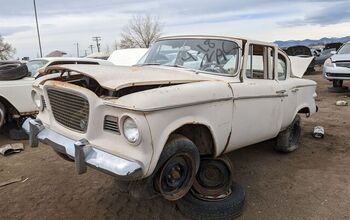
1959 Renault Dauphine in California wrecking yard.
Up to 40 miles to the gallon of gas.
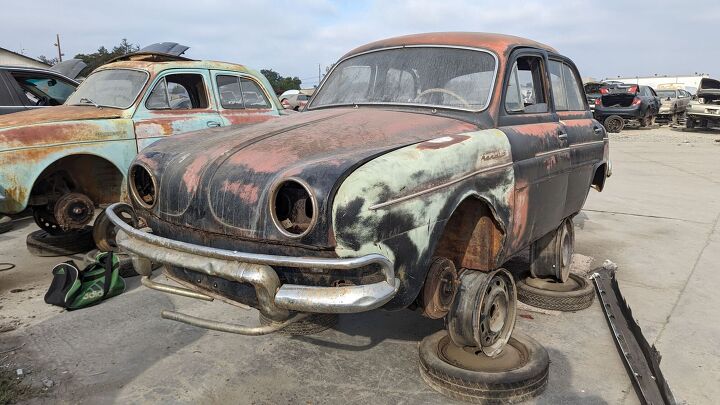
1959 Renault Dauphine in California wrecking yard.

1959 Renault Dauphine in California wrecking yard.

1959 Renault Dauphine in California wrecking yard.

1959 Renault Dauphine in California wrecking yard.

1959 Renault Dauphine in California wrecking yard.

1959 Renault Dauphine in California wrecking yard.

1959 Renault Dauphine in California wrecking yard.
[Images: The author]
Become a TTAC insider. Get the latest news, features, TTAC takes, and everything else that gets to the truth about cars first by subscribing to our newsletter.

Murilee Martin is the pen name of Phil Greden, a writer who has lived in Minnesota, California, Georgia and (now) Colorado. He has toiled at copywriting, technical writing, junkmail writing, fiction writing and now automotive writing. He has owned many terrible vehicles and some good ones. He spends a great deal of time in self-service junkyards. These days, he writes for publications including Autoweek, Hagerty and The Truth About Cars.
More by Murilee Martin








Comments
Join the conversation
When I was a kid....
there was a newspaper delivery man who drove a Renault Dauphine. He tied the door latch open with light rope so it wouldnt close and got out of the car to deliver the papers to each house. But the great part was that he left it in neutral when he got out and he let it roll. After he delivered a few papers he retrieved the rolling car and went on to the next set of houses. It was quite the feat of timing!
Yes it had a water-cooled engine for a much better heater than a beetle, BUT --
I had a 61, living in chilly Omaha. The engine, coolant and heater core are all in the back. The warm air (haha) was blown through a flattened insulation duct that ran under the car and then up into the front's heater inlets and defroster vents. If it was still warm by that time, and when it was REALLY COLD like it is in an Omaha winter, you might feel it. Otherwise you were scraping ice off the inside of the windshield and freezing your tail off.
I'm surprised the one sitting in the junk yard hasn't rusted completely away by now. Mine was close to dissolving by the late 60s when I traded it in on a VW and got $25 for it. Actually I had to beg them to take it because I had nowhere to put it.