
Rare Rides: A 1976 Pontiac Sunbird, Practical Malaise Luxury

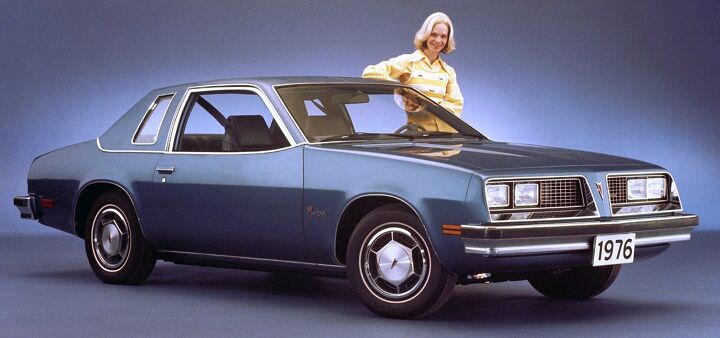
Today’s Rare Ride marks the third time we’ve featured a Pontiac Sunbird in this series. The first Sunbird was from 1978 and presented itself as the Safari Wagon. But that was just a renamed Astre and not a real Sunbird. The second Sunbird we saw was a convertible with a 2000 in its name, a J-body from a time of naming turmoil at Pontiac.
In contrast, the Sunbird we have here is the original: An economical and optionally luxurious car that debuted in the Seventies without a confused identity. Your author’s never seen one in real life.
Sunbird debuted in 1976 as a replacement for the Vega-adjacent Astre. The Astre and Sunbird coexisted for a couple of years, as seen above in the confused wagon from 1978. Though a new car, the Sunbird remained on the same H-body Vega platform as its Astre predecessor. Available only with two doors, the subcompact was presented only as a two-door sedan for 1976. The following model year added a more aggressive hatchback. For 1978 and 1979, the Astre wagon was refreshed visually joined the lineup as the Sunbird Safari Wagon. The first Sunbird continued through the 1980 model year but was limited to two body styles in its final offering.
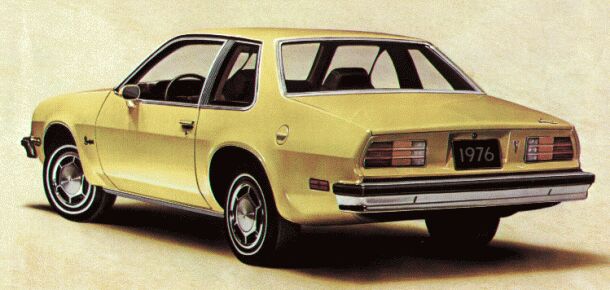
The rear-drive 1976 Sunbird was equipped with a base engine from the Vega, a 2.3-liter inline-four known as the 2300 (78 hp). The next year customers were rewarded with a new base engine: the powerful 2.5-liter Iron Duke. It produced between 84 and 90 horsepower dependent upon model year. Big spenders selected the Buick 3.8 V6 and its 110 horses, or the Chevrolet 305 (5.0L) as an option in 1978 and 1979. Transmissions on offer were a four-speed manual or three-speed automatic.
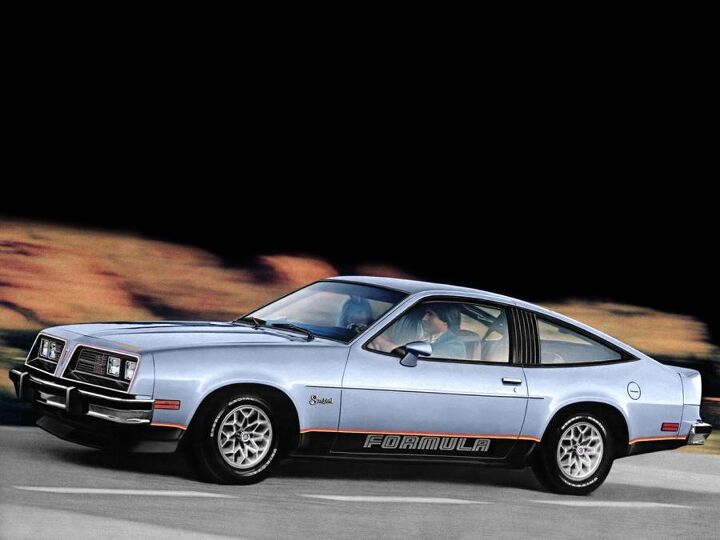
Customers could option their Sunbird with different packages to emphasize a luxury or sports personality. The Formula package was popular and included upgraded handling, spoiler, and decals. A quick seller, the Sunbird proved popular and GM sold nearly 480,000 Sunbirds over five model years. 1980 was a long-run year, as dealers needed inventory to hold them over until the ’82 arrival of the front-drive J platform J2000. It debuted at the start of Pontiac’s branding experimentation.
Today’s Rare Ride is firmly on the luxury end of the Sunbird spectrum. Dark red with a white vinyl coach roof, it’s got wheel covers, whitewalls, a plush velour interior, and an automatic transmission. There’s even V6 power and air conditioning. It’s traveled 17,000 miles since 1976 and is in spectacular condition. The price is also spectacular: $29,000.
[Images: Pontiac]
Interested in lots of cars and their various historical contexts. Started writing articles for TTAC in late 2016, when my first posts were QOTDs. From there I started a few new series like Rare Rides, Buy/Drive/Burn, Abandoned History, and most recently Rare Rides Icons. Operating from a home base in Cincinnati, Ohio, a relative auto journalist dead zone. Many of my articles are prompted by something I'll see on social media that sparks my interest and causes me to research. Finding articles and information from the early days of the internet and beyond that covers the little details lost to time: trim packages, color and wheel choices, interior fabrics. Beyond those, I'm fascinated by automotive industry experiments, both failures and successes. Lately I've taken an interest in AI, and generating "what if" type images for car models long dead. Reincarnating a modern Toyota Paseo, Lincoln Mark IX, or Isuzu Trooper through a text prompt is fun. Fun to post them on Twitter too, and watch people overreact. To that end, the social media I use most is Twitter, @CoreyLewis86. I also contribute pieces for Forbes Wheels and Forbes Home.
More by Corey Lewis






Comments
Join the conversation
Although the Sunbird (and the Monza) ended up as something of a replacement for the Astre (and the Vega) respectively, they (and the Starfire and Skyhawk )were originally intended to complete against other subcompact personal sporty cars, such as the Ford Mustang II and the Capri, as well as the Toyota Celica and the Opel Manta. Although I can't find written evidence to confirm it, I swear there were a handful of 1978 Pontiac Sunbirds built that used the Astre Hatchback bodyshell. They shared the Astre-derived front end-clip of the Sunbird Safari and were similar to the 1978 Chevrolet Monza 'S' Hatchback in concept.
Malaise, malaise, malaise!! Can we talk about the 70s and NOT use that ridiculous overused word? Every single article mentioning a 70s car now includes that stupid word. ENOUGH! By the way, this car looks great. I like it.