

Powerrr: Mopar Teases an Elephant-sized Crate Engine

Are you ready for a Dodge Omni R-GLH? (Really Goes Like Hell)? Okay, maybe this new engine won’t fit between the fenders of an old Chrysler subcompact, but it will probably plug quite nicely under the hood of your 1970 ‘Cuda.
As is Fiat Chrysler’s wont, they’ve left us plenty of clues over which to mull. All of them point to one thing – a return of the 426 Elephant engine.
First, a bit of history. Chrysler roared (literally) into Daytona in 1964 with a racing version of the engine shoehorned into a Plymouth Belvedere. It was so fast, NASCAR outlawed the thing for 1965. Racers dubbed it the “elephant engine” thanks to its massive amounts of power and weight. Yeah, the thing weighed more than most small moons, apparently.
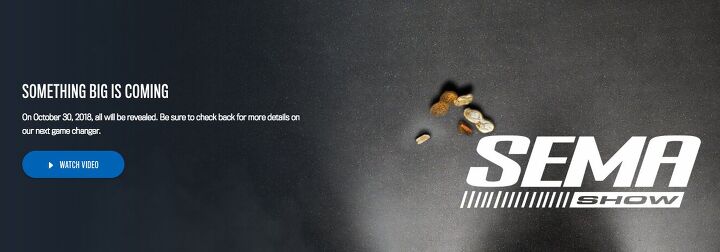
Earlier this week, Mopar dropped a teaser video showing two enormous footprints stomping over what appears to be Hellcat claws, followed by the sound of a lumpy cam and smoky burnout. A quick trip to the Mopar website brought up the image of the SEMA logo with a few peanut shells scattered around it, promising “something big” on October 30th.
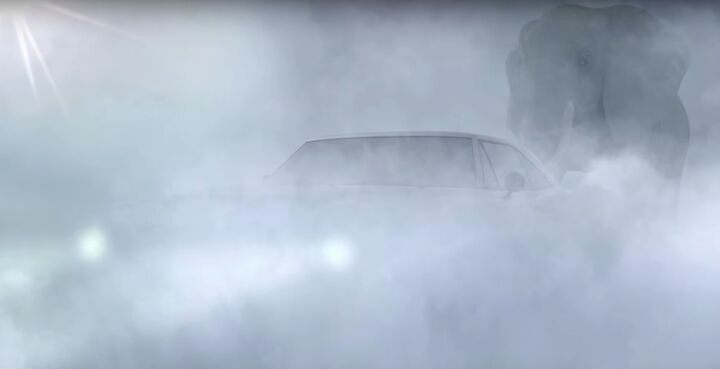
All doubt was removed today, when Mopar announced on Twitter they will be timing their press conference at SEMA for – ready for this? – 4:26 p.m. local time. Yeah, sure, Mopar news has been announced at that exact time in the past; this time we don’t think it’s a coincidence. Also, check out the newest teaser video below, which shows images of an elephant through a haze of tire smoke.
Let’s figure this out using math skills I’ve not deployed since high school. Gearheads know that both the SRT 6.4-liter and Hellcat 6.2-liter share a bore diameter of about 4.09 inches. It’s only the stroke that’s different, which makes sense in order to cut down on production costs by using the same (size) pistons.
Next, break out your geometry books and recall the formula for calculating the volume of a cylinder, which is 3.14 x bore2 x stroke)/4 for all you losers who were asleep in the back row. Taking a displacement of 426 cubes and dividing it by 8, and since we know the common bore size of 4.09, all one has to do is use that figure and solve for stroke (make your lewd jokes here).
It all works out to a stroke of somewhere in the neighborhood of 4.05 inches. Since this is a crate motor, there’s no need to muse over whether it’ll fit under the hood of a modern-day Challenger without the need for tin snips. That’s the installer’s problem. If it stomps a Hellcat, as indicated in the original teaser, expect it to be rated in the 1,000 horsepower range.
I’d still like to know how we can make it fit in the engine bay an Omni, however.
[Images: Mopar]
Matthew buys, sells, fixes, & races cars. As a human index of auto & auction knowledge, he is fond of making money and offering loud opinions.
More by Matthew Guy








Comments
Join the conversation
Dodge would probably be better off increasing the bore if at all possible. One of the problems with increasing the stoke on the engine is that the overlap between the throw and the main journal decreases and reduces the strength of the crank which invites flexing and vibration as well as the possibility of an increased rate of failure (then again a bore that is too thin will invite flex as well and cause ring seal integrity issues and possible block failures). Plus the added stroke will increase friction on the bore surface unless they put a longer rod in the engine which can effect the piston pin location and cause piston issues as the ring pack is forced upward or intersects with the pin bore creating its own set of problems. Not to mention piston speed goes up and dwell time at TDC goes down unless they opt for a longer rod as well. It will be interesting to see how Dodge tackles the issue and what trad eoffs they will be willing to accomodate in pursuit of thier goals.
There's no need to increase displacement above 6.2l to get 1000hp reliably. There are plenty of lightly modded Coyotes (5l) making 700+hp reliably. Heck, there are 2l turbo engines that easily make 1000hp. Admittedly, Coyotes have 32 valves compared to 24 for the Hellcat but that isn't a fatal obstacle. With forced induction, how much power you can make mostly comes down to block strength, crank strength, rod strength and cooling. So I think with a bigger radiator, bigger intercooler, stronger internals, coated headers and a smaller supercharger pulley it would not be hard for them to put out a factory 1000hp Hellcat. Edit: it may be harder to get emissions compliance with the more heavily booster engines without increasing displacement but I still think it's possible.