

2025 Aston Martin Vantage Review -- The Baby Aston Grows Up


Aiming for the established leaders in an automotive segment is a noble ambition that rarely pays off. Cadillac, for example, has been chasing the ghost of BMW’s M Division for more than two decades, and even with the objectively better-driving CT5-V Blackwing on the roster, the M5 remains the defacto standard-bearer for full-size sports sedans to this day.
Before taking a spin in the new DB12 Volante earlier this year, an Aston Martin representative explained to me that performance is taking on a much bigger role in their vehicle development than it ever has before. As a result, the British automaker now has its sights set on Lamborghini and Ferrari rather than Bentley.

Lofty targets, to be sure – especially for a brand that has bet heavily on its design prowess to outshine its dynamic and technological shortcomings in recent years. But after getting some seat time in that drop top, the updated DBX707 sport-utility, and now the refreshed Vantage, I’m now convinced that this isn’t just marketing bluster. The Vantage is considered Aston Martin’s entry-level machine, but with a starting price of $191,000 ($287,400, as-tested), expectations are inherently high. Fortunately, Aston Martin appears to firing with both barrels these days.
The changes are evident even at a glance thanks to a body that’s 30 mm wider than the outgoing car, along with the redesigned front end that features a grill opening that’s nearly 40 percent larger to enhance cooling. Twenty-one-inch forged wheels wrapped in model-specific Michelin Pilot Sport S 5 summer tires add to the performance-focused glow-up, as do the massive brakes, which are equipped with the optional carbon ceramic discs on this tester.

Underneath the skin, Aston says that increased lateral strengthening between the rear suspension towers has resulted in a 29 percent increase in stiffness under cornering load. Bilstein DTX adaptive dampers, an electronically-controlled rear differential, and revised stability and traction control systems – the latter of which offers nine levels of adjustment – are also on board to sharpen the Vantage’s dynamic behavior.
The good news continues under the hood, where the AMG-sourced 4.0-liter, twin-turbocharged V8 now boasts a hearty 656 horsepower and 590 pound-feet of torque, gains of 153 hp and 85 lb-ft over the outgoing car. Paired with a ZF eight-speed transaxle, Aston conservatively estimates that the new launch control system can vault this rear-wheel drive, 3,800-pound coupe to 60 mph from rest in 3.4 seconds on its way to a 202-mph top speed.

That’s all good news, but I’d argue that some of the most important changes are in the cabin, where the Vantage – like all of the latest Astons – is no longer saddled with some other automaker’s outdated technology. Instead, the company decided to develop an all-new system in-house, and the result is a sharp, responsive interface with a 10.25-inch touchscreen display that supports wireless Apple CarPlay and Android Auto. Aston also intends to support the next generation of CarPlay, which will reportedly extend the screen mirroring software’s control to other displays in the vehicle, whenever Apple makes that available.
Despite the clean-sheet approach, Aston Martin wisely chose to retain physical controls for often used features like audio volume, fan speed, and temperature adjustment rather than integrating those adjustments into the infotainment software. The layout is intuitive and allows for immediate, tactile access to important features without resorting to an overwhelming array of buttons and knobs. The knurled barrel-style dials are particularly pleasing to use, offering a just right amount of resistance to feel substantial and high-quality. I did find myself wishing that the transmission’s manual mode was tied to a physical movement of the shift nub rather than a nondescript button that’s outside of your line of sight while driving (an issue that’s exacerbated by the digital gauge cluster’s unnecessarily small font sizes when you want to visually confirm that the mode did indeed change), but hey, you can’t win ‘em all.

The boosted V8 comes to life with an authoritative baritone growl. While the Sport+ and Track modes ramp up the powertrain’s urgency as well as the stiffness of the dampers, Sport is the Vantage’s default drive mode. This was undoubtedly done to set expectations – around town, the suspension is stiffer than you might expect, leaning more toward 911 GT3 rather than Turbo territory in terms of body control, but harshness is kept to a relative minimum.
A nose lift system isn’t available despite the hunkered-down stance and the new integrated front splitter, but with some mindful navigation of steep driveway aprons, I was able to avoid chewing up the carbon fiber. The standard heated and ventilated sports seats are reasonably comfy, too, though if it were my money, I’d probably spring for the optional Carbon Fibre Performance Seat for the additional lateral support, given the suspension stiffness, available grip, and overall mission of the car. Due in part to relatively docile transmission behavior in the default drive mode, you could certainly still daily drive a Vantage if you wanted to. I doubt many owners will actually do that, though, so you might as well embrace the premise of this earnestly-tuned sports car.
2025 Aston Martin Vantage Fast Facts
Powertrain | 4.0-liter twin-turbo V8 (656 horsepower @ 6,000 RPM, 590 lb-ft @ 2,000-8,000 RPM) |
Transmission | Eight-speed automatic |
Fuel Economy, MPG | 15 city / 22 highway / 18 combined (EPA Rating) |
Fuel Economy, L/100km | 15.3 city / 10.5 highway / 13.1 combined (NRCan Rating) |
Base Price | $191,000 (U.S.)/ N/A (Canada) |
As-Tested Price | $287,400 (U.S.)/ N/A (Canada) |
Disclaimer | Prices include $3,500 destination charge in the United States. The D and D does not appear to be available in Canada. |
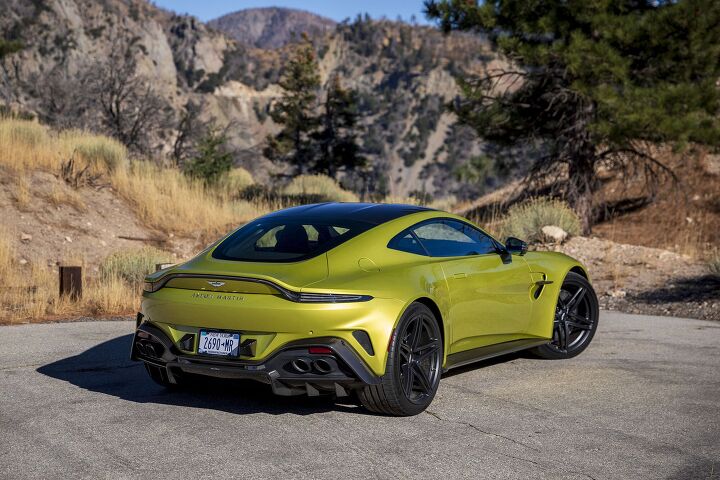
Out in the canyons, the newfound power and rowdy V8 soundtrack give this car a ton of grin-inducing character. There’s an incredible amount of shove just about everywhere in the rev range; turbo lag is essentially non-existent over about 2,500 RPM. Thankfully, there’s also plenty of stopping power on tap with nicely balanced response throughout the pedal’s travel.
Body motions are also admirably well controlled even when hustling the car in the suspension’s softest setting. The Sport+ damper setting might come in handy if you’re really, really caning it on well-maintained tarmac, but I found that it ended up causing the suspension to bounce over mid-corner bumps in technical sections rather than absorb them, and the Track setting is genuinely appropriate for the kind of consistent pace that’s only really achievable on a road course.

Though it’s admittedly still a half-step behind the best in the segment in terms of dynamics, the updates applied for 2025 improve the Vantage formula in just about every measurable way. While the overarching ethos is more about delivering an engaging driving experience rather than jaw-dropping lap times, this revamp will surprise a lot of well-heeled performance junkies who might’ve dismissed the Vantage in favor of the usual suspects. Now if Gaydon could just get a manual gearbox on the options sheet…
[Images ]
Become a TTAC insider. Get the latest news, features, TTAC takes, and everything else that gets to the truth about cars first by subscribing to our newsletter.
More by Bradley Iger









Comments
Join the conversation