
What The 'E' on a VW Manual Shifter Actually Means

If you have ever climbed into an early '80s Volkswagen and found a capital E sitting where fifth gear usually lives, the letter is not a decoration and it has nothing to do with electrification. In Volkswagen's '3+E' and '4+E' gearboxes, the E marks an overdrive slot, a tall ratio designed to drop engine speed, cut wear, and boost fuel economy at highway cruising speeds. You engage it the same way you would any other gear: row up through the numbered gears as the car gathers speed, then slot it into E once you reach the open road.

As for what the letter stands for, drivers at the time guessed liberally. Many assumed it meant "Economy" or an "Extra" gear, which is close enough in spirit but wrong on the badge. Volkswagen's own documents confirm the E stands for "Efficiency," and Car and Driver has backed the same reading for older manual-equipped German cars.
Blame the oil crisis. Stricter fuel economy rules took hold during the oil crunch of the late 1970s and early 1980s, and automakers had to engineer their way out of trouble. Volkswagen's answer was a dedicated manual gearbox whose topmost shift gate carried a capital E.
The approach was not entirely new. Earlier British and European cars often bolted an external electro-hydraulic overdrive unit, like the Laycock de Normanville system, onto the back of a conventional gearbox, flipped on by a dash switch or a stalk on the column. Volkswagen did it differently. It built the tall overdrive ratio directly into its front-wheel-drive transaxle casing and moved the control onto the shift lever. No extra box hanging off the back, no separate switch. Just another gate on the H-pattern.
Mechanically, a car with a 3+E or 4+E transmission drives like any other manual. You row through the gears as the vehicle builds momentum. The difference is only at the top of the pattern.

With a 4+E, you shift first through fourth, then engage E on the highway. With a 3+E, you move from first to third before dropping into E. In both cases, E is the cruising gear, the one you hold at speed rather than one you accelerate through.
The benefit is straightforward engine physics. Engaging E reduces engine rpm while mitigating pumping losses, the energy an engine wastes drawing air in and pushing exhaust out. Reducing those losses lets the engine breathe more efficiently and saves fuel. Pumping loss climbs with engine speed, so dropping revs pays off directly. Running at lower rpm also reduces engine wear and makes for a quieter ride.
The U.S.-spec Rabbit is the clearest case study. For 1981, the Rabbit gained a longer-stroke 1.7-liter four-cylinder and a gearbox Volkswagen called the 3+E manual. That gearbox was essentially the previous year's four-speed converted to three gears plus an E overdrive, and both the carryover four-speed and the new 3+E kept an identical 3.89:1 final-drive ratio.
The numbers tell the story. The E gear carried a 0.70:1 overdrive ratio feeding that 3.89:1 final drive. In E, engine revs dropped to 2,500 rpm at 60 mph. That taller gear lifted city fuel economy from the four-speed's 24 mpg to 28 mpg, an EPA-verified figure for the 1981 Rabbit that bettered its predecessor's 24 mpg. On the highway, the Rabbit in E reached 42 mpg.

There was a tradeoff. The E gear was built for holding a steady speed, so accessing full engine power meant downshifting out of it. You could not floor it in overdrive and expect much. The lower three gears carried the work: roughly 90% of city and back-road driving fell to first, second, and third. E existed for one job, and it did that job well.
In Europe, the E gear was the centerpiece of a broader fuel-saving trim. Volkswagen rolled out "Formula E" (Formel E in German) across its entire European lineup between 1981 and 1985. This predates the modern battery-powered racing series by decades; VW's Formula E was about efficiency, nothing to do with electric race cars.
The package was broad. You could get Formula E on the Polo, Golf, Jetta, Scirocco, Passat, and Santana, plus the Audi 80 and 100 of that era. It paired the 4+E transmission with mild aerodynamic refinements and an early kind of driver coaching. That coaching was the clever part: an electro-vacuum computer compared engine load with rpm, then flashed an amber arrow on the gauge cluster, prompting the driver to upshift for best efficiency.
The Mk1 Golf got in early. Some markets offered a Formula E version of the Golf for the 1981 model year, pairing the 3+E manual with a shift indicator, a readout for fuel use, and a slipperier body that trimmed the drag coefficient. In 1983, VW added an optional 4+E manual to certain diesel and gasoline Golf variants, basically a four-speed paired with an efficiency-minded overdrive top gear.

The rule is simple: use E for cruising, not for accelerating. The E position acts like a taller extra gear and helps most on highways and open roads, where its tall overdrive ratio keeps the engine spinning slowly and burning less fuel. Around town, stick to the numbered gears. In a 3+E, that means first through third do nearly all the stop-and-go work. In a 4+E, run up through fourth before reaching for E.
Treat E as a steady-state gear. If you need to pass, climb a grade, or pull away briskly, downshift back into a numbered gear for the power, then return to E once you have settled into a cruise. Trying to accelerate in overdrive just lugs the engine and defeats the purpose.
The 3+E and 4+E setups had a short run. After 1985, a wave of newer technology pushed them aside: electronically controlled multi-point fuel injection, variable valve timing, and standardized five- and six-speed manuals. Engineers found ways to squeeze out better everyday fuel economy without hurting drivability or saddling drivers with huge gear gaps. A proper five-speed with closer ratios beat a three-speed-plus-overdrive on nearly every measure, so the compromise gearbox had no reason to survive.
The manual itself has since become a niche interest in North America. Fewer than one percent of new U.S. vehicles sold in 2024 had a manual, even as the gearbox remains popular in countries like China and India. The decline tracks with newer, thriftier engines that lean on variable valve timing, cylinder deactivation, direct injection, and turbocharging, along with more competent automatics like CVTs and dual-clutch units.
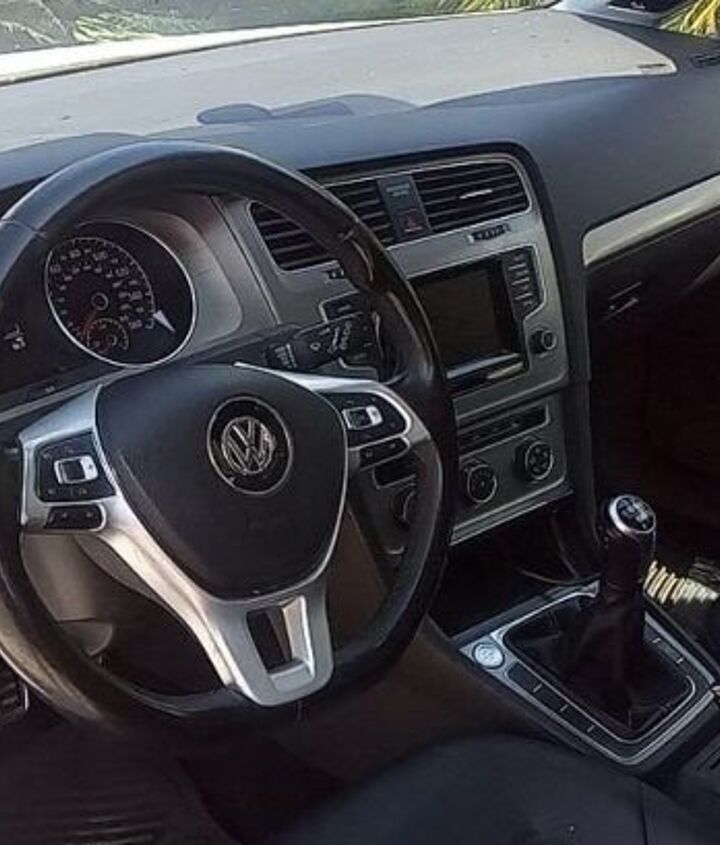
If you want to experience an E gear for yourself, look to the original Golf, Jetta, and U.S.-spec Rabbit, the models that carried the 3+E and 4+E setups. The 1981 Rabbit LS is the quintessential example, basically a four-speed casing spaced out wider. Just know that these obscure manual overdrive systems from the 1980s are becoming increasingly rare, so a clean example is a find worth checking the shift gate on. If the top slot wears an E, you now know exactly what to do with it.
[Images: Volkswagen, Heritage Parts Center]
Become a TTAC insider. Get the latest news, features, TTAC takes, and everything else that gets to the truth about cars first by subscribing to our newsletter.

More by TTAC News Staff






Comments
Join the conversation
It stands for Expensive.
That's a lot of words to say it's just a top gear with a different label on the shifter.