


Any Electric Mazda Will Actually Be a Toyota
Of all automakers, no company holds out hope for the gasoline engine’s longevity quite like Mazda. Not only does Mazda anticipate many decades of continued hydrocarbon-fueled driving, it’s also ensuring gas stays viable by inventing a new Skyactiv engine that (supposedly) uses much less of it. That motor, a first-of-its-kind gas compression ignition four-cylinder, debuts in 2019.
For now, Mazda’s North American lineup remains pure in terms of propulsion. The promised CX-5 diesel is taking its sweet time showing up, and neither a hybrid or EV can be found among the model ranks. That will soon change, but given Mazda’s size and finances, it won’t be a Mazda platform underpinning the next Mazda EV.
Back in August, Toyota announced it was acquiring a 5-percent stake in its Japanese rival, with the two companies consummating their new relationship with a plan for a $1.6 billion U.S. assembly plant. The joint venture would focus on sharing EV technology and building vehicles for the North American market. Now, we know a little more about that plan.
Announced late last week, Toyota, Mazda and Denso Corporation have signed an agreement to “jointly develop basic structural technologies for electric vehicles,” with the effort carrying a new corporate name: EV C.A. Spirit Co., Ltd.
Toyota is fronting 90 percent of the bill, with Denso and Mazda ponying up the remaining 10 percent.
Acknowledging that many automakers don’t have billions to toss around at every automotive tech trend, Toyota said the three companies will work on architecture capable of “covering a wide variety of vehicle segments and types to ensure flexible and rapid response to market trends.” EVs still represent a tiny slice of the market pie, but it’s a growing one. With governments the world over cracking down on vehicle emissions, Toyota feels the investment is worthwhile.
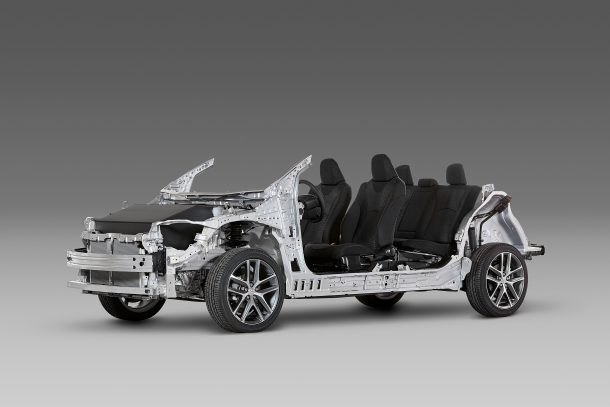
For Mazda, it’s a guarantee the automaker won’t be left in the technological dust if the EV scene really takes off. Headquartered in Japan, the new company brings together Denso’s electronics technologies, Mazda’s “bundled product planning and prowess in computer modeling-based development,” and Toyota’s versatile TNGA platform (found under the 2018 Camry). This means any future EV with a Mazda badge will have Toyota bones under its clothes.
Vehicle swapping between the two brands isn’t new. The Toyota Yaris iA is simply a badge-engineered Mazda 2. However, the two brands’ identities are quite different, with Mazda being seen as the sportier, more driving-focused of the two.
Clearly worried that consumers might anticipate the watering-down of the brand, Toyota claims the two companies “intend to focus their resources on fundamental vehicle values to enable the creation of appealing EVs that embody the unique identities of each brand and avoid the commoditization of EVs.”
In other words, a Mazda EV won’t have the driving dynamics, or appearance, of a engineless Toyota Prius C. The brand’s design language should remain intact, even with an electric powertrain and Toyota chassis.
Toyota claims the common architecture should be capable of underpinning electric SUVs and light trucks, as well as passenger car configurations. While no new timeline details emerged from the announcement, Toyota has already stated the joint assembly plant will be in operation in 2021.
[Image: Toyota]

More by Steph Willems









Comments
Join the conversation
Sergio is FUMING.
Mr Willems, the SkyActiv X engine is NOT pure compression ignition. By now you should have read the C/D article on the engine - it's been up for over two weeks. The engine is dubbed SCCI, Spark Controlled Compression Ignition. Worth learning how it works because it may well be important. All these EVs being released for sale make me laugh. Where's the market? It'll take years and years to develop, and meanwhile all the snobs with money will drive Elon Musk's dream and be so self-satisfied, it'll be sickening to watch them prat about acting smug. Wait, that's happening already. As Bloomberg said today, Tesla has $10 billion in loans and not 10 cents in profit.