
2026 Subaru Outback Wilderness Review -- Not Just An Appearance Package
Extra-outdoorsy trim levels are all the rage these days. More rugged styling bits are a must, while all-terrain tires represent the bare minimum amount of effort to increase actual capability.
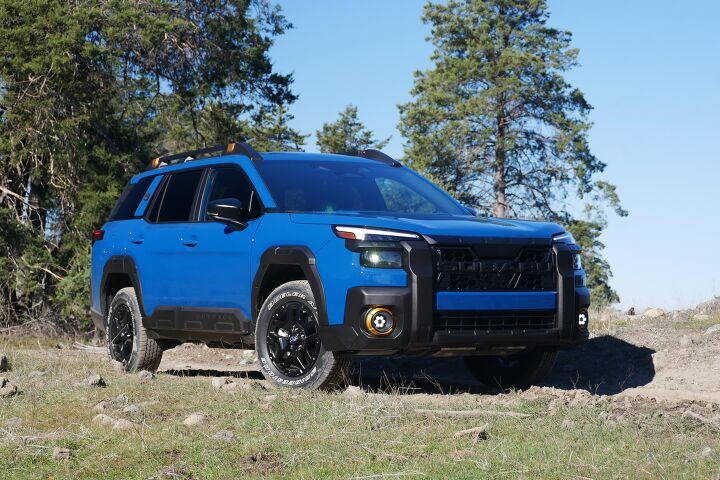
The redesigned, 2026 Subaru Outback Wilderness checks off both of those boxes (perhaps too aggressively when it comes to styling), but like its predecessor, this extra-outdoorsy trim level goes so much further than glorified appearances packages like the Honda CR-V TrailSport or Hyundai Tucson XRT. It’s the real deal.


Subaru also has plenty of data that shows that owners have actually been using the previous-generation Outback Wilderness for its intended, more rugged purposes. Off-road capability is a priority for 70 percent of its buyers – versus about 30 for both the regular Outback and other midsize SUVs. Frequently going off-road and taking road trips to get there are more common, too, as is partaking in outdoor activities like hiking, camping, and fishing. Sixty percent own dogs.
In many respects, the changes made to every 2026 Outback should better serve the Wilderness’ distinctive subset of buyers, especially its updated all-wheel-drive system, greater cargo capacity, and stronger, more functional roof rails. Yet, the Wilderness once again pushes the outdoorsy envelope.
Ground clearance is jacked up to 9.5 inches from Subaru’s standard lofty height of 8.7, while the approach, departure and breakover angles are improved. If that’s not enough to avoid an underbody impact, there’s an aluminum-alloy engine plate added. The special 17-inch matte black wheels are wrapped in Bridgestone Dualer all-terrain tires with raised white lettering (the outgoing Wilderness had Yokohama Geolanders). The suspension is also unique, as the Wilderness gains electronically controlled dampers, though more on those later.
The X-Mode off-road drive mode system that features one, “Snow/Dirt” setting in other trims gains a Deep Snow/Mud setting in the Wilderness.

Visually, the Wilderness gets even greater differentiation from the standard Outback. Subaru describes the front end as having an “off-road, truck-like grille” with its prominent vertical bars and “SUBARU” spelled out in place of the usual Pleiades badge. There are also gold-trimmed LED fog lights. It’s not a good-looking vehicle, though one hopes that creating one wasn’t the goal. Expressing the rough-and-tumble mission seems more like it.
The rear end isn’t exactly eye-pleasing, either. The tailgate’s gold-trimmed reverse lights and seemingly strange black plastic strips add visual clutter, but at least the latter serve a functional purpose. They’re “equipment rests” for snowboards, skis, and surfboards. There’s also now an accessory 2-inch hitch available that’s intended more for installing bike racks than satisfying the meh 3,500-pound towing capacity. Moreover, it’s accessed by a new removable panel in the bumper – dealers used to have to cut into the bumper, which they often did quite poorly.
(Full disclosure: Subaru flew me to Sonoma County, California, and fed and housed me for two nights so I could drive the Outback Wilderness).
The Wilderness comes standard with the Outback’s upgrade engine: a 2.4-liter turbocharged horizontally opposed four-cylinder that produces 260 horsepower and 277 pound-feet of torque. It has a continuously variable transmission (CVT), which slurs through kinda-sorta gear-like steps while accelerating and offers eight ratios that can be manually selected with paddle shifters. They proved unimpressive when on a steep downhill grade – even second “gear” was too tall to effectively slow the car without the brakes.

Having driven an Outback with the standard, 180-hp, non-turbocharged engine just before jetting off for Sonoma County, I can confirm that the added oomph is appreciated. It rapidly gets up to highway speeds with much lower effort and therefore noise from the engine. The same is true when traversing mountainous terrain. Low-speed behavior is actually pretty similar, be it around town or on a trail.
Fuel economy only drops to an EPA-estimated 23 mpg combined from the other turbo Outbacks’ 24 mpg combined estimate. It also returns an estimated 21 mpg city and 27 mpg highway.
The rest of the driving experience is indeed greatly improved from the prior generation, which rolled too much and had ultra-vague steering that verged on spooky. While there remains a yaw delay when moving the wheel side to side when driving straight, the steering no longer feels as compromised by the all-terrain tires. That, along with every new Outback’s tauter steering on center, has eliminated those spooky moments.
The excessive roll was addressed with electronically controlled dampers that adapt themselves based on data from various dynamic sensors. Body motions are reduced on-road compared to the floppy old Wilderness and, apparently, other 2026 Outbacks (at least according to Subaru, it was tough for me to tell). Ride comfort and wheel travel off-road are also increased to a degree that makes the new Outback Wilderness’ ride shockingly good when driving on dirt roads. It’s actually almost as good as the on-road ride, which still suffers from nervous and occasionally harsh reactions from the hard all-terrain rubber.
Indeed, unless you’re routinely driving on dirt roads, I’d strongly recommend swapping onto all-season rubber once the stock all-terrains wear out. Doing so would certainly improve the ride and probably the steering and handling as well, possibly beyond the standard Outback setup.

On slower, muddier off-road terrain, the Wilderness proved plenty capable. There was no doubt that the almost absurd amount of ground clearance (9.5 inches is pickup territory) made a difference in spots where I was bracing for impacts that never occurred. I would categorize the trails we traversed as being typical for people who go off-road for the purposes of getting somewhere off-road (as opposed to off-roading for the sake of off-roading). I’m virtually certain the CR-V TrailSports and Tucson XRTs of the world would literally have been stuck in the mud, whereas the Outback Wilderness went everywhere that a Jeep Wrangler Rubicon chase vehicle did.
I also appreciated that the forward-facing camera can stay on when the car is in an X-Mode up to between 10 and 12 mph (Subaru was still finalizing the programming during the drive program). They shut off once you go above its speed cutoff (as do the X-Modes, which are limited to 25 mph), but automatically come back on again when you go back below. By contrast, various Toyota off-roaders have a 9-mph threshold, and it’s surprising the difference that 1-plus mph can make in the camera constantly blinking off and on.
I’m happy to report that the build quality issues that Tim reported during the 2026 Outback First Drive were not present in the Wilderness test vehicle, nor the Outback Touring I tested the week prior. Turns out they were indeed pre-production issues. Materials quality remains just OK in the Wilderness, and I can’t see why someone would need to opt for the Wilderness’ newly optional leather interior upgrade when the standard StarTex fake leather is water-resistant, easier to clean, and should wear better.
If anything, it would be nice if Subaru did more to visually differentiate the cabin. The unique, Mars-looking background image for the instruments and touchscreen are nice, but otherwise, there are just two token bits of gold plastic on the wheel and shifter, and Wilderness badges on the headrests and all-weather floor mats. What about a special StarTex color, perhaps, such as Toyota offers with its TrailHunter models?
See More Photos Of The 2026 Subaru Outback Wilderness


As someone who thoroughly tests the cargo areas of every new vehicle that passes through my garage, I can confirm that the new Outback can indeed hold more stuff in its boxier, more easily loaded cargo area. There are also clever features like the multi-function fabric cargo cover, multiple utility hooks with a six-pound capacity, and the Wilderness’ unique “equipment rest.” The raised roof rails also have steel loops on each end that make it easier tie kayaks and other gear down with. The rails have the same hefty weight capacities as those of other Outbacks.
Pricing for the 2026 Outback Wilderness starts at $44,995, which is just a few hundred more than the turbocharged Limited XT trim and $3,000 less than the range-topping Touring XT. That said, there are two optional packages. One, for $2,045, adds a sunroof, navigation, and the surround-view parking camera. The other, for $4,090, makes the Wilderness the most expensive Outback thanks to all of the above extras plus leather upholstery, ventilated front seats, extra driver seat adjustments, and a power passenger seat. Every Outback is now built in Japan instead of Indiana, and will arrive in dealers soon.
When it does, all those extra-outdoorsy buyers should find that the 2026 Outback Wilderness doesn’t suffer as much on-road for its increased off-road capability. The old one was compromised enough that I would’ve recommended that most buyers avoid it. That’s no longer the case, even if swapping to all-season tires would be a good idea for buyers who don’t routinely drive on dirt roads.
[Images © 2026 James Riswick/TTAC.com]
Become a TTAC insider. Get the latest news, features, TTAC takes, and everything else that gets to the truth about cars first by subscribing to our newsletter.

James Riswick has been testing and reviewing cars since 2007, serving as an editor at Edmunds and Autoblog, and contributing to Autotrader, Car and Driver, AutoGuide, Auto Express, and Capital One Auto Navigator. You name it, he’s almost certainly driven it. He has attended an auto show every year since he was 2 and wanted to be an automotive journalist since high school. He owns a babied 1998 BMW Z3 2.8 in James Bond blue, a silver 2013 Mercedes-Benz E350 Wagon (his idea of a three-row family vehicle) and a 2025 Cadillac Optiq because his wife would rather drive something from this decade.
More by James Riswick







Comments
Join the conversation
As a Gen 6 owner I shared the impressions of many here when photos of the non-Wilderness Gen 7 Outback started appearing last fall. Too tall, too blocky, ugly cladding etc. However, most photos were from the "road kill" perspective, which too many car photogs still use.
I came out of an appointment yesterday to find a new Outback parked beside my 2021 and in the same colour. I sized it up as nonchalantly as possible and found that it looks much better from the altitude of someone old enough to have a drivers license. It appears to be very close to the same height and length as the Gen 6, and the cladding, at least on a white non-Wilderness model, didn't trigger my gag reflex, which is an improvement over the 2023-25 Outbacks. Close up it comes across as a low SUV, similar to the early years of the Saturn Vue.
I had written Subaru off as a replacement for my current XT, but will reconsider now, especially if James is correct that they are assembled in Japan. (This is an assembly quality opinion, not a political statement.)
Regarding the Wilderness model, who buys these? The higher ride height makes the wheels look under-sized and the extra plastic doo-dads are silly. Outbacks are quite common in my area, but Wildernesses are very rare, thankfully.
Why does it have to be so ugly?!
Also the Outback now looks like the same footprint as the Forester.