


2025 Polestar 4 Review -- Sporty And Relaxing

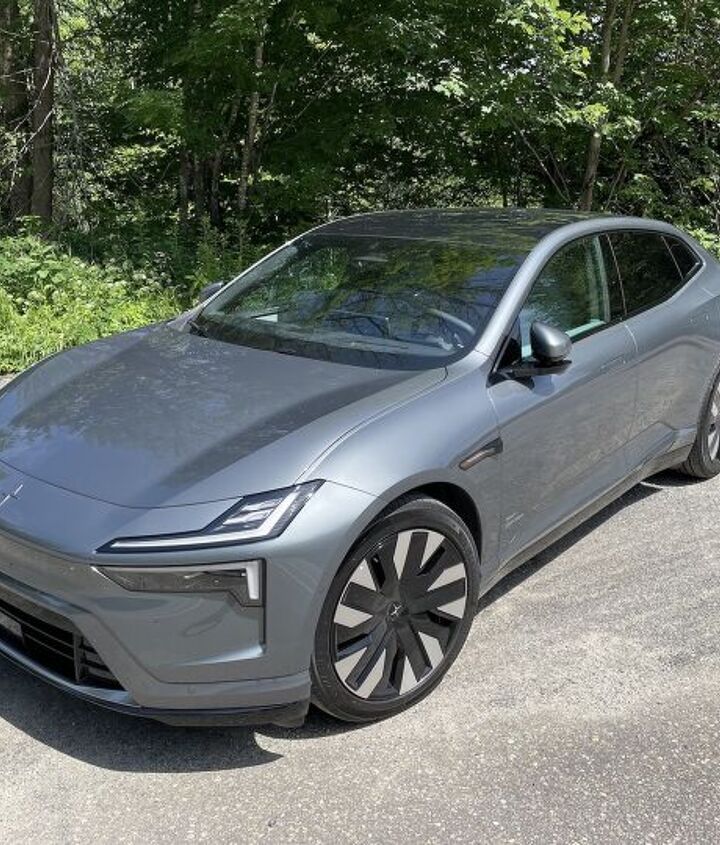
Polestar got its start as a Swedish racing team in the 1990s. It then became a Volvo tuner, and was purchased by Volvo in 2015 and turned into the functional equivalent of a BMW M or Mercedes AMG performance arm for the brand. It’s now its own EV company, with ties to both Volvo and the Chinese company Geely, but its performance tradition carries on.
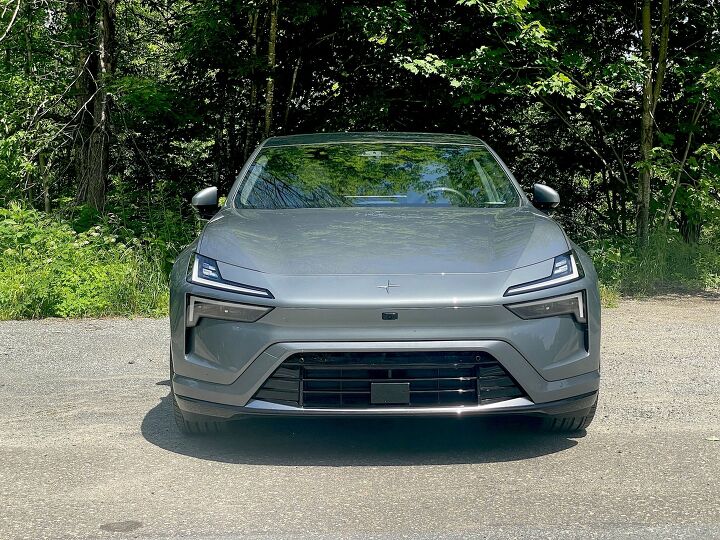
The 2026 Polestar 4 I’m driving in and around Montreal mixes relaxation with performance. It offers the calm, quiet experience of an electric vehicle, but it’s also sporty looking, powerful, and tuned for performance.
While the Polestar 4 may look like a coupe version of the Polestar 3 crossover SUV, it’s not. The fourth vehicle in the Polestar lineup (thus the name), the Polestar 4 is indeed a coupe-like crossover SUV, but it doesn’t share the Polestar 3’s SPA2 platform. Instead, it’s based on the Sustainable Experience Architecture from Chinese parent company Geely. Still, it feels like it was made for Polestar.
I’m driving a Long-range dual-motor model with the Plus Pack. That means this isn’t the sportiest version in the Polestar 4 stable. That’s reserved for models with the Performance Pack. However, it still feels damn sporty to me.
(Full disclosure: Polestar flew me to Montreal and fed and housed me so I could drive this car.).

The most prominent element of that sportiness is power. The dual-motor powertrain uses front and rear 200-kilowatt (272-horsepower) permanent magnet synchronous motors to produce a total of 544 horsepower and 506 pound-feet of torque. Whether the motors are in their base Range mode or the friskier Performance mode—both chosen via the infotainment screen—they provide easy, willing, and immediate power, and passing is a matter of a slight twitch of my right foot. The 0-60 mph sprint flashes by in just 3.7 seconds, according to Polestar, with little to no motor noise, real or synthetic. In the Performance mode, I try a hard launch at a remote stop sign on a country road, and the 4 rockets forward with the smooth determination of an EV and seems every bit as quick as Polestar claims it is.
The rest of the controls get a sporty tune, too. The dual-motor model comes standard with a coil spring suspension and adaptive dampers with three settings. The Standard setting is firm but comfortable on the standard 255/45R21 Michelin Primacy all-season tires. That does the trick for much of the drive out to Mount Tremblant on freeways and two-lane highways.

I turn the dampers to their top Firm setting when the route follows the twists and turns of a river to dial out some of the rather apparent body lean. It makes the Polestar 4 more nimble, but it can’t control the lean induced by 6.5 inches of ground clearance and 5,192 pounds of mass the way an air suspension or active anti-roll bars would. I still get a feeling of sitting on an axis and tilting one direction or another when I turn, accelerate, or slow down. The ride also gets too busy when the road turns patchy, so I dial it back to the Nimble and Standard settings for more comfort.
The Performance Pack’s 22-inch forged-aluminum wheels with summer performance tires, firmer ZF adaptive dampers, and stiffer coil springs and anti-roll bars would better control some of the body lean, but that equipment could also make the ride too firm for some buyers. The Performance Pack also comes with Swedish Gold seat belts and valve stem caps that look stylish and provide a welcome bit of contrast.
Thankfully, the brakes don’t feel spongy like they can in other EVs. The standard 14.3-inch front and 13.8-inch rear rotors, both with two-piston calipers, have a predictable pedal and provide good stopping power for the occasionally spirited driving I’m doing, but I’d want the bigger brakes of the Performance Pack if I were going to drive the Polestar 4 more aggressively. It upgrades to four-piston gold-painted Brembo calipers all around that clamp 15.4-inch front rotors and 14.3-inch rear rotors. That would likely be the ticket for regular jaunts on canyon roads.
No matter the chosen brakes, the Polestar 4 has three levels of brake regeneration. The Standard setting is the most aggressive, providing notable drag when I let off the throttle. It’s not quite enough to stop at every stoplight, but it will allow one-pedal driving in slow city traffic or neighborhoods.
But that’s not all the sporty tuning. The steering has a direct and responsive feel through the small-diameter, flat-bottom wheel, though without much road feel. Polestar offers Light, Standard, and Firm steering settings through the infotainment touchscreen, but I find little difference between them. Polestar has programmed in decent weight in any of the modes for good stability though turns.
The Polestar 4 is also offered as a rear-wheel-drive model called the Long range Single motor, which has 272 horsepower. Both versions draw their energy from a 100-kWh battery pack set in the floor. Polestar quotes EPA-certified range for 2026 Polestar 4 is up to 310 miles for the long-range single motor, and up to 280 miles for the long-range dual motor.

A 400-volt electrical architecture means the 4 can charge quickly but not as quickly as the rival Porsche Taycan EV with its 800-volt architecture. Polestar says the 4 can top out at a charging rate of 200 kW on a DC fast charger, which will take it from a 10 to 80 percent charge in 30 minutes. On a Level 2 home charger it can charge at up to 11 kW, which will fill it from empty in 11 hours. A standard heat pump makes the climate system more efficient when it’s cold outside.
Like SUV coupes such as the BMW X6 or Mercedes-Benz GLE-Class coupe, buyers will choose the Polestar 4 over the more practical Polestar 3 due to its looks. The 4 has a fast rear roofline like those vehicles, but it lacks something every vehicle on the market has—a rear window. The coupe-like design would give the 4 a small rear window if it had one, but it still seems like an odd bit of design that Polestar outfits every 4 with a standard full-length glass roof yet opts for a metal rear window area.
The lack of a rear window isn’t usually a problem as the 4 comes standard with a rear camera mirror that projects a wide digital image of what’s behind the vehicle. During my drive, it always lets me know what’s back there, but the image makes items appear closer than they actually are. I start to get annoyed when I think cars behind are tailgating and it becomes more of an issue when it’s hard to back out of a spot as I worry about hitting that car parked an aisle behind me.

The design doesn’t adversely affect passenger space because Polestar extends the roof over the rear seat before angling it down. A long 118-inch wheelbase leaves good space for rear legroom, and six-footers can easily sit behind six-footers. Rear headroom is also plentiful for those folks, and available reclining rear seats improve comfort and allow a bit more headroom. However, taller riders may hit their heads on the glass roof, which is 99.5 percent UV resistant to keep the cabin from getting too hot. An adjustable electrochromic roof is available, too. My test car has the adjustable roof and I leave it on its most opaque setting throughout my drive.
Rear cargo space, on the other hand, is rather compromised by the roofline. The 4 has a decent 18.6 cubic feet of space behind the rear seat and that expands to 54.2 cubes with the rear seats folded flat. A rather tiny 0.5 cubic foot cargo area is also located under the low-slung hood. That’s all useful space but far less than that of a traditional SUV of the same size or even a class down.
Polestar leans into the 4’s green bona fides with its upholstery. The standard upholstery is a sustainable synthetic leather with a material called TechKnit on the door panels. TechKnit is a polyester yarn that’s knit like the materials on some sneakers. On the doors, it can be backlit to create an appealing design element. Buyers can also choose Bridge of Weir Nappa leather.

See More Photos Of The 2025 Polestar 4

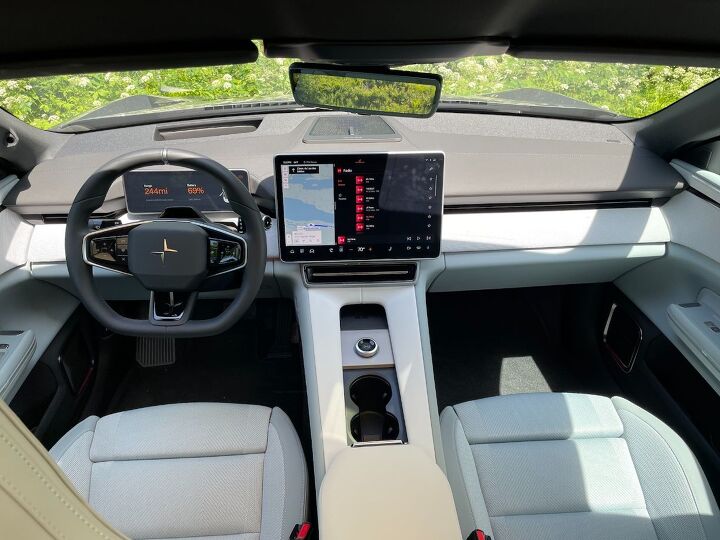
The Polestar 4 foregoes a hooded instrument cluster for a stand-alone 10.2-inch digital panel behind the steering wheel. It works just as well, as I experience no glare. The center touchscreen is a large 15.4-inch unit in a landscape layout. It runs Google Android Automotive operating system and comes loaded with Google Maps, Google Assistant, and the Google Chrome and Vivaldi browsers. It also provides access to such apps as Spotify, YouTube, Waze, Tidal, TuneIn Radio, and Amazon Prime Video.
The 2026 Polestar 4 is scheduled to go on sale late this year with a starting price of $57,800 for the rear-drive version and $64,300 for the more powerful dual-motor model, both including a $1,400 destination fee. For $5,500, the Plus Pack adds useful features like a head-up display, 12-way power-adjustable front seats, power reclining rear seats, three-zone automatic climate control with rear controls, a heated steering wheel, heated rear seats, and a 12-speaker Harman Kardon audio system. The Performance Pack adds another $4,500.
It may not be a race car like the original Polestars, but the 2026 Polestar 4 offers luxury, style, and a relaxing driving character. It compromises on space for that style and its oddball lack of a rear window has some challenges of its own, but Polestar 4 carries on the brand’s performance tradition admirably.
[Images © 2025 Kirk Bell/TTAC.com]
Become a TTAC insider. Get the latest news, features, TTAC takes, and everything else that gets to the truth about cars first by subscribing to our newsletter.
Latest: Kirk has oil in his blood, and his knowledge of cars includes both the old and the new. He grew up in the automotive culture, watching his father drag race a pair of Pontiacs, rather unsuccessfully, at Great Lakes Dragaway in Union Grove, Wisconsin. He is senior editor at Motor Authority, specializing in luxury and performance cars. In that role, he drives the latest toys on racetracks around the world several times a year, a role that he relishes. Kirk has been reviewing cars and writing about the automotive industry since 2001, when he joined Consumer Guide Automotive. At Consumer Guide, Kirk wrote and edited several books, including the award-winning Hot Rod & Custom Chronicle and NASCAR Chronicle. He spent eight years as a freelance journalist, with such clients as the Chicago Tribune, the New York Daily News, and MSN Autos, and most recently he was Senior Editor at Motor Authority. In 2014, Kirk was named to the North American Car and Truck/Utility of the year jury and recently completed a turn as its Secretary-Treasurer. Before working in the automotive industry, Kirk was editor of Scale Auto Enthusiast magazine, the leading magazine about the model car hobby. In his spare time, Kirk is a sports fan and tinkers with his 2006 Porsche 911 Carrera S.
More by Kirk Bell







Comments
Join the conversation
I've had the long range single motor Polestar 4 since May (in Europe) and I'm still excited everytime I climb into this car, like on the first day. It's a dang good EV for, what it seems, a decent price in the US and Canada (they're way pricier in Europe). If you're interested in getting yourself a good looking EV with power packed "under the hood", try to get a test drive. I came back from mine to sign right then and there. And no, I'm no bot or Polestar agent. Just aPolestar 4 owner who wants to share the excitement.
BMW came close once. And so did Saab.