

Abandoned History: The Austin Allegro Story, a Fine Motorcar (Part II)


When it came time to replace the dated (but very popular) Austin 1100 and 1300 models, British Leyland had many different and conflicting missions in mind. It wanted to turn the Austin brand into an outlet for new, adventurous cars while simultaneously using as many off-the-shelf BL parts as possible. The company also requested a sleek and forward-looking design in the angular early Seventies tradition, but then insisted on making it rounded because of its recent metalwork research for an ill-fated Mini replacement.
BL also wanted the Allegro to resemble the 1100/1300 (which were rebadged into too many other variants) but proceed without badge engineering moving forward. And that didn’t happen either. However, though styling ended up a disjointed disappointment, British Leyland management was sure Allegro’s uniqueness would make it a success. Now, let’s find out what Allegro’s engineering was like underneath all that bulbous metal.
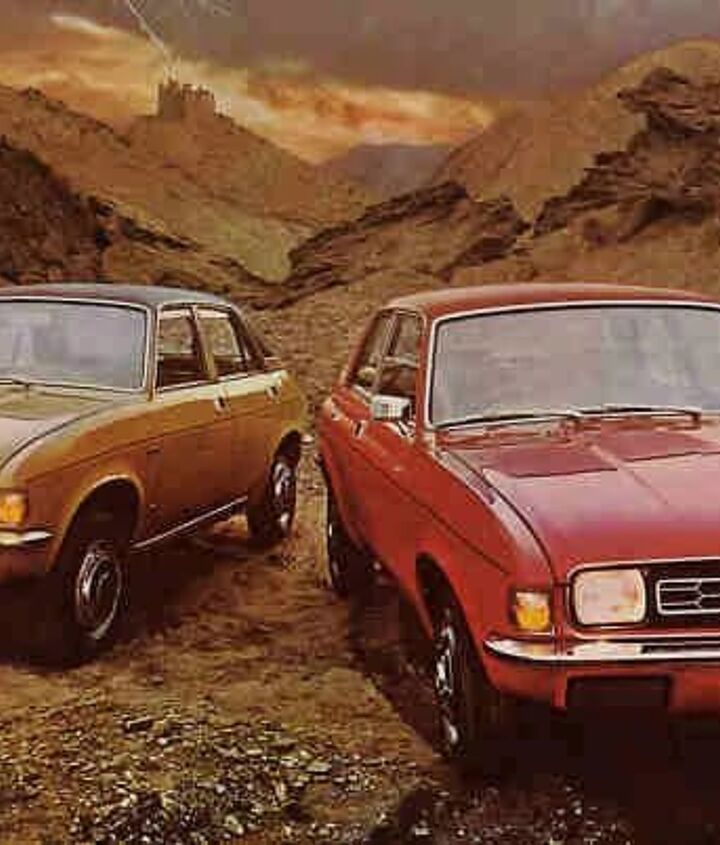
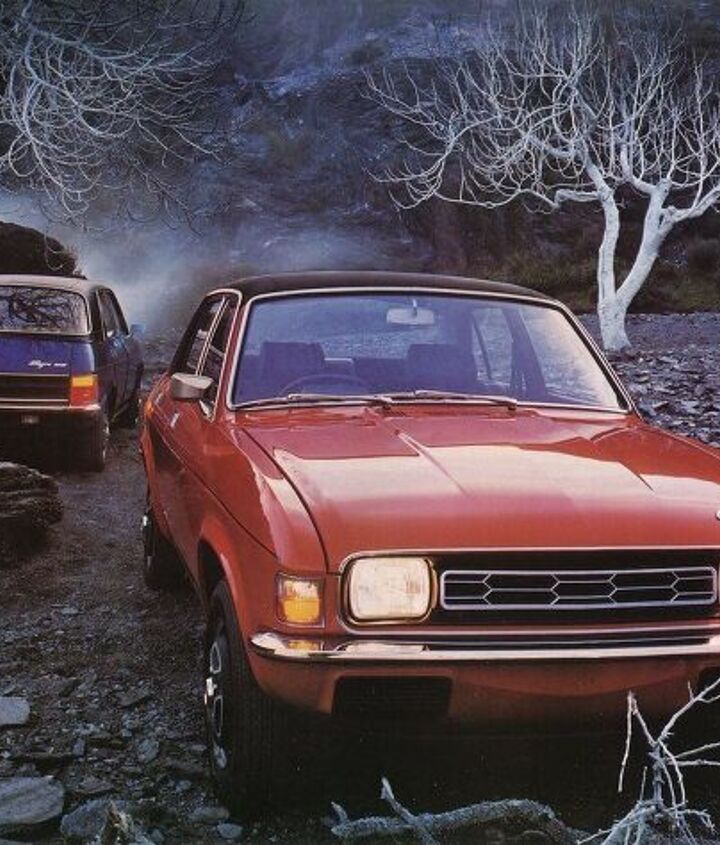
Austin developed a new platform for the Allegro but maintained the front-engine and front-drive layout of the successful 1100 and 1300. The new Allegro rode on a 96-inch wheelbase, two and a half inches more than the 1100’s. Allegro’s exterior was almost six inches longer, due to the packaging requirements of the big HVAC system from the Marina, as well as the larger E-series engines: 152 inches overall, whereas the 1100 was 146.6 inches long.
As expected in the transition from a Sixties car to a Seventies car, width grew almost three inches from 1100 to Allegro, to 63”. With its high sills and tall hood line that forced an increase in roof height, Allegro was 55 inches tall (53” for the 1100). Under its tall hood were a couple of familiar engines, and a couple of new ones.
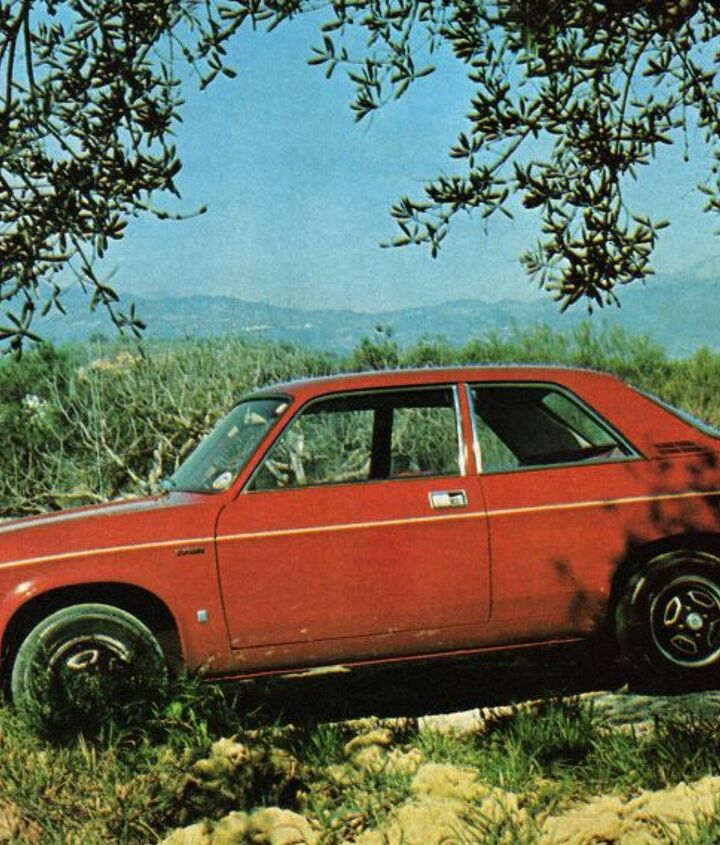
The most basic Allegros used a 1.1-liter version of the A-Series engine. Available at introduction in 1973, the 1098-cc engine dated to 1962. In Allegro usage it made 49 horsepower and 60 lb-ft of torque - a high water mark it turned out: In 1975 the engine was reworked for emissions purposes, and saw a decrease to 45 horsepower.
A 1.3-liter A-series engine was also available at the introduction, the largest standard A-series engine. Ported from the prior 1300, the engine dated to the Mini Cooper of 1964. In Allegro usage it offered 59 horsepower and 69 torques. For more power, a customer turned to the larger E-Series engines, which the Allegro’s designer later asserted were unsuitable for a passenger car.
The smallest of the E was a 1.5-liter, which dated from 1969. Shared with the Maxi and Marina, the 1.5 made 69 horsepower and 83 lb-ft of torque. For the upper-crust customer, there was the 1.7-liter E-series, which produced a hefty 76 horsepower and 104 lb-ft of torque. That engine was shared with the same cars as the 1.5.
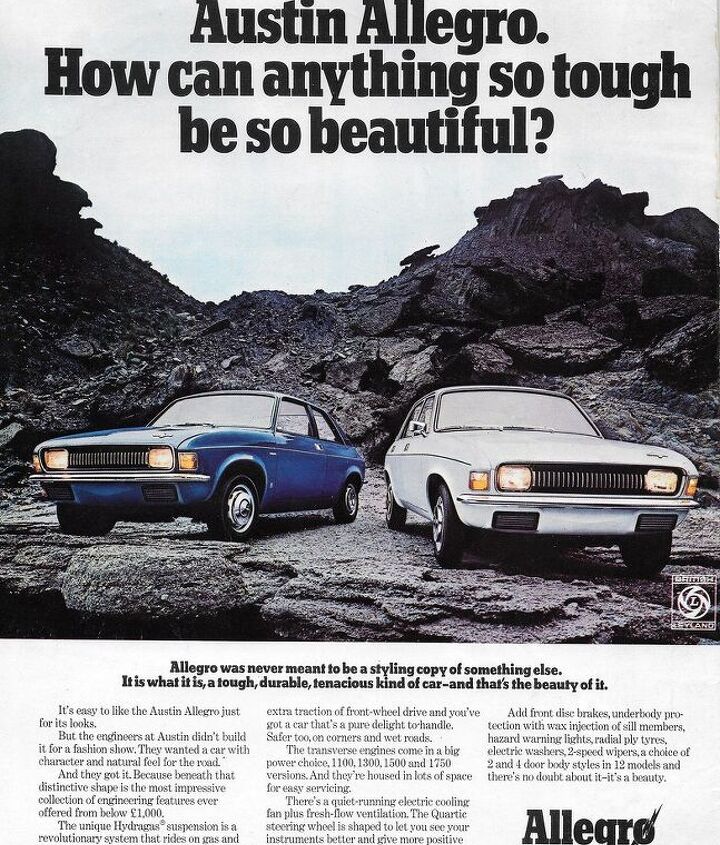
After its introduction, there was an additional twin-carb version of the 1.7-liter E-Series, which promised 90 horsepower and 104 lb-ft of torque. It’s unclear how long that particular engine version was offered. Fortunately, the Allegro’s engine line was reworked in 1980 with new versions of the A-Series called A-Plus.
The A-Plus engines were a last resort replacement for the Fifties A-Series after BL spent time and money on a failed engine line called K, and an overhead cam version of the A-Series. The company’s engineers found that though the A-Series was old, it was not uncompetitive against more modern power plants. For its displacement, the A had excellent fuel economy and torque figures.
Scrapping their prior ideas, BL decided to improve the A into something more modern. That allowed a faster development timeline than a new engine line, and it was also less expensive. The resulting engines had better engine blocks, revised pistons that were lighter, and better piston rings. There was also a revision to the timing chain tensioner and other small changes that meant it needed service less often.
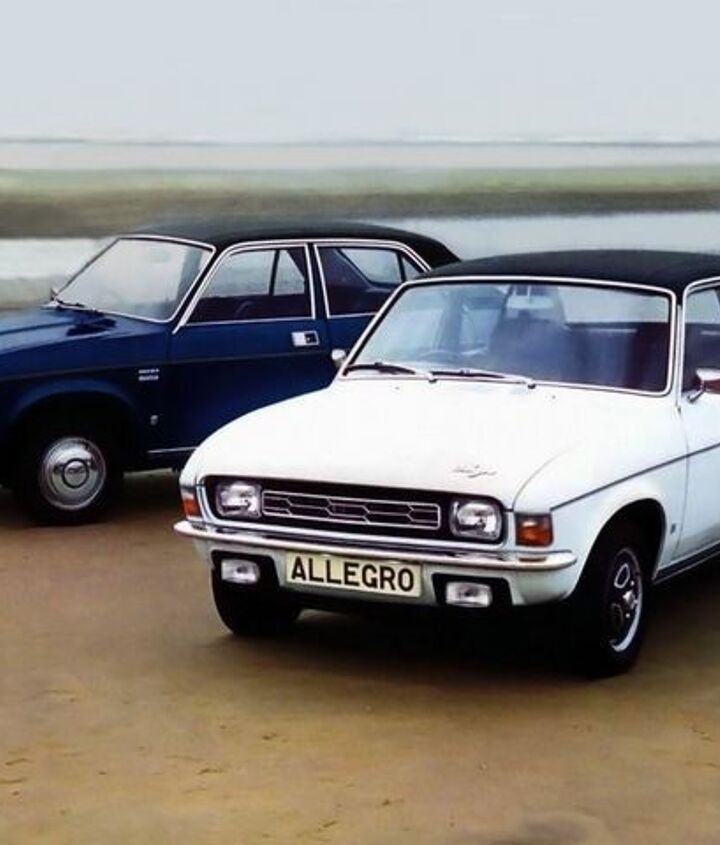
Other changes included different carburetors and a better intake manifold design. As a result, the A-Plus engines were generally improved in many areas and made more power without a decrease in fuel economy. BL didn’t port every A-Series over to an A-Plus, as the Plus was offered in only 998-cc and 1275-cc displacements.
The A-Plus replaced the A-Series engines in the Allegro for 1980. The 1.0-liter produced 44 horsepower and 52 lb-ft of torque, while the 1.3-liter made 61 horsepower and 69 lb-ft of torque. Time proved the A-Plus engines were better than the A-Series, as they were better made, more reliable, and longer lived overall.
While the Allegro’s engine offerings took a 50/50 old/new approach, the suspension BL implemented was a new take on the old Hydrolastic suspension from the 1100/1300. Hydrolastic was first used in 1962 on the 1100 project and replaced the typical springs and dampers with displacer units filled with fluid.
Within the units was a rubber spring, which dampened the car by passing the fluid through rubber valves. The units were connected between the front and rear wheels at each side, which balanced the car and minimized any pitching effect over bumps. With this system as a starting place, BL developed Hydragas for the Allegro.
Hydragas was invented by Alex Moulton (1920-2012), who also invented Hydrolastic. Allegro received the honor of being the first car to implement the exciting new suspension at its 1973 debut. Hydragas was an attempt to replicate the sort of advantages of Citroën’s hydropneumatic suspension, without being quite so complicated.
Once again displacer units were used, this time shaped as spheres that contained pressurized nitrogen instead of liquid. The displacers replaced springs entirely, different from the Hydrolastic that still required an internal rubber spring. Gas was pressurized by hydraulic fluid in the system, and displacers front and rear were linked as they were with Hydrolastic.
Constant system pressure was assured as the system was fully sealed. After its Allegro debut, the system spread quickly to other Austin, Morris, Wolseley, MG, and Rover products. Though the original version of Hydragas earned a reputation fairly quickly for being terrible, BL kept at it and eventually worked the system into a reasonable imitation of Citroen’s suspension. Hydragas was used through 2002 on the MG F roadster.
In the Allegro, Hydragas was intended to provide a softer ride than Hydrolastic. The pressurized gas could react more quickly to road conditions than liquid movement. Cost savings were another big factor, as the Hydragas units were smaller and cheaper to make.
In our next installment, we’ll move inside the Allegro’s cabin and have a look at a lot of parts bin BL stuff, and one Allegro-specific invention that nobody liked. Then we’ll cover the additional models the Allegro spawned as British Leyland embraced the badge engineering it initially resisted.
[Images: BL]
Become a TTAC insider. Get the latest news, features, TTAC takes, and everything else that gets to The Truth About Cars first by subscribing to our newsletter.
Interested in lots of cars and their various historical contexts. Started writing articles for TTAC in late 2016, when my first posts were QOTDs. From there I started a few new series like Rare Rides, Buy/Drive/Burn, Abandoned History, and most recently Rare Rides Icons. Operating from a home base in Cincinnati, Ohio, a relative auto journalist dead zone. Many of my articles are prompted by something I'll see on social media that sparks my interest and causes me to research. Finding articles and information from the early days of the internet and beyond that covers the little details lost to time: trim packages, color and wheel choices, interior fabrics. Beyond those, I'm fascinated by automotive industry experiments, both failures and successes. Find me on Twitter, @CoreyLewis86.
More by Corey Lewis







Comments
Join the conversation
Looks awful even now in the early 90s vauxhall launched the latest astra that looked like the allegro what were they thinking.
Did I read that correctly? Les than 1,000 pounds?