


Mega Dealerships Continue Consolidating Strength

If you frequent this website, there’s a good chance you’ve seen an article discussing how smaller car dealerships are being incorporated into larger entities over the last few years. As with most other industries, the trend has been accelerating and Automotive News just shared the metrics showing how far we’ve come over the last decade. According to the report, consolidation among mega dealers has made heaps of progress of late and should continue on with their mission of never-ending growth because none of them want to become the little guy after every pint-sized showroom has been bought up in North America.
“With the consolidation that’s happening across all of the large major automotive groups, we want to make sure that we are keeping up pace,” Liza Borches, CEO of the Carter Myers Automotive Group in Charlottesville, VA, explained to the outlet after her company’s buyout of Miller Auto Group raised its profile on Automotive News‘ top 150 dealer groups currently operating in the United States.
While 2021 may not have been the biggest year for automotive sales in terms of pure volume, America’s largest dealer groups enjoyed record profits and the widespread buyup of their less financially robust competitors.
From AN:
The top 10 and the top 150 groups now own more of the industry’s dealerships and are responsible for a larger share of the industry’s new-vehicle sales.
Dealers who want to be competitive in the long term are realizing it’s time to “get big or get out,” said Alan Haig, president of Haig Partners, a buy-sell firm in Fort Lauderdale, Fla. For the first time in many years, all six of the main public dealership groups are acquiring stores, he said.
“The consolidators have capital,” Haig told Automotive News. “They have confidence, they have support of their shareholders. They’re going to continue to do deals.”
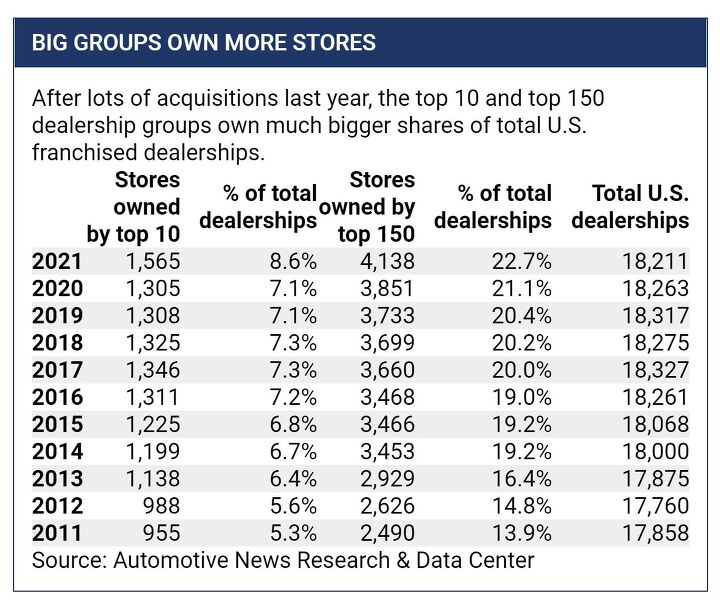
The top 150 groups in the U.S. owned 4,138 stores, including a small but undetermined number of used-only and non-U.S. outlets, at the end of 2021, according to the Automotive News Research & Data Center, which compiles the list. That equates to 22.7 percent of Automotive News’ total count of franchised dealerships in the U.S., up from 21.1 percent for 2020 and 13.9 percent for 2011. The top 10 groups owned 1,565 stores at the end of 2021, an 8.6 percent share of all U.S. dealerships and up from 7.1 percent for 2020 and 5.3 percent for 2011.
That’s a lot of headway in such a short time and everyone seems to be convinced that the buyouts will continue until the AutoNations and Penskes of the world hold onto the lion’s share of the market. But this isn’t even a complete data set, with several of the largest dealer groups opting against furnishing the relevant information or beholden to a reporting schedule that was at odds with the study. AN confirmed this by suggesting the figures “actually understate the share of industry sales commanded by the top 10 and top 150” businesses in its reporting.
“Dealership groups report only the sales they recorded during the year — but not sales made by an acquisition target before a transaction being finalized,” the outlet explained. “That means the vehicle sales recorded by acquired groups before transaction completion dates go unrepresented on the list.”
In some instances all this did was shift around the placement of which auto groups happened to be the biggest dog in the yard. But it also helps obfuscate just how massive some of these mega dealerships are becoming. Though we do have a good idea of which stores grew the most in 2021 — Asbury Automotive Group reportedly nabbed 71 showrooms last year, followed by Lithia Motors’ 69 new stores. Meanwhile Sonic Automotive added 56, Group 1 Automotive acquired 35 lots, Penske Motor Group got 27, and AutoNation scooped up 21.
With even some of the midsized groups vying to grow, lest they be destroyed by their larger competitors, nobody expects this trend to cool off. Corporate consolidation has also accelerated over the last few years, with pandemic restrictions making times tougher for smaller dealerships (among other businesses) despite the relief funds that were earmarked to ensure something like this wouldn’t happen. If anything, the industry seems to expect dealer buyouts to increase through 2022.
“We’re gonna see a continued acceleration in consolidation and then the normal sort of changing hands of targets that aren’t really the typical consolidators,” suggested Mark Johnson, president of buy-sell firm MD Johnson in Enumclaw, WA.
[Images: LM Photos/Shutterstock; Automotive News]
Consumer advocate tracking industry trends and regulations. Before joining TTAC, Matt spent a decade working for marketing and research firms in NYC. Clients included several of the world’s largest automakers, global tire brands, and aftermarket part suppliers. Since adding automotive writing to his repertoire, he has become an ardent supporter of the right-to-repair movement, discussed the status of the automotive sector on national broadcasts, participated in a few amateur rallying events, and driven more rental cars than anyone should ever have to. Handy with a wrench, Matt grew up surrounded by Detroit auto workers and learned to drive by twelve. Alleged to be contrarian, Matt claims to prefer understeer and motorcycles.
More by Matt Posky











Comments
Join the conversation
Why would Tesla change from direct buying to franchise dealerships when direct sales has worked so well that Ford is even considering it for sales of their EVs. With the huge markups above MSRP that many dealers are doing many consumers will start demanding a better buying experience. As for selling a vehicle to a big franchise dealer you are better off selling it to Carvana or Car Max. Big franchise dealers want to chisel you for every dollar. I would rather cut the dealer out entirely and buy direct from the manufacturer. Most dealers treat the buyer like an idiot and most sales people know less about what they are selling than many customers but they use the same dishonest underhanded tactics that have gotten them the scummy reputation they deserve. There might be some good dealers out there but most are not and many buyers dread wasting hours at a dealership which play games at the buyers expense. I feel like taking a shower every time I have to deal with the sales and finance people at a dealership. Most are scumbags.
I likes me some data but this has been happening for several years prior to 2020.