


Rare Rides: The 1984 Ferrari 400 GTi - Luxurious Ruching for Four

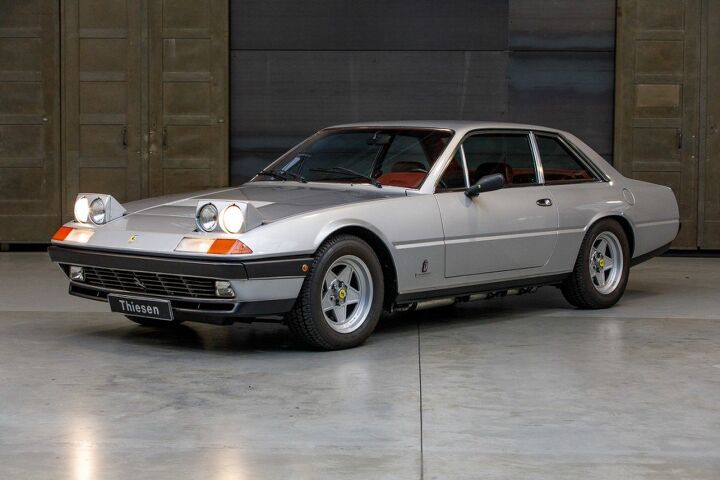
Today’s Ferrari 400 took a more upscale approach than its contemporaries wearing the prancing horse badge. The engine was at the front instead of the middle, the seats numbered four instead of two, and the accommodations were more cocktail lounge than race car.
Let’s find out more about the vintage Ferrari many fans gloss over entirely.

To learn the history of the 400, one must start with the 365 GT4 2+2. Introduced in 1972, the new 365 GT4 was a modern replacement for the much more classically styled 365 GT 2+2. On sale since 1967, the older 365 was the company’s V12 -powered, four-place coupe offering. By the dawn of the Seventies its sweeping Pininfarina design found itself in need of replacement. So, Ferrari hired Pininfarina again… and everyone at the office picked up a ruler.

The formula of the new 365 stayed the same as before: V12 up front, four seats in the middle, and a good-sized grand touring trunk at the rear. Initially cars were offered with the 4.4-liter V12 from the prior 365. With Weber carbs, the engine promised 335 horses shifted through a five-speed manual.

Luxury came standard with the 365, as occupants nestled into leather recliners in the middle of an air conditioned room. Perhaps contrary to expectations, this high-line Ferrari was never officially brought to the American market. Enzo took one look at the changing regulatory environment and considered how those changes might translate into excessive fiddling with his most expensive model. Understandably, he passed.

The 365 GT4 remained in its initial form through 1976, when a lightly reworked model debuted with a new name. Reaching further into luxury territory, the new 400 arrived with more choice for the customer. Available in five-speed GT or new three-speed Automatic guises, the 400 carried a massaged and enlarged version of the engine from the 365, now with 4.8 liters displacement. According to Ferrari, the larger engine made no additional power.

Today, Ferrari seems a bit confused about what they were after with the 400. They say the 400 was the first Ferrari offered with an optional automatic to meet the demand of American customers. In the same blurb, they also state “…no USA market version was made.” Interesting.

The two 400s continued through 1979, at which point Bosch fuel injection was added (in keeping with the times). An i was appended to either model’s name, creating the GTi and Automatic i. Injection meant power dropped to 306 horses, a figure which improved to 311 in 1982 with revised camshafts and a new exhaust manifold. Accompanying the injection were revisions and modernization of the interior, all of which added around 300 pounds to the 400’s weight. Its heft reached 4,034 pounds when bone dry.
Ferrari updated the 400 once more in 1985, when a slightly larger displacement of 4.9 liters necessitated a name change to 412. The 412 continued through 1989 before its 17-year long tenure came to an end. The brand next offered a four-seat V12 in 1992, with the debut of the 456.
Today’s manual transmission 400 GTi hails from 1984. One of 422 examples produced, it asks $87,000.
[Images: seller]
Interested in lots of cars and their various historical contexts. Started writing articles for TTAC in late 2016, when my first posts were QOTDs. From there I started a few new series like Rare Rides, Buy/Drive/Burn, Abandoned History, and most recently Rare Rides Icons. Operating from a home base in Cincinnati, Ohio, a relative auto journalist dead zone. Many of my articles are prompted by something I'll see on social media that sparks my interest and causes me to research. Finding articles and information from the early days of the internet and beyond that covers the little details lost to time: trim packages, color and wheel choices, interior fabrics. Beyond those, I'm fascinated by automotive industry experiments, both failures and successes. Find me on Twitter, @CoreyLewis86.
More by Corey Lewis









Comments
Join the conversation
I love a lot of older Ferraris, but no matter how much money I had, I feel like the school bus steering wheel angles would keep me away. Why? Whyyyy??
The Bitter SC managed to copy the styling and was even very briefly officially offered for sale in the U.S. The SC was based on the Opel Senator and used the Opel inline 6. It was was a decent car, but no Ferrari V12.