


Volkswagen Wants the World to Buy Like Americans
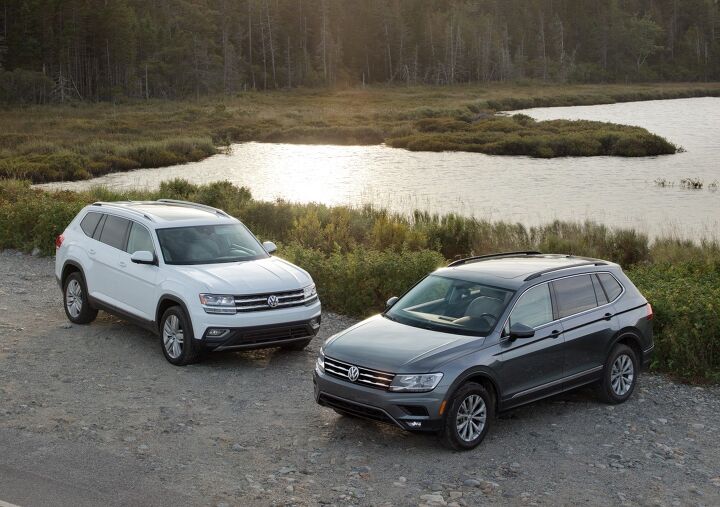
The world needs to adopt North America’s penchant for high-riding SUVs if Volkswagen has any hope of building a clean, green, safe future for your kids. That’s basically the message coming from the automaker, which wants 50 percent of its global product mix to be made up of crossovers and SUVs by 2025.
High-margin SUVs will bolster the brand’s business, the company says, helping bring in the cash needed to eventually take your internal combustion engine and steering wheel away.
It’s a similar product/planning strategy underway at BMW, which recently launched the massive X7 to help expand its line of electric cars. Judging by a flurry of model trademarks (X8, X9), Bimmer’s got other large, multi-cylinder vehicles on the way.
VW made its cargo-happy declaration at the overseas launch of the tiny T-Cross crossover, a Polo-based vehicle slotting below the T-Roc on the utility ladder.
“SUVs are becoming increasingly popular with our customers throughout the world,” said Jürgen Stackmann, the Volkswagen board member responsible for sales. “This is why we are consistently pursuing our current SUV offensive. It will be a key contribution to strengthening our core business so that we can invest the necessary billions of euros in mobility and autonomous driving. The T-Cross rounds off our SUV family in the rapidly growing small SUV market.”
The recent global launch of the larger, redesigned Tiguan led to boffo sales, while North American and Chinese customers now enjoy the identical three-row Atlas and Teramont, respectively. Europeans just received a new, range-topping Touareg. A new, smaller crossover is due in our market before too long, as is a sportier, two-row Atlas variant.
As it continues its SUV offensive on the global stage, the brand holds equally lofty expectations for its looming I.D. electric car line. VW hopes to sell 1 million EVs by 2025. The two product plans make for strange bedfellows, though they’re married by money. EVs aren’t known for their generous margins, and development costs are sky-high. Throwing a number of different-sized bodies onto the MQB platform will deliver the cash needed to get the I.D.s, later EVs, and futuristic self-driving vehicles off the ground, VW hopes.
In the U.S., utility vehicles made up 40.2 percent of Volkswagen’s September sales volume. Even the American market isn’t American enough for VW at this point.
[Image: Volkswagen of America]

More by Steph Willems











Comments
Join the conversation
I would think that CUVs will eventually become more popular in the EU than in the US. My logic behind this is with the smaller footprinted EU vehicles a taller vehicle offering better interior space usage will become dominant.
“It will be a key contribution to strengthening our core business so that we can invest the necessary billions of euros in mobility and autonomous driving.” This is sorta like McDonald’s saying that they need fat goober-pantloads to swallow heaps of their heart-clogging slime-burgers in order to develop healthy, nutritious alternatives for later on.