


More Korean Crossovers? Ssangyong Isn't Giving Up on the United States
Hyundai and Kia did it, so why not Ssangyong? The India-owned Korean automaker has been itching to expand its horizons for years, but tentative plans to invade the Chinese car market have fallen victim to bad timing and geopolitics. Now, the company’s board is weighing a U.S. entry.
It’s not the first time Ssangyong Motor, owned by Mahindra & Mahindra, has eyed the United States for a big volume boost. Early last year, the automaker and its parent company temporarily shelved a proposed 2019 U.S. expansion plan, with Ssangyong’s CEO warning it could “make or break” the company.
Well, the idea’s back. With Ssangyong eager to land on American shores by 2020, a new report says the company has already made its decision.
The only problem is, we don’t yet know if it’s a green light or a thumbs-down. According to Wards Auto, Ssangyong’s board of directors met in Seoul on October 26th to vote on the automaker’s plan.
“As of now, we cannot confirm it,” a spokesman told WardsAuto following the meeting. “There may be some news coming out, but not today.”
Even if the board votes it down this time, it might not do the same in February. Mahindra Group managing director (and Ssangyong board chair) Pawan Goenka says the automaker will re-submit the plan at the next possible opportunity if it fails this time.
“We certainly need to develop two or three good markets for SsangYong outside Korea. China is one such possible market, but not the only possible market,” Goenka told The Korea Herald on the 25th.
“We are working on the possibility of (a U.S. entry in) 2020. The board of SsangYong will be deciding either tomorrow (Thursday), or the February meeting to give an approval for the investment for the U.S. And once the board gives the approval, then after that it is going to take about three or 3 1/2 years to enter the U.S.”
Mahindra’s 72-percent stake in Ssangyong means the automaker’s enthusiasm for expansion is tempered by its parent’s control of the purse strings. Last year, Ssangyong CEO Choi Johng-sik told Reuters, “It is true that there are many concerns about the U.S. entry.”
Mahindra wanted to focus on China first, but South Korea’s defensive missile battery — set up to ward off the nuclear threat from the North — has placed relations with China on edge. Production was supposed to start in that country in 2019 via a joint venture with Shaanxi Automobile Group. That plan is now kaput. With China no longer a friendly market for Korean cars, Ssangyong’s gaze has once again turned eastward.
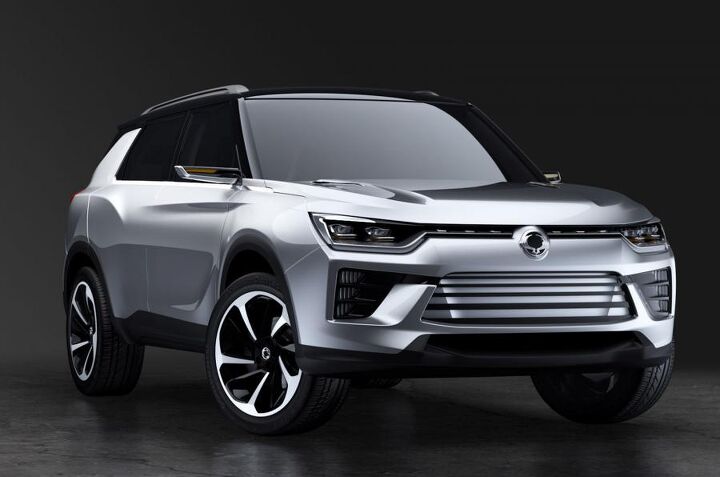
What type of vehicle would Ssangyong launch as its inaugural U.S. product? Assuming Mahindra and Ssangyong’s board approves of the move, it’s looking like an electric SUV (already in the works for 2020) will be that vehicle. Ssangyong also debuted a very fleshed-out SIV-2 hybrid crossover concept at last year’s Geneva Motor Show that should reach production sometime in 2018. The company also builds the existing Tivoli SUV.
The jury’s out on whether America will quickly adopt the electrified lifestyle once the right kind of vehicles (with the right kind of range) appear, but Ssangyong’s SUV-heavy lineup does seem like a natural fit for the U.S. marketplace. Stay tuned.
[Image: Ssangyong Motor]

More by Steph Willems









Comments
Join the conversation
Oh My Lord! An electric/hybrid crossover from an Indian owned, Korean built company. There will be lines around the block! Mahindra needs to re-examine their small truck plans. But hey, we'll get some of the sweet; sweet vehicles the Aussies do!
in addition to everything said above... Stuff gets lost in translation/transliteration from West to East and vice-versa. Ssangyong literally means "double/twin/two dragons" if i recall correctly. Two "s" mean it's an extra "s" sound if that makes any sense. Rebrand the name as Mahindra or Dragon Motors or Tivoli. Ssangyong already has a lot of hill to climb outside of Korea, no point in footing itself in the foot with a name that gives Western speakers a double take. Like Kumho tires. ;)