
Capsule Review: 2014 Chevrolet Traverse LT AWD


My, haven’t you matured.
You’re a few years removed from realizing that a society’s population must grow if it is to thrive over the long haul. Yet instead of traditional government tactics like recruiting doctors from the other side of the Atlantic and engineers from the other side of the Pacific, you made the hilarious decision to utilize an in-house solution.
You’ve expanded the population all right. By way of the womb.
Child number one brought with him a surprising amount of stuff. Child number two takes up a lot of space, as well. But it’s the third and fourth kids that suddenly made the first bungalow and the first CR-V seem so very small.
Odds are, you’re not about to buy a minivan.
In July, Americans registered 46,519 new minivans. The Ford Explorer, Toyota Highlander, Honda Pilot, Nissan Pathfinder, and Dodge Durango combined for 53,467 sales. (Another 12,649 sales were generated by premium three-row crossovers from Acura, BMW, Infiniti, and Audi.)
And then there are the very popular Lambda platform crossovers from General Motors. Of the three, the Chevrolet Traverse stands out as the most likely minivan comparison tool because of its lower base price: $31,870 for an LS front-wheel-drive Traverse, $34,745 to add all-wheel-drive, $40,565 for an AWD Traverse 2LT with rear seat entertainment.
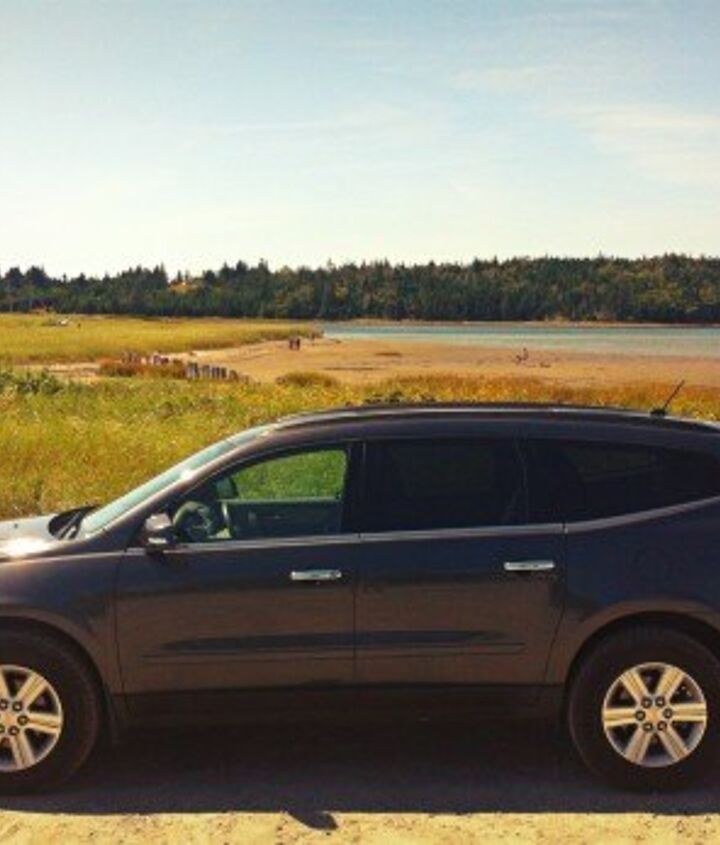
Not much wonder. The Traverse is 6.6 inches longer than the Explorer, 12.6 inches longer than the Highlander, and 12.3 inches longer than the Pilot. It’s longer than the Dodge Grand Caravan, as well, and comes within three-tenths of an inch of stretching as far as the Chevrolet Tahoe from bumper to bumper.
Traverses can also tow in quite a truck-like fashion, with a maximum rating of 5200 pounds, slightly more than the Explorer and Highlander; 700 pounds more than the Pilot.
The Traverse is more.
But as we know, less is actually sometimes more, and bigger is not always better.
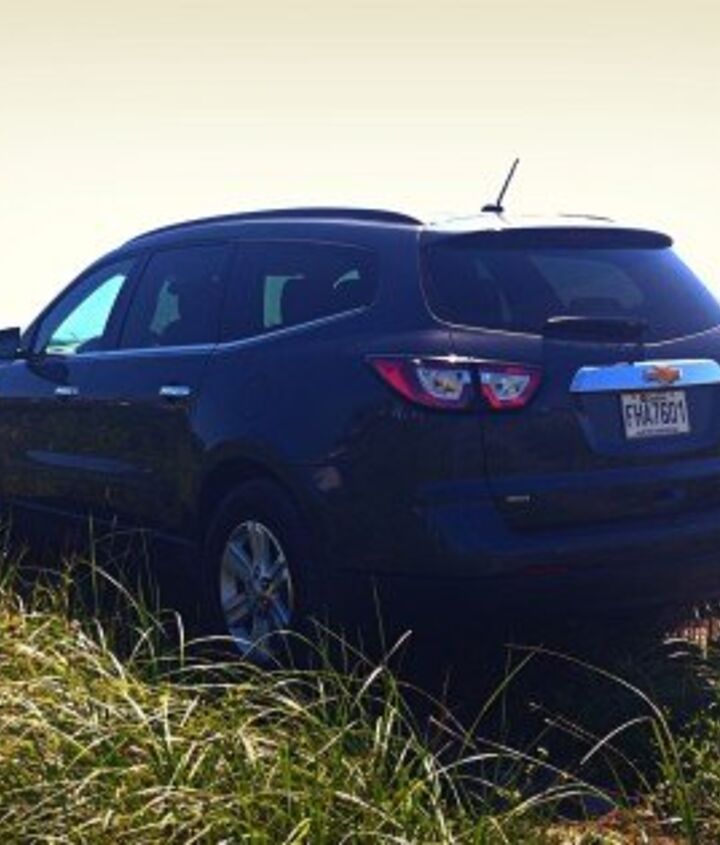
The third row in the Traverse that GM Canada sent our way in August is more challenging to access than the third row in the Nissan Pathfinder, in part because of the Traverse’s flimsy second row levers. It’s roomy enough back there for typical third row occupants, but the seats themselves are torturous little items, hard and flat afterthoughts in what should be a contemporary minivan alternative.
Second row passengers are granted more space and comfort. Our test Traverse didn’t have the expansive glass roof, however, so one glance up reveals a fuzzy headliner. (One look around also reveals great deal of unfortunate grey-beige.)
For the driver and front passenger, there’s no arguing with the comfort level in highway cruise mode. This is a huge cabin with very adjustable seats. But almost all of the controls felt as though they were mounted too low, particularly in comparison to the very intelligent design of the latest Toyota Highlander’s cabin, where the screen is mounted high, a shelf holds items you want to easily grab hold of, and a massive centre bin swallows the lunch order for a family of eight.
GM’s MyLink is still slow, a trait which was admittedly exacerbated by the fact that during the Traverse’s stay, I also spent time with a Tesla Model S’s fast-acting touchscreen.
It’s not that there are any great complaints regarding the Traverse’s on-road behaviour. The ride quality could be slightly firmer, just enough to remove a hint of float. There’s something to be said for the way a modern near-5000-pound high-rider can handle. If 3000-pound sedans had made these kinds of advances over the last 15 years we’d be in awe. Even the brakes offer real bite, and the 281-horsepower 3.6L/6-speed automatic combo never struggles to adequately motivate the Traverse. More low-down torque would be appreciated, as thoroughly wringing out the V6 to locate that adequate motivation feels somewhat out of character for this not-a-minivan.
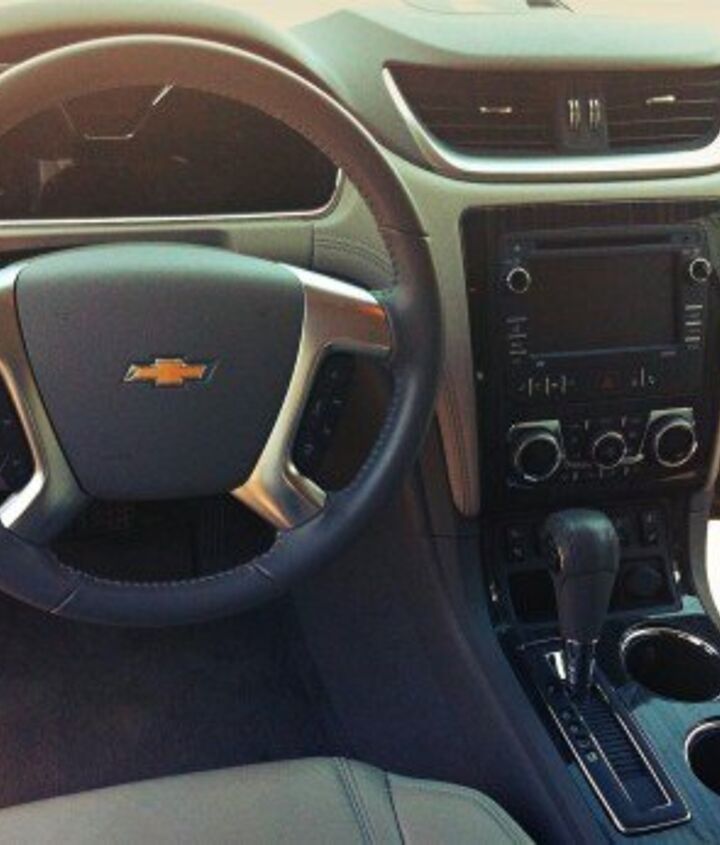
In fact, the most significant dynamic issue isn’t found under the hood or near the wheels, it’s in the cabin. The steering wheel is pencil-thin, as if GM is saying, “You were never going to have fun piloting this behemoth, so we’ve made sure the steering wheel reminds you of the least sporting Oldsmobile you’ve ever driven.”
So the Traverse is vast, it doesn’t need to be expensive, and it remains surprisingly composed in motion. It nevertheless feels like a product designed as a Saturn Outlook for an introduction in late 2006. That was a while ago.
There’s a cheapness to the often-touched interior parts that’s out of keeping with the huge cabin quality increases we’ve seen over the last seven years. That roughness around the edges – from the gravelly second row seat operation to the crude operation of the driver’s armrest and a sliding panel in the centre console – would disappoint in a vehicle of any price.
Even with the 2013 redesign, the Traverse looks like a bloated second-generation Hyundai Santa Fe, which wasn’t ugly, but isn’t exactly current.
Although the fuel economy our Traverse achieved during a mostly low-speed week on the highway easily beat its EPA ratings, the all-wheel-drive Traverse is rated at 16 mpg in the city. The Pathfinder is rated at 19; the Highlander and stretched Santa Fe at 18. Consuming between 12% and 19% more fuel in city driving isn’t a way of winning friends, nor will it positively influence buyers.
The Traverse is undeniably showing signs of age. That it remains relatively competitive is perhaps a symbol of some level of inherent goodness. It may also relate to the idea that, for many family car buyers, bigger is simply better. Though you may frequently have doubts about how accurately that maxim applies to the size of your own family.
More by Timothy Cain





Comments
Join the conversation
Finally a good looking truck from GM, ruined by hideous bowties. Those things wouldn't make it off the car lot with me. Even if I had to break them off in front of sales staff. They'd probably applaud.
I rented a 2015 Traverse in August. So there! Huge and thirsty. Lousy access to the third row, though the kids didn't mind climbing over the seats. A backuo camera but no proximity alarm, so you can watch in colour as you back into something. The centre thing is a horrible sloppy mess of sliding "arm rest" with a nasty surface and some subdivided bins that wouldn't hold anything. One quarter of the instrumentation display area is taken up by a voltmeter, an analog gauge that nobody has needed since 1956. It stayed on 12 volts the whole time. What a surprise! The alternator light was one of the first idiot lights and for good reason. It might never actually come on in the life of the vehicle.