Abandoned History: Oldsmobile's Guidestar Navigation System and Other Cartography (Part VI)

Sacrificing much, GM spent billions and billions of 1980s dollars on technology and engineering entities at the behest of CEO Roger Smith, who wanted to transform The General into a company more resembling a conglomerate like GE. Half a decade later Smith was gone, and the remaining brass began to unwind the costly EDS and Hughes deals and return GM to its standard operating procedure. But behind the layers of finance and paperwork, Guidestar GPS was developed. And the first time the public got to see it was in 1994 in a very exciting debut.
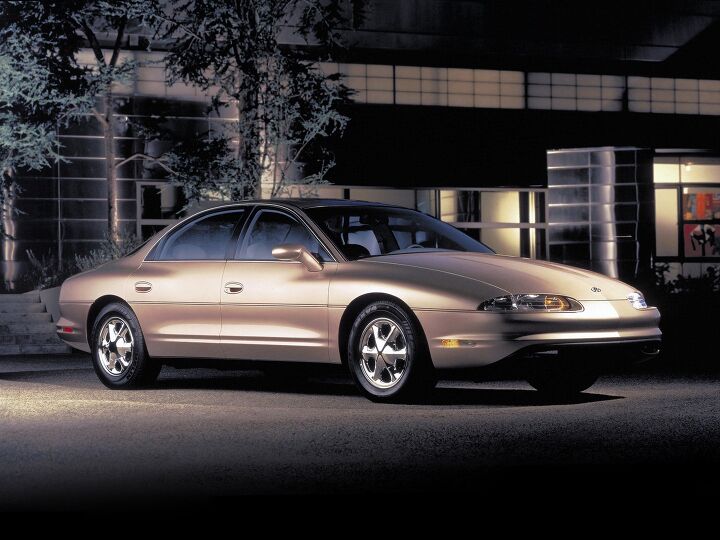
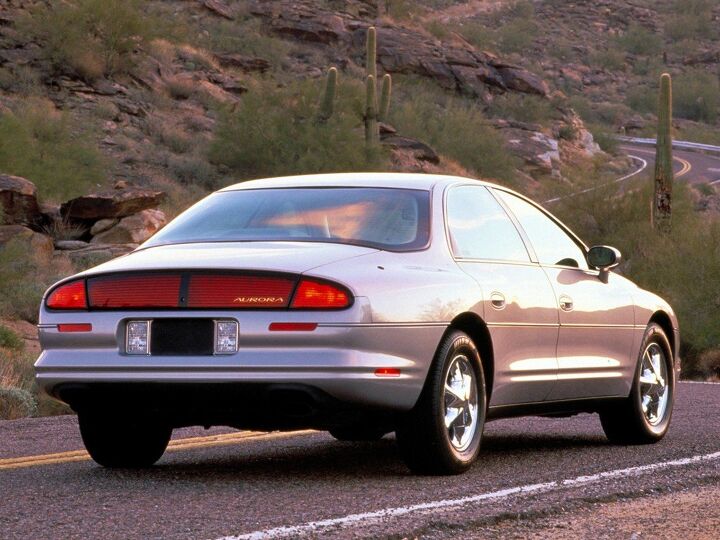
A daring aerodynamic shape, frameless windows, grandiose full-width heckblende, and in-dash Guidestar navigation were all present on the 1994 Oldsmobile Aurora show car. The show car was production ready, save for the Guidestar. The all-new navigation system entered testing in late 1994 and was put into production Oldsmobiles for the 1995 model year.
Guidestar was developed in conjunction with Oldsmobile engineers, the newly formed Delco Electronics (Hughes), and component supplier Zexel USA. The high-tech navigation relied on multiple hard disk cartridges rather than multiple map CDs. The system’s computer was located in the trunk of each vehicle, and received satellite information via a small antenna (unlike on the TravTek Toronados).
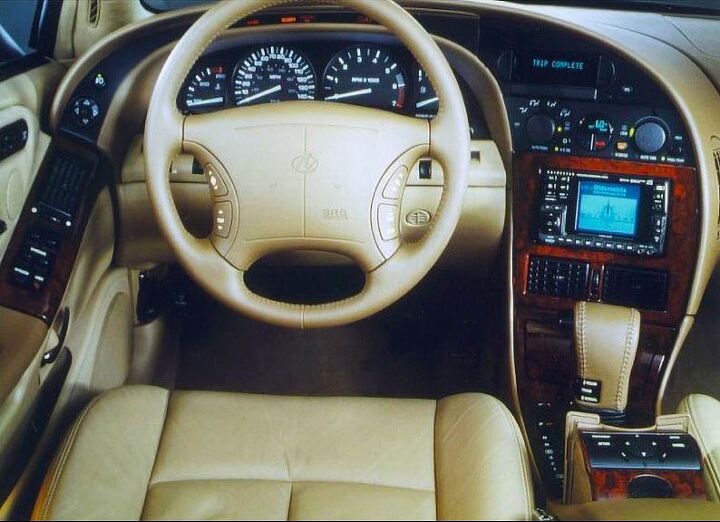
Location information was more accurate than a few years prior, given increasing civilian and corporate access to military-grade GPS information. Information was presented to the driver via a four-inch color LCD screen, with seven different LCD keys used for inputs. No touch screen troubles here!
The first Guidestar test models in late 1994 were implemented in the San Jose, California area, distributed once again through Avis rental outlets. Notably, the Avis partnership was not directly with GM this time but negotiated through Zexel. Guidestar was only implemented on the Eighty Eight sedan for preliminary testing. Though it was not the company’s flagship (that’d be the Ninety Eight), Eighty Eight was more popular than the stodgy Ninety Eight. Ninety Eight was also due to be phased out in favor of the upcoming flagship Aurora, a most needed product change.
Guidestar testing ramped up in a second location, Florida, after San Jose testing received positive reviews. As a result, Oldsmobile declared it would offer Guidestar as an option on 1995 Eighty Eight sedans. At the time the system cost $2,000 ($4,085 adj.). It could technically be implemented into any Eighty Eight, because it was not in-dash.
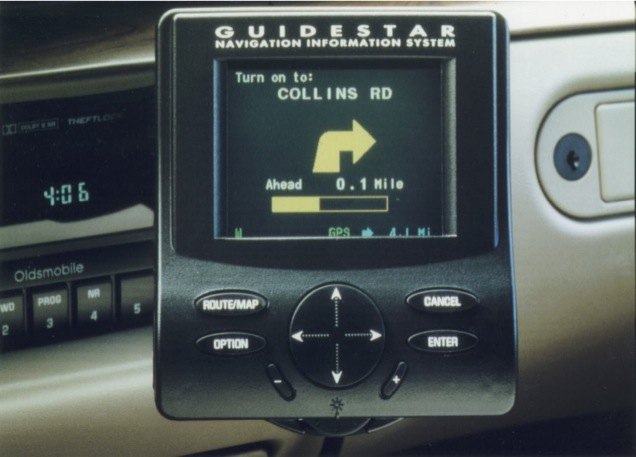
Rather the Guidestar that entered production resided on a stalk mounted to the floor under the dash. The unit itself was removable to prevent theft, though it would’ve been useless without the proprietary GM onboard computer in the trunk, and the requisite satellite antenna. It was neither as clean looking nor as slick as the Aurora show car, but could be installed without major changes to the dash.
When it arrived, the Oldsmobile Eighty Eight became the first production car available in the United States with a GPS navigation system. The timeline is a little unclear, but shortly after its introduction on the Eighty Eight Oldsmobile expanded Guidestar’s availability to the more expensive LSS and Bravada. It was available on all three models for 1996. Guidestar was never made available in the flagship Aurora, likely because the dash design was finalized long before Guidestar was ready for production. Given Aurora’s center console layout, a floor mounted metal post was not an option.
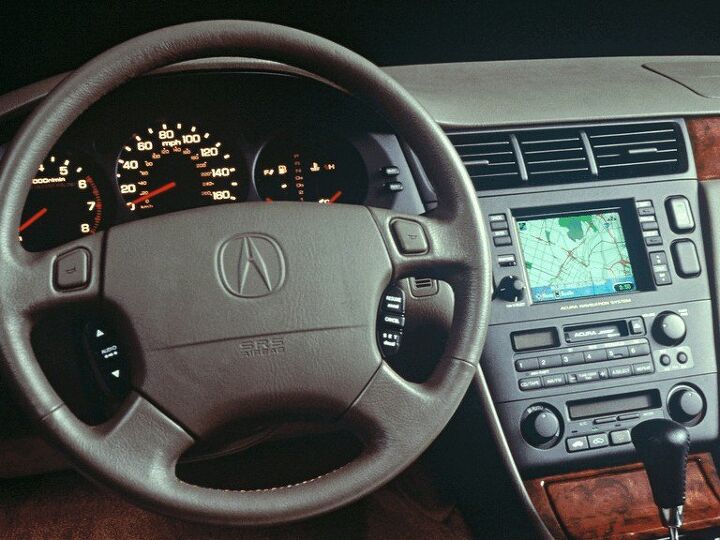
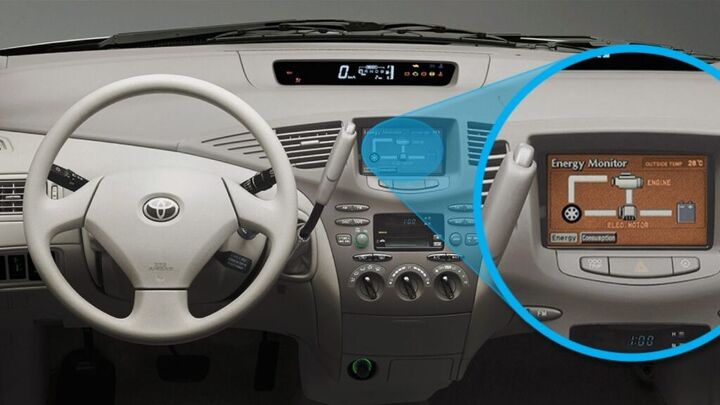
Competition in the in-car navigation space heated up after Oldsmobile’s lead. Acura followed with hard drive navigation in the 1996 3.5 RL, though that implementation was in-dash and looked much more polished than Guidestar on a stick. The following year, the 1997 Prius became available with more accurate differential GPS, installed in-dash. Both the RL and the Prius used touchscreens in their navigation systems.
Unlike its TravTek predecessor, Guidestar did not offer live traffic information. Specific address numbers could be input, rather than a general street name as on TravTek. Additionally, points of interest were included to help guide to tourist spots, hospitals, gas stations, and other useful places. And because the hard disk storage was removable, the system could (in theory) be updated easily with new information and map cartridges.
Said mapping was a downside with Guidestar, as there was data for only 17 states. Each map cartridge installed in the system cost an additional $400 ($817 adj.). It would also mean a visit and payment to your local Oldsmobile dealer if you wanted to use guidance in a part of the country not covered by your car’s current set of maps.
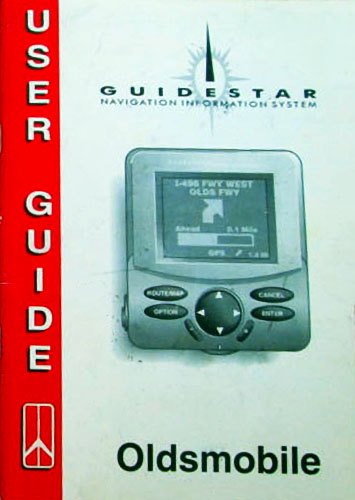
In case you were curious, in 1996 Guidestar worked in California, Connecticut, Delaware, Florida, Georgia, Illinois, Indiana, Maryland, Maine, Massachusetts, Michigan, New Hampshire, New Jersey, New York, Rhode Island, Vermont, and Virginia. Assuming you received your state complimentary from GM at purchase, you’d need just $6,400 ($13,074 adj.) to have a complete set of Guidestar maps.
A very novel idea at the time, Guidestar was technology consumers had never seen previously. This cringy clip shows an Eighty Eight with Guidestar navigating the tony Detroit suburb of Bloomfield Hills, and arriving at a suitably contemporary mansion. Unfortunately, the way Guidestar was launched, implemented, marketed, and priced assured it remained a novelty for the wealthy.
With a high price and lacking usability in cross-country journeys, it appealed primarily as a $5 per day rental car device, and to some real estate agents. By the latter half of 1996, only 2,000 Guidestar systems had been installed in Oldsmobiles. Of those, 1,000 were the units purchased by Avis. Can you find an Oldsmobile for sale with Guidestar intact? Let me know.
Oldsmobile’s advanced concepts manager Vic Ide (retired 1999) said he wanted the system’s price to be cut to under $1,000 ($1,988 adj.) to make it more appealing, and insisted it must offer real-time traffic information. Both of those were admirable goals, but the Oldsmobile-only scope of Guidestar meant production scale for cost cutting and dollars for development just weren’t there. By all accounts 1996 was the final year Guidestar was offered.
GM would return with in-dash navigation on the Cadillac STS in 1998, but by that time there was steep competition as every other auto manufacturer offered in-dash GPS. Additionally, portable offerings like Garmin came to market and would continually undercut the cost of in-car navigation packages. But Oldsmobile was still the first, and may we always remember Guidestar (1995-1996).
[Images GM]
Become a TTAC insider. Get the latest news, features, TTAC takes, and everything else that gets to the truth about cars first by subscribing to our newsletter.
Interested in lots of cars and their various historical contexts. Started writing articles for TTAC in late 2016, when my first posts were QOTDs. From there I started a few new series like Rare Rides, Buy/Drive/Burn, Abandoned History, and most recently Rare Rides Icons. Operating from a home base in Cincinnati, Ohio, a relative auto journalist dead zone. Many of my articles are prompted by something I'll see on social media that sparks my interest and causes me to research. Finding articles and information from the early days of the internet and beyond that covers the little details lost to time: trim packages, color and wheel choices, interior fabrics. Beyond those, I'm fascinated by automotive industry experiments, both failures and successes. Lately I've taken an interest in AI, and generating "what if" type images for car models long dead. Reincarnating a modern Toyota Paseo, Lincoln Mark IX, or Isuzu Trooper through a text prompt is fun. Fun to post them on Twitter too, and watch people overreact. To that end, the social media I use most is Twitter, @CoreyLewis86. I also contribute pieces for Forbes Wheels and Forbes Home.
More by Corey Lewis








Comments
Join the conversation
about 4 years ago there was a 1992 oldsmobile toronado which was a travtech-avis pilot car that had the prototype nav system and had a big antenna on the back. it sold quick and id never seen another ever again. i think they wanted like 13500 for it which was steep for an early 90s gm car.
Funny how Oldsmobile was offering a GPS system to help if you were lost, yet GM as a company was very lost. Not really sure that they are not still lost. They make hideous looking trucks, Cadillac is a crappy Chevy pretending to be fancy. To be honest, I would never step in a GM show room now or ever. Boring, cheap ugly and bad resale why bother. I get enough of GM when i rent on trips from airports. I have to say, does anybody at GM ever drive what everyone else drives? Do they ever then look at what crap they put out in style fit and finish? Come on, for real, do they? Cadillac updated slogan should be " sub standard of the 3rd world", or " almost as good as Tata motors". Enough said.